


Artificial intelligence companies are no longer competing only to build the smartest model.
They are also competing on speed, token efficiency, availability, and cost.
This change matters because many businesses have moved beyond simple chatbot experiments. They are now using AI for software development, document analysis, customer support, financial research, data processing, and long-running agentic workflows.
These tasks can consume millions of tokens. A small difference in price can become a major monthly expense once an AI application reaches production.
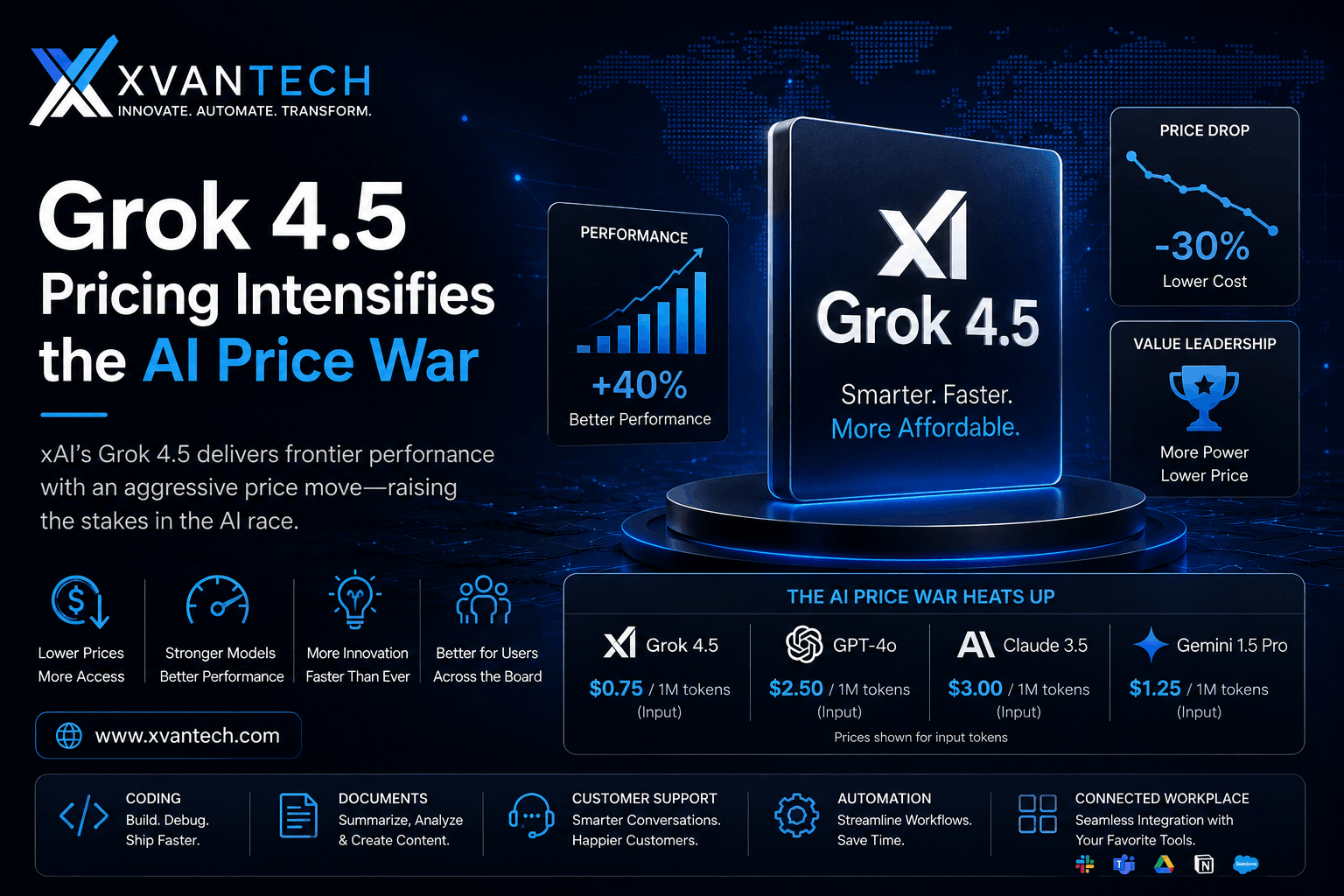
SpaceXAI’s release of Grok 4.5 puts new pressure on this market. The model is designed for coding, agentic tasks, engineering, and professional knowledge work. Its standard API price is $2 per million input tokens and $6 per million output tokens.
That output price is significantly lower than the $30 per million output tokens charged for OpenAI’s flagship GPT-5.6 Sol model. However, price alone does not tell the complete story. Businesses must compare quality, reliability, speed, token use, context limits, and the total cost of completing a task.
The arrival of Grok 4.5 shows that the AI price war is entering a more practical stage: the competition to deliver useful intelligence at a cost businesses can justify.
What Is Grok 4.5?
Grok 4.5 is a mixture-of-experts AI model jointly trained by SpaceXAI and Cursor.
Unlike a model built only for chat or short coding questions, Grok 4.5 is designed to handle difficult tasks that may require planning, tool use, research, iteration, and correction.
Cursor says the model was trained for work across several fields, including:
- Software engineering
- Data science
- Finance
- Legal work
- Scientific and technical research
- General professional knowledge work
Its training included trillions of tokens of Cursor data representing interactions with codebases and software tools. The model was also trained on broader science, technology, engineering, mathematics, and research material.
This partnership is important. Cursor has access to real developer workflows, including how programmers explore repositories, correct mistakes, use tools, and complete multi-step coding tasks.
That experience may help Grok 4.5 perform more like a working software agent instead of a model that only generates isolated code snippets.
Elon Musk described Grok 4.5 as an “Opus-class” model that is faster and less expensive. This is a positioning claim rather than an independent measurement, so businesses should test the model against their own workloads before treating it as equivalent to another frontier model.
Understanding Grok 4.5 Pricing
The standard Grok 4.5 pricing structure is:
- Input tokens: $2 per million
- Cached input tokens: $0.50 per million
- Output tokens: $6 per million
- Standard context window: Up to 500,000 tokens
- Reasoning levels: Low, medium, or high
The model supports function calling, web search, X search, code execution, the Responses API, and Chat Completions. It is available through the SpaceXAI API, Grok Build, Cursor, selected office add-ins, and several model gateways.
However, there is an important pricing detail.
The standard $2 input and $6 output rates apply to requests within the regular pricing range. Requests exceeding 200,000 context tokens are priced at $4 per million input tokens and $12 per million output tokens.
Cursor also offers a faster Grok 4.5 variant priced at $4 per million input tokens and $18 per million output tokens.
Businesses should therefore avoid budgeting based only on the lowest advertised number. The actual rate can depend on context length, platform, speed tier, caching, reasoning level, and the number of tokens generated.
Grok 4.5 vs. GPT-5.6 Pricing
OpenAI’s GPT-5.6 family includes three different pricing tiers:
- GPT-5.6 Sol: $5 input and $30 output per million tokens
- GPT-5.6 Terra: $2.50 input and $15 output per million tokens
- GPT-5.6 Luna: $1 input and $6 output per million tokens
These prices show that comparing Grok 4.5 only with GPT-5.6 Sol can create an incomplete picture.
Grok 4.5 has the same standard output-token price as GPT-5.6 Luna, while its price sits below Terra and far below Sol. However, each model targets a different balance of intelligence, speed, and cost.
For example, a workload that produces 100 million output tokens would cost approximately:
- Grok 4.5 standard: $600
- GPT-5.6 Luna: $600
- GPT-5.6 Terra: $1,500
- GPT-5.6 Sol: $3,000
That difference can be meaningful for a business running large-scale coding agents, document-processing systems, or customer-support automation.
But the cheapest price per token does not always produce the lowest cost per completed task.
A less capable model may require more retries, longer prompts, additional verification, or greater human involvement. A more expensive model may sometimes solve the problem correctly in fewer attempts.
The right business metric is therefore not simply cost per token. It is cost per successful outcome.
Speed and Token Efficiency
SpaceXAI says Grok 4.5 is served at approximately 80 tokens per second.
The company also claims that the model uses roughly half as many tokens as comparable leading models for similar tasks. In one company-reported SWE-Bench Pro comparison, Grok 4.5 generated an average of 15,954 output tokens per task, compared with 67,020 for Opus 4.8 at its maximum reasoning setting.
Independent testing by Artificial Analysis measured Grok 4.5 at roughly 73 to 76 output tokens per second, depending on the test view and provider measurement. That is reasonably close to the company’s advertised speed, although real performance can vary according to traffic, prompt size, reasoning level, and API conditions.
Token efficiency can be even more important than raw speed.
Consider two AI models completing the same task:
- Model A generates 50 tokens per second but uses 10,000 tokens.
- Model B generates 100 tokens per second but uses 40,000 tokens.
Model B writes faster, but it can still take longer overall and cost more because it produces four times as many tokens.
For businesses, an efficient model may provide several advantages:
- Lower API expenses
- Faster task completion
- Shorter agent loops
- Fewer unnecessary explanations
- Reduced context growth
- Better performance at scale
Still, token-efficiency claims must be evaluated on real business tasks. A result from a coding benchmark may not apply equally to contract review, financial analysis, customer service, or marketing content.
Why Grok 4.5 Pricing Matters for Businesses
AI Costs Can Grow Quickly
A small pilot may cost very little. A production system can be different.
Imagine an AI agent that reviews software repositories, searches documentation, runs tests, corrects code, and prepares a pull request. One job may require a large prompt, several tool calls, multiple reasoning steps, and thousands of output tokens.
Now multiply that process by hundreds of developers and thousands of tasks.
The monthly cost can increase rapidly.
Competitive Grok 4.5 pricing gives businesses another option when building high-volume AI workflows.
More Competition Reduces Vendor Dependence
Businesses have often built AI applications around one provider. That can create vendor lock-in.
When multiple capable models support similar API structures and tools, companies can route tasks according to cost, quality, and availability.
For example:
- Use a lower-cost model for classification and basic coding.
- Use a stronger flagship model for difficult reasoning.
- Use a fast model for real-time user interactions.
- Use a specialized model for research or document analysis.
- Switch providers when one service experiences capacity problems.
This model-routing approach can improve resilience while controlling costs.
Affordable Models Make Experimentation Easier
High model prices can discourage smaller businesses from testing AI applications.
Lower rates allow teams to run more experiments, evaluate more use cases, and gather better evidence before making a large investment.
Businesses could test Grok 4.5 for tasks such as:
- Code generation and debugging
- Test creation
- Repository analysis
- Spreadsheet development
- Financial research
- Technical documentation
- Internal knowledge assistants
- Data extraction
- Workflow automation
- Long-running digital agents
The goal should be to identify measurable value, not simply adopt a model because its price appears attractive.
Key Challenges and Limitations
Benchmarks Do Not Represent Every Business Task
A model can perform well on a coding benchmark and still struggle with a company’s internal systems, documentation, terminology, or quality requirements.
Cursor also disclosed that Grok 4.5 had an advantage on CursorBench because an earlier snapshot of Cursor’s codebase was accidentally included in training. Cursor excluded that result and said the data would be removed for future models.
This disclosure is a useful reminder that benchmark results require context.
Total Cost Includes More Than Tokens
Businesses must also consider:
- Engineering and integration work
- Search or tool-call charges
- Human review
- Failed requests
- Repeated attempts
- Monitoring infrastructure
- Security controls
- Data storage
- Compliance requirements
- Maintenance and model updates
A cheap API can still support an expensive system if the workflow is poorly designed.
Long Context Can Increase Costs
Grok 4.5 supports a large context window, but using more than 200,000 tokens increases its input and output rates.
Teams should avoid sending entire databases, document collections, or repositories with every request.
Retrieval systems, prompt caching, context compression, and careful data selection can reduce unnecessary usage. SpaceXAI specifically recommends using a prompt cache key and context compaction for long, tool-heavy conversations.
Security and Reliability Still Matter
Coding agents may access repositories, terminals, cloud services, files, and production systems.
A low price should never justify weak access controls.
Businesses should restrict permissions, isolate execution environments, review important code changes, log agent activity, and require human approval for high-risk actions.
How to Evaluate Grok 4.5 for Your Business
The best way to assess Grok 4.5 is through a controlled pilot.
1. Select a Real Use Case
Choose a repetitive task with a clear outcome, such as fixing small software bugs, generating unit tests, reviewing documents, or preparing structured research.
2. Create a Representative Test Set
Use examples that reflect the complexity and quality of your actual work. Avoid relying only on simple demonstrations.
3. Compare Multiple Models
Run the same tasks through Grok 4.5 and relevant alternatives.
Compare:
- Completion quality
- Accuracy
- Response time
- Total token use
- Number of retries
- Human correction time
- Cost per successful result
4. Measure Business Outcomes
A useful model should improve a measurable result.
That could include:
- Shorter development cycles
- Lower support costs
- Faster document processing
- Fewer manual errors
- Better employee productivity
- Reduced cloud spending
5. Introduce Guardrails
Set spending limits, permission boundaries, review requirements, logging rules, and quality thresholds before scaling the system.
Will Grok 4.5 Reshape the AI Market?
Grok 4.5 does not end the competition between AI companies. It makes the competition more complex.
The most capable model may still be worth a premium for difficult work. But businesses will increasingly question whether every task requires the most expensive model.
AI buyers are beginning to evaluate models in the same way they evaluate cloud infrastructure:
- What level of performance is required?
- How fast must the result arrive?
- How reliable is the service?
- What is the real cost at scale?
- Can another provider complete the same work for less?
- How easily can the workload move between vendors?
This creates pressure on model providers to improve both performance and efficiency.
The likely result is not one model winning every category. Businesses may use portfolios of models, assigning each task to the option that provides the best combination of quality, speed, and cost.
Conclusion
Grok 4.5 brings serious pricing pressure to the market for coding and agentic AI models.
Its standard rate of $2 per million input tokens and $6 per million output tokens makes it considerably less expensive than several flagship alternatives. Its integration with Cursor, support for professional tools, and focus on long-running work make it particularly relevant for software and knowledge-based workflows.
However, Grok 4.5 pricing should not be evaluated in isolation.
Businesses must consider task quality, token efficiency, long-context pricing, retries, tool costs, security, and the amount of human review required.
The most important question is not which model has the lowest advertised price.
It is which model can produce a reliable business result at the lowest total cost.
As AI providers continue lowering prices and improving efficiency, companies will gain more choices. The businesses that benefit most will be those that test models carefully, measure real outcomes, and avoid becoming dependent on a single provider.
Turn AI Pricing into Measurable Business Value
Choosing an AI model is only one part of building a successful AI solution.
XVanTech helps businesses evaluate AI use cases, compare model options, automate workflows, and develop practical systems around real operational needs.
Whether you are exploring AI coding agents, financial automation, document processing, business intelligence, or custom software, the right approach starts with a clear problem and measurable goals.
Contact XVanTech to discuss how your business can use AI efficiently without losing control of cost, quality, or security.

