


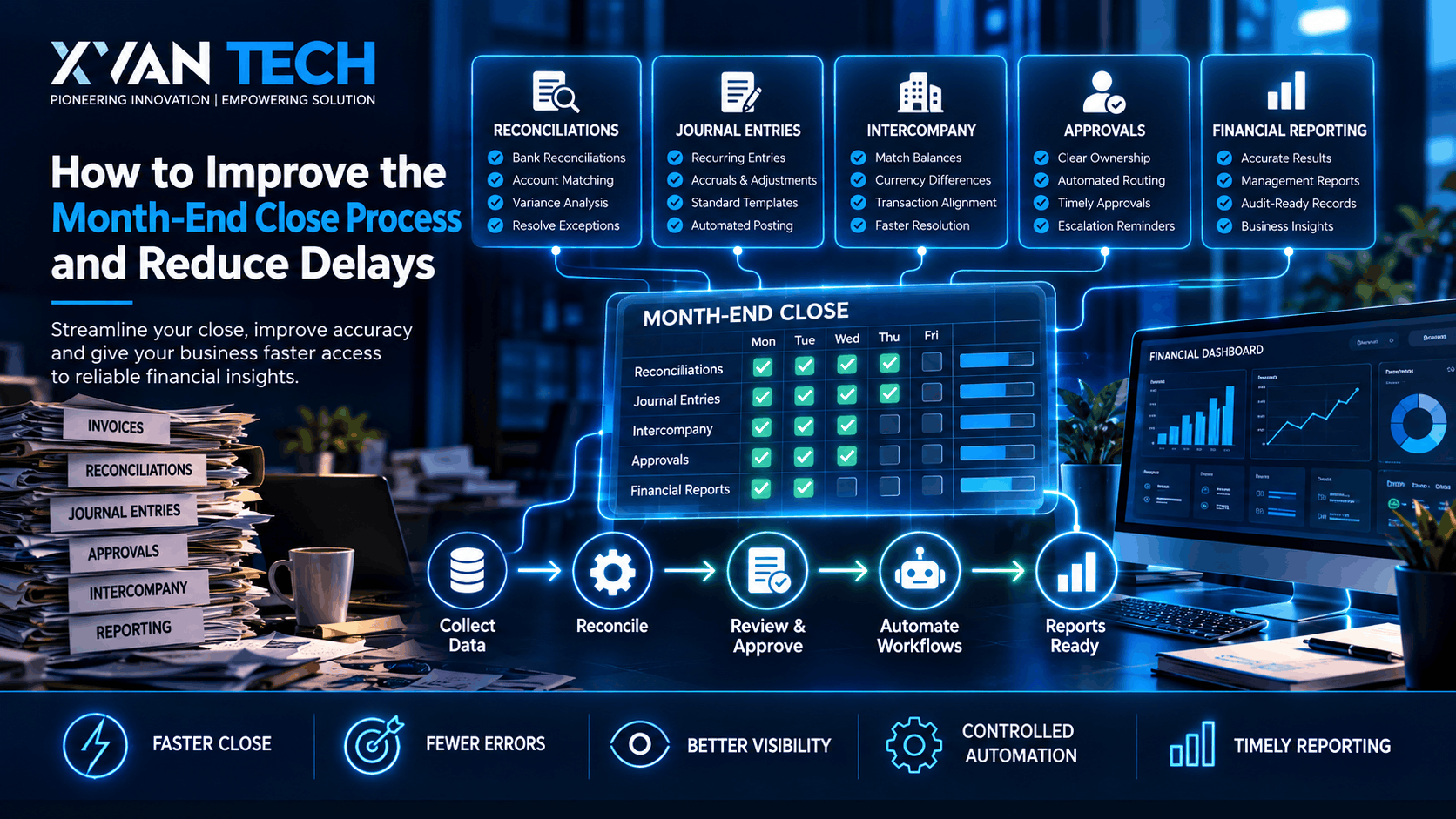
For many finance teams, completing the month-end close takes more than eight business days. During that time, accountants work under pressure, managers wait for reliable numbers, and business leaders make decisions using incomplete information.
It is easy to assume that one major issue is responsible for the delay. In practice, the problem is usually more complicated. A slow month-end close process is often caused by several small bottlenecks spread across different people, systems, and workflows.
A reconciliation may start one day late. An approval may sit with a manager for two days. A missing invoice may require several emails. An intercompany difference may take hours to investigate. Each delay looks minor when viewed separately, but together they can add several days to the close.
The answer is not to ask the finance team to work longer hours. A sustainable improvement requires better visibility, clearer responsibilities, stronger controls, and sensible automation.
Why the Month-End Close Process Takes Too Long
The month-end close process involves collecting financial information, checking its accuracy, recording adjustments, reconciling accounts, and preparing reports. Every task depends on accurate data and timely action from the people involved.
When the process is not properly designed, delays begin to build before the accounting period has even ended.
Common problems include:
- Account reconciliations starting too late
- Supporting documents being scattered across emails and folders
- Journal entries requiring repeated manual preparation
- Intercompany balances failing to match
- Approvals remaining with managers for several days
- Data being exported from multiple systems into spreadsheets
- Errors being discovered near the end of the close
- Team members being unsure who owns a task
- The close checklist not reflecting the real workflow
- Progress being tracked through meetings and email chains
None of these problems may appear serious on its own. However, the combined effect creates an inefficient close that depends heavily on manual effort and individual knowledge.
The Business Impact of a Slow Financial Close
A delayed close is not only an accounting problem. It affects decision-making throughout the business.
Management receives information too late
Business leaders need timely figures to understand revenue, costs, cash flow, profitability, and operational performance. If reliable reports arrive halfway through the next month, management has less time to respond to problems or opportunities.
A faster month-end close process gives decision-makers earlier visibility into actual performance.
Finance has less time for analysis
When the accounting team spends most of the month closing the previous period, little time remains for forecasting, planning, and business support.
This creates a cycle in which finance is constantly looking backward. The team becomes focused on collecting information and correcting errors instead of helping the company understand what the numbers mean.
Employees experience unnecessary pressure
A poorly managed close often requires late nights, urgent follow-ups, and repeated checking. This pressure may appear manageable for one month, but it becomes exhausting when repeated throughout the year.
Constant close-related stress can reduce morale, increase mistakes, and make it more difficult to retain experienced finance professionals.
Errors become more likely
Speed and accuracy are sometimes presented as competing priorities, but an inefficient close can damage both. When employees are tired and deadlines are tight, they are more likely to miss discrepancies, enter incorrect information, or approve work without enough review.
A well-designed process can improve speed while strengthening accuracy and control.
Where Time Is Commonly Lost
Understanding the source of delay is the first step toward improving the close.
Account reconciliations start after month-end
Some teams wait until the period has ended before beginning every reconciliation. This creates a large workload that must be completed within a short window.
However, many balance-sheet accounts can be reviewed before the final day of the month. Bank activity, fixed assets, prepaid expenses, and selected clearing accounts may be reconciled or prepared in advance.
This approach, sometimes called a continuous close, spreads the workload across the month and allows problems to be identified earlier.
Supporting documents are difficult to find
Invoices, contracts, calculations, approval records, and other evidence may be stored in different inboxes, shared drives, or personal folders.
Employees then spend valuable time searching for files or asking colleagues to resend them. The same problem may happen every month because there is no standard location or naming method.
A central document structure can remove much of this unnecessary work.
Journal entries are prepared manually
Recurring journal entries are often copied from old spreadsheets and updated each month. This may involve changing dates, amounts, descriptions, and account codes manually.
The work is repetitive and creates a risk of using outdated information. Standard templates and automated journal-entry workflows can reduce preparation time while making reviews more consistent.
Intercompany balances do not match
Intercompany reconciliation is a frequent source of delay, particularly in organisations with several legal entities.
One entity may record a transaction while the other does not. The parties may use different currencies, dates, or account classifications. These differences are often discovered late, when the reporting deadline is approaching.
Regular intercompany matching during the month gives teams more time to investigate and correct differences.
Approvals remain outstanding
A task may be complete from the accountant’s perspective but still remain open because a manager has not reviewed it.
Approvals are easily delayed when requests are sent through email without a visible deadline or escalation process. Managers may not realise that one outstanding approval is preventing several other tasks from moving forward.
Automated reminders, named backup approvers, and clear review deadlines can reduce this waiting time.
Data comes from multiple systems
Finance teams often collect information from accounting platforms, payroll applications, banking portals, expense tools, operational systems, and spreadsheets.
If these systems are not connected, employees must export, clean, combine, and validate the information manually. Every manual transfer adds work and creates another opportunity for error.
Integration and controlled automation can reduce these steps, although the underlying process should be reviewed before new technology is introduced.
How to Build a Faster Month-End Close Process
Improvement should begin with the workflow, not with software.
1. Map the complete process
Document every activity required to complete the close, including:
- The person responsible
- The planned start date
- The deadline
- Required information
- Dependencies on other tasks
- Review and approval requirements
- Typical causes of delay
- Time spent completing the work
The map should reflect what actually happens, not what the official procedure says should happen.
Speaking directly with the employees who perform the work is essential. They often know exactly where information is delayed, which tasks are duplicated, and which spreadsheets create unnecessary effort.
2. Measure actual completion times
A checklist may show that a reconciliation is due on day three, but it does not explain when the work really begins or why it finishes late.
Track planned and actual completion times for several close cycles. This will reveal recurring bottlenecks and help the team separate occasional problems from structural ones.
Useful measures may include:
- Total number of business days required
- Percentage of tasks completed on time
- Number of late approvals
- Number of post-close adjustments
- Time spent preparing recurring entries
- Number of unreconciled items
- Hours of overtime during the close
These measurements provide a practical baseline for improvement.
3. Assign clear ownership
Every close activity should have one accountable owner. Shared responsibility often becomes unclear responsibility.
The owner does not need to perform every part of the task, but that person should ensure it is completed, reviewed, and supported by the correct evidence.
Each important task should also have a backup owner. This prevents the process from stopping when someone is unavailable.
4. Move suitable work before period-end
Not every close activity needs to wait until the final day of the month.
Teams can often complete or prepare the following work earlier:
- Reviewing fixed-asset additions
- Updating recurring journal entries
- Checking intercompany activity
- Reviewing open purchase orders
- Investigating old reconciling items
- Confirming accrual requirements
- Validating master data
- Preparing reporting templates
Moving work forward reduces the volume of activity concentrated in the first few business days after month-end.
5. Standardise repetitive activities
Standardisation makes the close easier to perform, review, and improve.
Useful tools include:
- Consistent reconciliation templates
- Standard journal-entry formats
- Defined document names and storage locations
- Approval rules
- Materiality thresholds
- A central close calendar
- Written review procedures
- Clear status definitions
Standardisation does not mean adding unnecessary paperwork. The goal is to remove uncertainty and reduce the number of decisions employees must repeatedly make.
6. Automate the right tasks
Automation works best when applied to a stable and clearly understood process.
Strong candidates for automation include:
- Recurring journal entries
- Data imports and validation
- Account matching
- Intercompany comparisons
- Workflow reminders
- Approval routing
- Close-status reporting
- Standard management reports
Automating a poorly designed process may only make its problems happen faster. Finance leaders should first remove unnecessary steps, clarify ownership, and resolve inconsistent data practices.
Challenges to Expect During Improvement
Changing the month-end close process is not always easy.
Employees may be comfortable with existing spreadsheets, even when those files require significant manual effort. Different business units may follow different processes. System limitations may prevent immediate integration. Teams may also struggle to make improvements while continuing to meet current deadlines.
A practical approach is to improve one bottleneck at a time.
Begin with a high-volume or frequently delayed activity. Measure its current performance, make a targeted change, and review the results over several periods. Once the improvement is stable, move to the next bottleneck.
This approach reduces disruption and helps the team build confidence through visible results.
Benefits of a Better Month-End Close
An improved close can deliver benefits across the organisation:
- Faster access to reliable financial results
- Fewer manual errors and late adjustments
- Better visibility into task status
- Reduced overtime and employee stress
- Stronger accountability
- More consistent supporting evidence
- Easier internal and external audits
- More time for forecasting and analysis
- Better decisions by management
- A finance function that can support business growth
The goal is not simply to close the books faster. It is to create a reliable process that produces accurate information without depending on last-minute effort.
Conclusion
A month-end close that takes more than eight business days is rarely delayed by one dramatic problem. Time is usually lost through many smaller issues: late reconciliations, missing documents, manual journal entries, intercompany differences, slow approvals, disconnected systems, and errors found too late.
Improving the month-end close process begins with visibility. Map every step, measure actual completion times, identify repeated delays, and assign clear ownership. Move suitable work earlier in the month, standardise repetitive tasks, and use automation where it creates a genuine operational benefit.
The most effective finance teams do not improve close speed by asking people to work harder. They build a better process—one that gives employees control, provides management with timely information, and leaves finance with more time to analyse the business.
Build a Faster and More Reliable Month-End Close
If your finance team is spending too much time collecting data, chasing approvals, and correcting recurring errors, the process needs attention.
XVanTech can help you assess your current workflow, identify the activities causing delays, and introduce practical automation without weakening financial control.
Contact XVanTech to discuss how you can build a faster, more accurate, and more manageable month-end close process.

