


Artificial intelligence is becoming more powerful, but many AI models still depend on expensive cloud infrastructure and high-performance computing.
That creates a serious problem for companies building smart cameras, industrial sensors, medical wearables, agricultural devices, and other connected products.
These devices often use microcontrollers with limited memory, processing power, storage, and battery capacity. A model that works perfectly on a powerful computer may be too large, slow, hot, or energy-hungry to run on the actual device.
Getting that model onto tiny hardware can take weeks of testing by specialists who understand both machine learning and embedded systems.
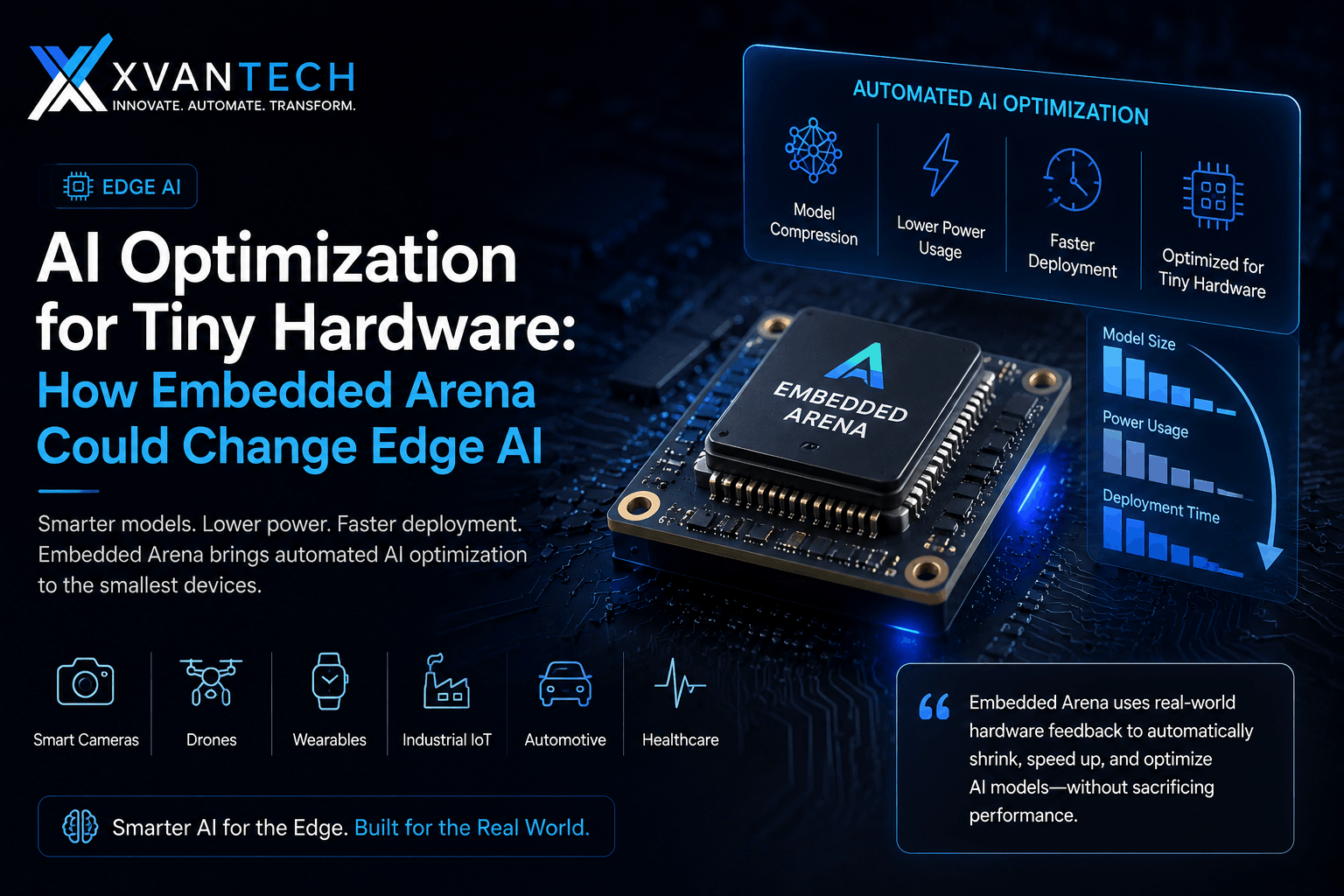
Embedded Arena is an experimental system designed to make this process more autonomous. It allows AI agents to compile software, install it on physical hardware, measure the results, and improve the model or firmware based on real device feedback.
The early results suggest that AI optimization for tiny hardware could become faster, more efficient, and accessible to a wider group of developers.
However, the research is still at the preprint stage. Businesses should view it as a promising direction rather than a finished commercial solution.
Why Running AI on Tiny Hardware Is So Difficult
Microcontrollers are found inside millions of everyday products. They control sensors, appliances, machines, wearables, cameras, vehicles, and industrial equipment.
Unlike cloud servers, these devices operate under strict physical limits.
A typical embedded AI project must balance several requirements at the same time:
- The AI model must fit within the device’s memory.
- The system must process information quickly enough.
- Power consumption must remain low.
- The device must not become too hot.
- The model must maintain acceptable accuracy.
- The software must work with the chip’s supported operations.
- The product must remain stable in real operating conditions.
Improving one area can easily damage another.
For example, reducing image resolution may lower memory and power use, but it can also make object detection less accurate. Lowering the processor’s clock speed may reduce peak power consumption, but it can increase the time required to complete an inference.
This is why deploying AI on microcontrollers is not simply a software task. It is a complex engineering problem involving code, models, processors, sensors, memory, energy, and temperature.
Researchers behind Embedded Arena noted that skilled developers can spend weeks optimizing one model for one hardware target. The process may need to be repeated when the company changes the chip or product design. What Is Embedded Arena?
Embedded Arena is a hardware-in-the-loop environment for optimizing AI models and firmware on real microcontrollers.
The system gives an AI agent access to the development process. Instead of only suggesting code, the agent can participate in a complete optimization cycle.
It can:
- Modify the AI model or firmware.
- Compile the updated software.
- Flash it onto a physical microcontroller.
- Run the required workload.
- Measure memory, power, temperature, accuracy, and performance.
- Use those measurements to make another improvement.
This creates a closed feedback loop between the AI agent and the physical device.
The important difference is that the agent does not have to rely entirely on documentation or assumptions. It receives evidence from the real hardware.
The research team tested the approach on three microcontroller platforms: the ESP32-S3, MAX78000, and STM32N6. The experiments covered model compression, power reduction, and thermal management. How Hardware Feedback Helps AI Improve Its Own Deployment
An AI model may produce code that looks correct but fails when installed on a real device.
The firmware might not compile. The model may exceed available memory. A required operation may not be supported by the chip. The system may consume too much power or fail to complete the workload within the required time.
Software-only testing cannot always reveal these problems.
The Traditional Approach
In a traditional embedded AI project, engineers perform the optimization loop manually.
They change the model, update the firmware, compile the program, install it on the device, run tests, record the results, and decide what to change next.
Every iteration requires time and specialist knowledge.
The Embedded Arena Approach
Embedded Arena automates much of this loop.
After every attempt, the agent receives structured feedback. That feedback may include:
- Whether the software compiled successfully
- Whether the device started correctly
- Memory and storage usage
- Inference accuracy
- Current and energy consumption
- Device temperature
- Runtime and workload completion
- Error messages and device logs
The agent can then use previous successes and failures to prepare its next attempt.
In the researchers’ benchmark, some frontier AI models failed to complete the hardest deployment tasks without physical feedback. With hardware-in-the-loop feedback, the first successful deployment appeared within three iterations, and some results surpassed human expert baselines within seven iterations. The paper also reported success rates of up to 80% on its hardest tasks under the hardware-feedback setup. Key Results from the Embedded Arena Research
The most interesting part of the research is not simply that an AI agent generated embedded code. The system produced measurable improvements on physical devices.
250× Compression for a Vision Model
The researchers reported compressing a vision model by 250 times while keeping accuracy loss below 3.3%.
Model compression is essential for edge AI because many computer-vision models are originally designed for hardware with far more memory and processing capacity than a microcontroller.
A smaller model can make local image recognition possible without constantly sending images to a cloud server.
400× Compression for an Audio Model
The system also achieved 400× compression for an audio model, with less than a 6% increase in Feature Error Rate.
This result matters for products that need to process sound locally, including wearables, voice interfaces, monitoring devices, and assistive technologies.
Lower Power Consumption
Embedded Arena reduced power draw by more than 58% in the reported experiments.
Lower power use can create significant business value. It may allow companies to use smaller batteries, extend operating time, reduce charging frequency, or operate devices through harvested energy.
The researchers demonstrated this possibility through a solar-powered deployment running on a commercial microcontroller. Better Thermal Management
The research also reported reducing peak device temperature rise by more than 40%.
Temperature is an important consideration for wearables, industrial systems, and devices operating in enclosed spaces. Excessive heat can affect user comfort, component reliability, and product safety.
These results show why AI optimization for tiny hardware must consider more than model accuracy alone.
Real-World Applications Tested by the Researchers
Embedded Arena was evaluated through two practical applications rather than only laboratory benchmarks.
Solar-Powered Elk-Detection Camera
The first application was a remote camera trap designed to detect elk.
Wildlife-monitoring cameras can generate large numbers of unnecessary images due to wind, moving plants, people, or animals that are not part of the research target.
Sending every image to the cloud consumes power and communication bandwidth. It also increases storage requirements and manual review time.
Running AI directly on the camera allows the system to identify relevant images before transmitting them.
The research team reported 96.7% detection accuracy while keeping average power below seven milliwatts. The design combined local classification, solar energy harvesting, and long-range communication. businesses, similar technology could support:
- Agricultural monitoring
- Remote security systems
- Infrastructure inspection
- Environmental research
- Livestock tracking
- Smart-city sensors
Wearable Phonetic-Transcription Device
The second application was a head-worn device designed to transcribe speech sounds for child-development research.
Audio recorded by a wearable can contain sensitive personal information. Processing it locally may reduce the need to continuously send raw recordings to external servers.
The optimized system achieved an 8.44% on-device Feature Error Rate for phonetic transcription in the researchers’ tests. broader idea could influence future healthcare devices, language-learning tools, accessibility products, and privacy-focused wearables.
Business Benefits of AI Optimization for Tiny Hardware
Automating embedded AI optimization could improve how companies design and launch intelligent products.
Faster Product Development
Engineering teams may spend less time repeating manual experiments. Faster optimization can reduce the gap between a working AI prototype and a deployable product.
Lower Development Costs
Embedded AI specialists are valuable but limited. An automated system could handle repetitive testing while engineers focus on product architecture, safety, and difficult technical decisions.
It would not remove the need for experts, but it could help them work more efficiently.
Reduced Cloud Dependence
Local AI processing can reduce the amount of information sent to cloud platforms.
This may lower:
- Cloud computing expenses
- Data-transfer costs
- Network dependency
- Response delays
- Central storage requirements
Better Privacy
A device that processes images, audio, or sensor data locally may avoid transmitting sensitive raw information.
This can be valuable for healthcare, workplaces, homes, children’s products, and industrial environments.
Longer Battery Life
Power-efficient AI can help devices operate for longer periods. In some situations, solar or other energy-harvesting methods may support battery-free operation.
Faster Decisions
Local inference removes the delay created by sending data to a remote server and waiting for a response.
That can be important for safety systems, machinery, medical monitoring, security devices, and other time-sensitive applications.
Challenges Businesses Should Consider
Embedded Arena is promising, but autonomous optimization also introduces risks and limitations.
It Is Early-Stage Research
The published work is an arXiv preprint dated June 15, 2026. Its results should be tested independently and across more hardware before companies depend on the approach in production. Physical Testing Infrastructure Is Still Required
The system still needs real development boards, measurement equipment, flashing tools, sensors, and automated testing infrastructure.
It simplifies the optimization loop, but it does not remove the hardware.
AI Agents Can Produce Invalid Solutions
Agents may create firmware that fails to compile, does not boot, skips part of the workload, or produces misleading results.
The researchers used validation checks to reject solutions that bypassed required processing or used fake outputs. Similar controls would be essential in commercial environments. Safety Requires Human Oversight
An automatically optimized model should not be placed directly into a medical, automotive, industrial, or safety-critical product without expert review.
Human engineers must still validate accuracy, security, reliability, regulatory compliance, and behavior under unusual conditions.
Optimization Goals Must Be Clear
An agent needs measurable objectives.
A company must decide what matters most:
- Lowest power consumption
- Minimum model size
- Best possible accuracy
- Fastest response time
- Lowest temperature
- Longest battery life
Without clear limits and priorities, the system may optimize one metric while creating problems elsewhere.
How Businesses Can Prepare for More Autonomous Edge AI
Companies do not need to wait for fully autonomous deployment tools before improving their edge AI strategy.
A practical starting point is to:
- Identify where cloud dependence creates cost, privacy, or latency problems.
- Choose a specific device and business use case.
- Define acceptable levels for accuracy, power, memory, and response time.
- Collect representative real-world data.
- Build automated hardware-testing processes.
- Start with low-risk pilot applications.
- Keep experienced engineers involved in validation.
- Measure business value instead of focusing only on technical benchmarks.
The goal should not be to place AI inside every device.
The goal should be to use local intelligence where it solves a clear operational problem.
The Future of AI on Microcontrollers
Embedded Arena points toward a future in which AI agents do more than write code or recommend model settings.
They may eventually become active engineering partners that test their own work against real physical constraints.
This could make AI optimization for tiny hardware more accessible to startups, research teams, and businesses that do not have large embedded AI departments.
It could also support a new generation of intelligent products that are smaller, more private, more responsive, and less dependent on cloud infrastructure.
Still, the technology must move carefully from research environments into production. Independent testing, security controls, human review, and clear business objectives will remain essential.
Conclusion
Running advanced AI on microcontrollers has traditionally required a difficult balance between accuracy, memory, power, speed, and temperature.
Embedded Arena shows how real hardware feedback could help AI agents manage that balance more independently.
The reported results—including major model compression, lower power consumption, improved thermal performance, and successful real-world prototypes—make the research worth watching.
The biggest opportunity is not simply smaller AI models. It is a faster and more repeatable way to build intelligent products that can operate directly in the physical world.
Autonomous optimization will not replace experienced engineers. It may give them a more powerful way to test ideas, solve deployment problems, and bring edge AI products to market.
Bring Practical AI into Your Products
Is your business exploring edge AI, intelligent devices, custom AI software, or workflow automation?
XVanTech helps organizations evaluate practical AI opportunities and build solutions around real operational needs. Our focus is not AI for the sake of AI—it is technology that improves efficiency, reduces unnecessary work, and creates measurable business value.
Contact XVanTech to discuss how artificial intelligence and custom software could support your next product or business initiative.

