


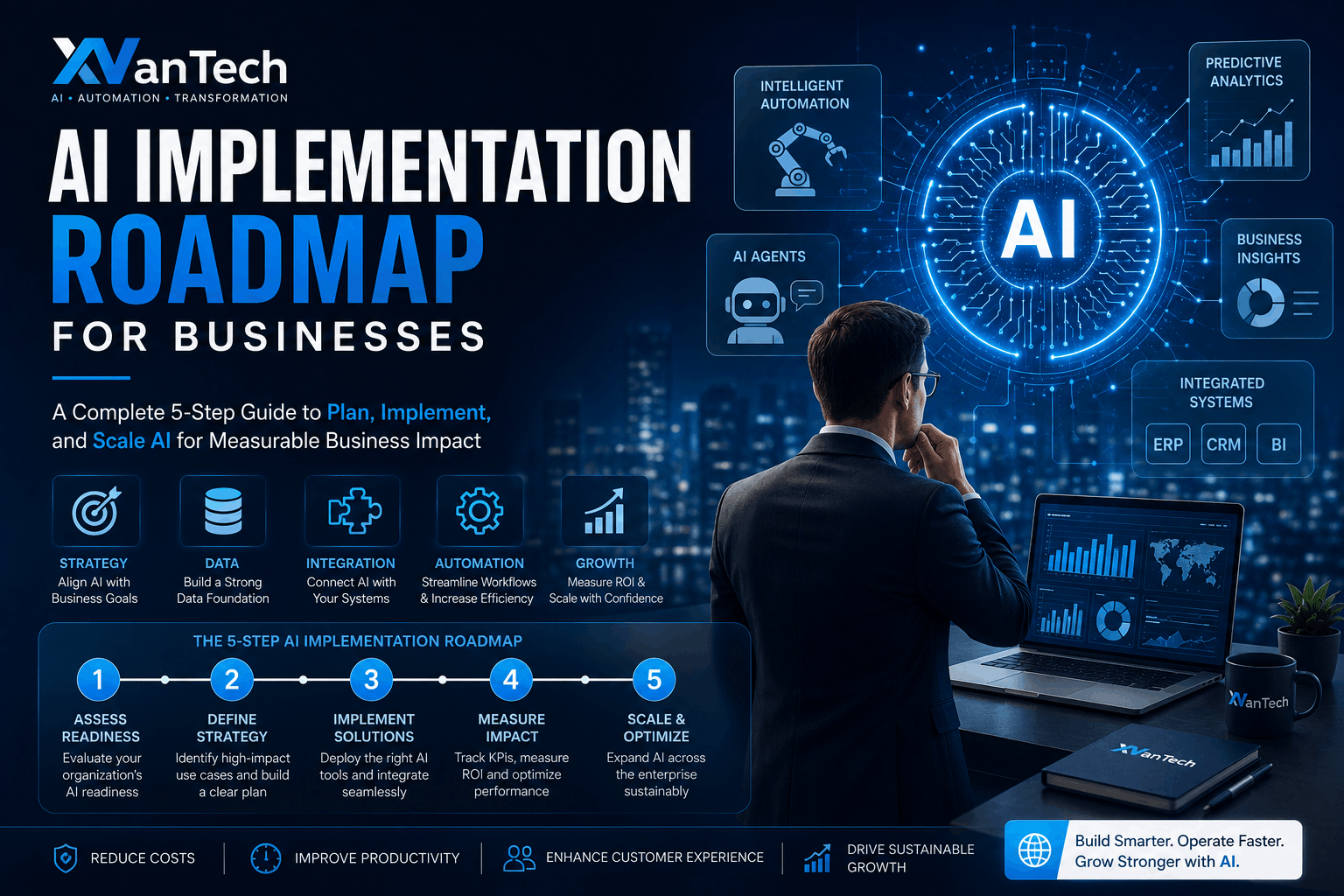
Artificial Intelligence has evolved from an emerging technology into a core business capability. Organizations are no longer asking whether they should invest in AI they are asking how to implement AI successfully while minimizing risk and maximizing measurable business value.
Yet despite billions of dollars invested globally, many AI initiatives fail to achieve their intended outcomes. Common challenges include unclear objectives, poor data quality, disconnected technology ecosystems, inadequate governance, unrealistic expectations, and resistance to organizational change.
Successful AI implementation is not about deploying the newest Large Language Model (LLM), purchasing another software platform, or launching an AI chatbot. It is about designing a structured business transformation program that aligns artificial intelligence with strategic objectives, operational processes, people, and technology.
Whether your organization is considering enterprise AI, generative AI, AI-powered automation, predictive analytics, AI agents, or intelligent document processing, success depends on following a well-defined implementation roadmap rather than adopting technology without a clear strategy.
This comprehensive guide explains how businesses can plan, deploy, govern, measure, and continuously improve AI initiatives using proven implementation principles. It is designed for executives, business owners, CIOs, CTOs, COOs, CFOs, IT leaders, operations managers, and digital transformation teams seeking a practical framework for long-term AI adoption.
By the end of this guide, you will understand:
- What AI implementation actually involves
- Why many AI projects fail
- How to evaluate organizational AI readiness
- A step-by-step AI implementation roadmap
- Technology, data, and governance requirements
- AI implementation costs and ROI considerations
- Industry-specific implementation strategies
- Common implementation mistakes to avoid
- How to scale AI across the enterprise responsibly
Rather than focusing on isolated tools or trends, this guide presents AI implementation as a strategic capability that enables sustainable growth, operational efficiency, better decision-making, and competitive advantage.
Why AI Implementation Matters More Than Ever
Artificial intelligence is reshaping how organizations operate, compete, and create value. Across industries, businesses are using AI to automate repetitive tasks, improve customer experiences, optimize supply chains, accelerate software development, strengthen cybersecurity, support financial planning, and generate actionable insights from large volumes of data.
However, implementing AI successfully requires more than simply adopting new software. Organizations must rethink workflows, modernize data infrastructure, establish governance policies, prepare employees for change, and integrate AI into existing enterprise systems such as ERP, CRM, finance, HR, and business intelligence platforms.
Businesses that approach AI strategically often realize benefits such as:
- Faster decision-making supported by real-time analytics
- Reduced operational costs through intelligent automation
- Increased employee productivity by automating repetitive work
- Improved customer engagement through AI-powered experiences
- Better forecasting and predictive planning
- Enhanced compliance and risk monitoring
- Stronger competitive differentiation
- Greater organizational scalability
Conversely, organizations that adopt AI without a structured implementation strategy frequently experience fragmented initiatives, inconsistent data, duplicated investments, poor user adoption, and limited return on investment.
AI should not be viewed as a standalone technology project. It should be treated as a business transformation initiative supported by technology, governance, leadership, and continuous improvement.
What Is AI Implementation?
AI implementation is the structured process of integrating artificial intelligence technologies into an organization’s operations, systems, and decision-making processes to solve specific business challenges and achieve measurable outcomes.
An effective AI implementation program combines multiple disciplines, including:
- Business strategy
- Digital transformation
- Data management
- Enterprise architecture
- Machine learning
- Generative AI
- Workflow automation
- Cloud computing
- Cybersecurity
- Governance
- Change management
- Performance measurement
This process extends beyond selecting an AI platform. It involves identifying business opportunities, assessing organizational readiness, preparing high-quality data, choosing appropriate technologies, integrating with existing systems, training employees, monitoring performance, and continuously refining AI models and workflows.
Successful organizations recognize that AI implementation is an ongoing capability—not a one-time deployment.
AI Implementation vs AI Adoption vs Digital Transformation
These terms are often used interchangeably, but they represent different concepts.
AI Implementation focuses on planning, deploying, integrating, and managing AI technologies within business operations.
AI Adoption refers to how effectively employees, departments, and leadership embrace and use AI solutions in their daily work.
Digital Transformation is the broader organizational strategy of modernizing business processes, operating models, customer experiences, and technology using digital capabilities—including AI, cloud computing, automation, analytics, and enterprise software.
Understanding the distinction is essential because organizations can successfully deploy AI technologies yet fail to achieve meaningful business outcomes if adoption, governance, or process redesign are neglected.
Why Most AI Projects Fail
Despite increasing investment, many AI initiatives fail to move beyond pilot projects or deliver measurable business value. While the reasons vary, the underlying challenges are remarkably consistent across industries.
1. Technology Before Business Strategy
Many organizations purchase AI tools before defining the business problems they intend to solve. Without clear objectives, AI becomes an expensive experiment rather than a strategic capability.
AI should always begin with measurable business outcomes—not technology selection.
2. Poor Data Quality
Artificial intelligence depends on accurate, relevant, secure, and accessible data.
Incomplete records, duplicate information, inconsistent formatting, siloed databases, and outdated systems significantly reduce model performance and decision quality.
Data readiness is often a greater challenge than AI development itself.
3. Lack of Executive Alignment
AI initiatives require sponsorship from executive leadership.
Without alignment between business leaders, technology teams, finance, operations, compliance, and department managers, implementation efforts frequently stall due to competing priorities and unclear ownership.
4. Unrealistic Expectations
Artificial intelligence is not a shortcut to instant transformation.
Organizations expecting immediate productivity gains without investing in governance, process redesign, employee training, and continuous optimization often become disappointed with initial results.
Successful AI implementation is iterative.
5. Ignoring Change Management
Employees may resist AI due to concerns about job security, changing responsibilities, or unfamiliar technologies.
Organizations that communicate clearly, provide training, involve employees early, and demonstrate practical benefits generally achieve significantly higher adoption rates.
6. Weak Governance
Without governance, organizations expose themselves to security risks, regulatory issues, biased outputs, inconsistent AI usage, and reputational damage.
Governance should address:
- Data privacy
- Security
- Compliance
- Human oversight
- Responsible AI
- Model monitoring
- Ethical decision-making
Governance is not a barrier to innovation—it is what enables AI to scale responsibly.
AI Readiness Assessment: Is Your Business Ready for AI?
One of the biggest misconceptions surrounding artificial intelligence is that organizations can purchase an AI platform and immediately begin generating business value. In reality, successful AI implementation begins long before software selection or model deployment.
The most successful organizations first evaluate their AI readiness—their ability to adopt, integrate, govern, and scale AI effectively across people, processes, technology, and data.
An AI readiness assessment identifies strengths, weaknesses, risks, and opportunities before significant investments are made. It helps executives prioritize initiatives, reduce implementation risks, and establish realistic expectations for business outcomes.
Rather than asking:
“Which AI tool should we buy?”
Business leaders should ask:
- Are our business objectives clearly defined?
- Is our data reliable enough to support AI?
- Do we have executive sponsorship?
- Which business processes will benefit most from AI?
- Do employees understand how AI will change their work?
- Can our existing technology infrastructure support AI integration?
- How will we measure success?
Organizations that answer these questions early are significantly more likely to achieve measurable returns from AI initiatives.
The Six Pillars of AI Readiness
A practical AI readiness assessment should evaluate six interconnected areas.
1. Business Strategy
Every successful AI initiative begins with a clearly defined business objective.
Artificial intelligence should support organizational priorities such as:
- Increasing operational efficiency
- Reducing costs
- Improving customer experience
- Accelerating decision-making
- Enhancing forecasting accuracy
- Increasing revenue
- Reducing manual workloads
- Improving compliance
Avoid implementing AI simply because competitors are doing so. AI should solve measurable business problems.
Questions to consider include:
- Which business objectives will AI support?
- What KPIs will improve?
- How will success be measured?
- Which departments should be prioritized?
Without strategic alignment, AI becomes an isolated technology project rather than a business transformation initiative.
2. Data Readiness
Artificial intelligence is fundamentally dependent on data.
High-performing AI systems require accurate, consistent, secure, and accessible information.
Organizations should evaluate:
- Data quality
- Data ownership
- Data governance
- Duplicate records
- Missing information
- Legacy systems
- Integration capabilities
- Security controls
Poor-quality data leads directly to poor-quality AI outputs.
Many organizations discover that improving data quality delivers business benefits even before AI is introduced.
3. Technology Infrastructure
Existing technology should support—not limit—AI implementation.
Technology assessments should include:
- ERP systems
- CRM platforms
- Cloud infrastructure
- APIs
- Business intelligence platforms
- Data warehouses
- Cybersecurity controls
- Identity management
- Integration architecture
For example, organizations already using Microsoft Dynamics 365, Microsoft Azure, Microsoft Power BI, Salesforce, Oracle NetSuite, SAP, or modern cloud platforms often have a stronger foundation for enterprise AI than organizations operating with disconnected legacy systems.
Technology readiness should focus on integration rather than replacement wherever possible.
4. Organizational Readiness
Artificial intelligence changes how people work.
Employees must understand:
- Why AI is being introduced.
- How their roles may evolve.
- What repetitive tasks will be automated.
- Which decisions will continue to require human judgment.
- How AI supports—not replaces—the workforce.
Organizations with strong communication and change management programs consistently achieve higher adoption rates than those focusing solely on technical implementation.
Executive sponsorship, departmental champions, and structured training programs play a critical role in organizational readiness.
5. Governance and Risk Management
AI introduces new responsibilities related to privacy, ethics, security, compliance, and accountability.
Organizations should establish governance policies before large-scale deployment.
Governance should define:
- Acceptable AI use
- Human approval processes
- Data privacy requirements
- Model monitoring
- Regulatory compliance
- Security standards
- Risk management procedures
- Vendor evaluation criteria
Responsible AI governance builds trust among employees, customers, regulators, and stakeholders while reducing operational risk.
6. Financial Readiness
AI implementation should be treated as a strategic investment rather than a technology expense.
Organizations should evaluate:
- Implementation costs
- Infrastructure costs
- Software licensing
- Integration costs
- Employee training
- Change management
- Ongoing maintenance
- Expected ROI
- Business value realization
Financial planning helps organizations prioritize initiatives with the highest potential impact while avoiding unnecessary investments.
The AI Opportunity Assessment
Before selecting any AI solution, organizations should identify where AI can create the greatest value.
Rather than implementing AI everywhere, focus on business functions with repetitive, data-intensive, or decision-heavy processes.
Examples include:
Finance
- Invoice processing
- Expense management
- Cash flow forecasting
- Financial reporting
- Fraud detection
- Budget analysis
Operations
- Workflow automation
- Resource planning
- Predictive maintenance
- Quality assurance
- Inventory optimization
Customer Service
- AI assistants
- Customer support automation
- Knowledge management
- Intelligent routing
- Sentiment analysis
Human Resources
- Resume screening
- Employee onboarding
- Internal knowledge assistants
- Learning recommendations
- Workforce analytics
Sales & Marketing
- Lead qualification
- Sales forecasting
- Personalized marketing
- Proposal generation
- Customer segmentation
Organizations often achieve the fastest return by starting with high-volume, repetitive processes before expanding AI into more complex decision-making workflows.
The 8-Phase AI Implementation Roadmap
Successful AI implementation follows a structured lifecycle rather than isolated projects.
Phase 1 – Define Business Objectives
Identify measurable business challenges.
Examples include:
- Reduce invoice processing time by 60%
- Improve forecast accuracy by 20%
- Reduce customer response time
- Increase employee productivity
- Improve operational visibility
Every AI initiative should begin with business outcomes—not technology selection.
Phase 2 – Assess Organizational Readiness
Evaluate:
- Business strategy
- Data maturity
- Technology infrastructure
- Skills
- Governance
- Budget
- Change readiness
This assessment establishes realistic expectations and identifies implementation risks early.
Phase 3 – Identify High-Value Use Cases
Prioritize AI initiatives based on:
- Business impact
- Implementation complexity
- Expected ROI
- Available data
- Executive support
Quick wins help build organizational confidence while demonstrating measurable value.
Phase 4 – Build the Business Case
Executive leadership should understand:
- Expected benefits
- Estimated investment
- Timeline
- Risks
- Resource requirements
- Success metrics
A strong business case ensures continued executive sponsorship throughout implementation.
Phase 5 – Design the AI Solution
Once objectives are clear, organizations can begin designing the technical solution.
This includes selecting:
- AI models
- Data architecture
- Integration strategy
- Security controls
- Governance processes
- Infrastructure
- User experience
Technology decisions should always support business objectives—not drive them.
Building an AI Center of Excellence (CoE)
As organizations expand AI initiatives, many establish an AI Center of Excellence (CoE) to coordinate strategy, governance, standards, and knowledge sharing across departments.
An effective CoE typically includes:
- Executive Sponsor
- CIO or CTO
- AI Program Manager
- Data Architect
- Security & Compliance Lead
- Business Process Owner
- Change Management Lead
- Department Representatives
Rather than allowing departments to adopt AI independently, a CoE promotes consistency, reduces duplication, and ensures responsible governance across the organization.
Executive Planning Before Technology Selection
A common mistake is evaluating AI vendors before defining organizational requirements.
Instead, executive teams should first agree on:
- Business objectives
- Success metrics
- Budget
- Timeline
- Governance model
- Security requirements
- Compliance obligations
- Data ownership
- Integration priorities
- Change management strategy
Only after these decisions are documented should technology evaluations begin.
This approach significantly reduces the risk of investing in tools that fail to meet long-term business needs.
From Strategy to Execution: Building the Right AI Technology Foundation
Once an organization has defined its objectives, assessed its readiness, identified high-value use cases, and secured executive alignment, the next step is selecting the technologies and architecture that will support long-term success.
This is where many AI initiatives begin to lose momentum.
Organizations often rush into purchasing AI platforms based on vendor demonstrations, market hype, or competitive pressure rather than evaluating how those technologies fit within their existing business ecosystem.
Successful AI implementation is not determined by using the most advanced AI model—it is determined by selecting the right combination of technologies that align with business goals, integrate with enterprise systems, protect sensitive data, and can scale as organizational needs evolve.
Technology decisions should support a long-term business strategy rather than solving isolated problems.
Understanding the Enterprise AI Technology Stack
Enterprise AI is not a single application. It is an ecosystem of technologies working together.
A modern AI implementation typically includes:
- Large Language Models (LLMs)
- Machine Learning platforms
- AI agents
- Workflow automation tools
- Enterprise Resource Planning (ERP) systems
- Customer Relationship Management (CRM) platforms
- Cloud infrastructure
- Business Intelligence (BI) platforms
- Data warehouses and data lakes
- APIs and integration platforms
- Security and identity management
- Monitoring and governance solutions
When these components are properly integrated, organizations create an intelligent business ecosystem rather than isolated AI tools.
Choosing the Right Type of AI
Different business challenges require different AI capabilities.
Selecting the wrong technology often results in unnecessary complexity and poor adoption.
Generative AI
Generative AI creates new content from existing knowledge.
Common enterprise applications include:
- Drafting reports
- Proposal generation
- Knowledge assistants
- Customer support
- Marketing content
- Documentation
- Meeting summaries
- Email assistance
Best suited for:
- Knowledge-intensive businesses
- Professional services
- Customer service
- Marketing
- Human Resources
Machine Learning
Machine Learning analyzes historical data to identify patterns and make predictions.
Typical use cases include:
- Sales forecasting
- Demand prediction
- Fraud detection
- Predictive maintenance
- Customer segmentation
- Financial forecasting
- Risk scoring
Best suited for organizations with large volumes of structured historical data.
AI Agents
AI agents go beyond answering questions.
They can:
- Reason
- Plan
- Execute workflows
- Interact with multiple applications
- Retrieve information
- Trigger automations
- Escalate approvals
- Complete repetitive business tasks
For example, an AI procurement agent might:
- Review inventory
- Compare supplier pricing
- Generate purchase requests
- Route approvals
- Update ERP records
- Notify stakeholders
All without constant human intervention.
AI agents represent one of the fastest-growing areas of enterprise AI because they combine intelligence with action.
Intelligent Automation
Many organizations achieve faster ROI by combining AI with Business Process Automation (BPA) and Robotic Process Automation (RPA).
Examples include:
- Invoice processing
- Employee onboarding
- Purchase approvals
- Document classification
- Contract management
- Claims processing
- Customer onboarding
Rather than replacing employees, intelligent automation removes repetitive administrative work so employees can focus on higher-value activities.
Build vs Buy: Which AI Strategy Is Right?
One of the first strategic decisions organizations face is whether to build custom AI solutions or adopt existing commercial platforms.
Neither approach is universally better—the right choice depends on business objectives, available expertise, regulatory requirements, and long-term scalability.
Building Custom AI Solutions
Organizations often choose custom development when they require:
- Proprietary business logic
- Deep integration with internal systems
- Industry-specific workflows
- Greater control over security
- Competitive differentiation
- Specialized AI models
Advantages include:
- Tailored functionality
- Greater flexibility
- Full ownership
- Long-term customization
Challenges include:
- Higher initial investment
- Longer implementation timelines
- Ongoing maintenance
- Greater technical complexity
Buying Commercial AI Platforms
Commercial AI solutions typically offer:
- Faster deployment
- Lower upfront costs
- Vendor support
- Regular updates
- Proven infrastructure
These platforms work well for organizations seeking rapid implementation without extensive custom development.
However, businesses should evaluate:
- Vendor lock-in
- Integration capabilities
- Data ownership
- Customization limitations
- Compliance requirements
- Long-term licensing costs
Many organizations adopt a hybrid strategy—using commercial AI platforms for common capabilities while developing custom AI solutions for unique business processes.
Integrating AI with Enterprise Systems
Artificial intelligence delivers the greatest value when connected to the systems employees already use.
Rather than introducing disconnected applications, organizations should integrate AI directly into their existing digital ecosystem.
Common integrations include:
Enterprise Resource Planning (ERP)
ERP systems centralize finance, operations, procurement, inventory, and manufacturing data.
AI can enhance ERP by enabling:
- Demand forecasting
- Inventory optimization
- Procurement recommendations
- Financial forecasting
- Production planning
- Exception detection
- Automated reporting
Common enterprise platforms include Microsoft Dynamics 365, Oracle NetSuite, SAP, and other ERP ecosystems.
Customer Relationship Management (CRM)
CRM platforms contain valuable customer intelligence.
AI enhances CRM by supporting:
- Lead scoring
- Sales forecasting
- Customer segmentation
- Opportunity prioritization
- Personalized communications
- Customer retention analysis
- Predictive sales insights
Rather than replacing CRM systems, AI extends their capabilities through intelligent recommendations and automation.
Business Intelligence Platforms
Business intelligence platforms transform organizational data into actionable insights.
AI extends traditional analytics by providing:
- Natural language querying
- Predictive analytics
- Executive dashboards
- Automated anomaly detection
- Intelligent reporting
- Real-time recommendations
Instead of manually searching dashboards, executives can ask business questions using natural language and receive contextual insights.
Building a Strong Data Foundation
Every successful AI initiative depends on reliable data.
Organizations often underestimate the amount of preparation required before AI can deliver meaningful outcomes.
A mature data strategy should address:
Data Quality
Ensure information is:
- Accurate
- Complete
- Consistent
- Current
- Reliable
Poor-quality data produces unreliable AI outputs regardless of model sophistication.
Data Integration
Business information often exists across multiple systems.
AI should access relevant data from:
- ERP
- CRM
- HR systems
- Financial platforms
- Customer support software
- Document repositories
- Operational databases
Modern API-driven architectures make this integration significantly more manageable.
Data Governance
Organizations should define:
- Data ownership
- Retention policies
- Access permissions
- Privacy controls
- Compliance requirements
- Audit trails
- Data classification standards
Effective governance supports both regulatory compliance and trustworthy AI outputs.
Cloud Strategy for Enterprise AI
Most enterprise AI initiatives rely on cloud infrastructure because of its scalability, flexibility, and access to advanced AI services.
Cloud platforms provide:
- High-performance computing
- AI development services
- Secure storage
- Model deployment
- Monitoring
- Disaster recovery
- Global scalability
Organizations should evaluate cloud architecture based on performance, security, compliance, and integration with existing systems.
A well-designed cloud strategy enables businesses to expand AI capabilities without repeatedly rebuilding infrastructure.
Security and Responsible AI
As AI becomes embedded in business operations, cybersecurity and governance become strategic priorities rather than technical afterthoughts.
Organizations should establish controls for:
- Identity and access management
- Encryption of sensitive data
- Secure API communication
- Multi-factor authentication
- Role-based permissions
- Continuous monitoring
- Incident response
- Model security
- Third-party risk management
Security should be incorporated into every phase of AI implementation rather than added after deployment.
Responsible AI Principles
Trustworthy AI requires clear organizational standards.
Every enterprise AI initiative should align with principles such as:
- Transparency in AI-assisted decisions
- Human oversight for high-impact decisions
- Fairness and bias mitigation
- Accountability for AI outcomes
- Privacy-by-design
- Regulatory compliance
- Continuous monitoring and improvement
Responsible AI is not only a compliance requirement—it strengthens customer trust, improves adoption, and supports sustainable innovation.
Industry-Specific AI Implementation Priorities
While the implementation framework remains consistent, each industry should prioritize different AI opportunities.
Manufacturing
- Predictive maintenance
- Production scheduling
- Inventory optimization
- Quality control
- Supply chain forecasting
Healthcare
- Clinical documentation
- Patient scheduling
- Medical coding assistance
- Administrative automation
- Operational analytics
Financial Services
- Fraud detection
- Credit risk assessment
- Financial forecasting
- Regulatory compliance
- Intelligent reporting
Retail & eCommerce
- Demand forecasting
- Product recommendations
- Inventory planning
- Customer service automation
- Dynamic pricing insights
Professional Services
- Proposal generation
- Knowledge management
- Resource planning
- Document analysis
- Client support assistants
Although use cases differ, every organization benefits from aligning AI investments with measurable business outcomes rather than adopting technology for its own sake.
AI Implementation Costs: Understanding the True Investment
One of the most common misconceptions surrounding artificial intelligence is that implementation costs are limited to software licensing. In reality, successful AI adoption is a strategic investment that includes technology, people, processes, governance, integration, and continuous optimization.
Organizations that budget only for AI software often underestimate the resources required to achieve meaningful business outcomes.
Instead of asking, “How much does AI cost?”, business leaders should ask:
- What business value will AI create?
- Which processes should be prioritized?
- What operational costs can be reduced?
- How quickly can we realize measurable returns?
- How will AI support long-term business growth?
The objective is not to minimize investment—it is to maximize return on investment (ROI).
What Determines AI Implementation Costs?
AI implementation costs vary depending on several factors, including:
- Organization size
- Number of users
- Existing technology infrastructure
- Data quality and availability
- Integration complexity
- Industry regulations
- Security requirements
- Level of customization
- Deployment model (cloud, hybrid, or on-premises)
- Internal technical capabilities
Businesses with modern cloud-based systems and well-governed data generally experience lower implementation costs than organizations relying on fragmented legacy environments.
Typical Cost Categories
A comprehensive AI budget should account for more than software subscriptions. Common investment areas include:
Strategy and Discovery
- AI readiness assessments
- Business process analysis
- Opportunity identification
- Solution architecture
- Roadmap development
This phase ensures AI initiatives align with strategic objectives before implementation begins.
Technology and Infrastructure
Costs may include:
- AI platforms
- Cloud computing resources
- APIs
- Storage
- Enterprise software licensing
- Development environments
- Monitoring tools
Organizations should prioritize scalable infrastructure that can support future AI initiatives.
Integration
AI rarely operates independently.
Implementation often requires integration with:
- ERP systems
- CRM platforms
- HR software
- Finance applications
- Business intelligence tools
- Customer support platforms
- Internal knowledge bases
- Document management systems
The more disconnected an organization’s systems are, the more complex integration becomes.
Data Preparation
High-quality AI depends on high-quality data.
Investment may include:
- Data cleansing
- Standardization
- Migration
- Data governance
- Metadata management
- Master data management
- Data security improvements
Improving data quality often creates business value beyond AI implementation itself.
Change Management
Technology alone does not transform organizations.
Successful implementation also requires:
- Executive communication
- Employee training
- Process redesign
- Internal documentation
- Adoption programs
- Departmental workshops
- Leadership engagement
Organizations that invest in change management generally achieve significantly higher adoption rates.
Governance and Security
Responsible AI requires ongoing investment in:
- Security controls
- Compliance monitoring
- Risk management
- AI governance
- Model evaluation
- Access management
- Vendor assessments
- Audit processes
Governance protects organizations while enabling sustainable AI growth.
Measuring AI Return on Investment (ROI)
Many organizations evaluate AI based solely on cost reduction.
While operational savings are important, the true value of AI extends far beyond automation.
A mature ROI framework should evaluate multiple dimensions of business performance.
Financial Impact
Measure improvements such as:
- Revenue growth
- Cost reduction
- Margin improvement
- Reduced operational expenses
- Lower support costs
- Increased productivity
Operational Performance
Track:
- Process completion times
- Workflow efficiency
- Automation rates
- Error reduction
- Resource utilization
- Decision-making speed
Customer Experience
AI can improve:
- Response times
- Customer satisfaction
- Personalization
- First-contact resolution
- Service quality
- Customer retention
Employee Productivity
Evaluate:
- Administrative workload reduction
- Time saved
- Employee engagement
- Knowledge accessibility
- Collaboration improvements
- Decision support
Innovation
AI also enables:
- Faster product development
- Better forecasting
- New business models
- Data-driven innovation
- Competitive differentiation
Organizations should evaluate both direct financial returns and strategic business outcomes.
Key Performance Indicators (KPIs) for AI Success
Every AI initiative should define measurable success metrics before implementation begins.
Examples include:
Operational KPIs
- Process cycle time
- Automation percentage
- Error rate reduction
- Productivity improvements
- Workflow completion speed
Financial KPIs
- Cost savings
- Revenue growth
- ROI percentage
- Payback period
- Operational efficiency gains
Customer KPIs
- Net Promoter Score (NPS)
- Customer Satisfaction (CSAT)
- Average response time
- Customer retention
- Resolution rates
Employee KPIs
- Adoption rate
- Training completion
- Time saved
- Employee satisfaction
- AI utilization across departments
Tracking KPIs consistently allows organizations to demonstrate business value, justify continued investment, and identify areas for improvement.
Change Management: The Human Side of AI
Technology projects often fail because organizations underestimate the importance of people.
Employees may worry about:
- Job displacement
- Changing responsibilities
- Increased complexity
- Lack of training
- Reduced decision-making authority
Addressing these concerns early is essential.
Successful change management includes:
- Transparent communication
- Executive sponsorship
- Departmental champions
- Continuous learning
- Practical training
- Clear documentation
- Feedback mechanisms
When employees understand how AI supports their work rather than replacing it, adoption improves significantly.
Upskilling the Workforce
AI implementation is an opportunity to enhance workforce capabilities.
Organizations should invest in role-specific training for:
Executives
- AI strategy
- Governance
- Risk management
- Business value realization
Managers
- Process redesign
- AI-assisted decision-making
- Performance measurement
- Team adoption
Technical Teams
- AI architecture
- Integration
- Security
- Data engineering
- Monitoring
Business Users
- AI literacy
- Responsible AI practices
- Prompt engineering
- Workflow optimization
- Productivity tools
Continuous learning ensures organizations maximize the long-term value of AI investments.
Common AI Implementation Mistakes
Even well-funded AI initiatives can fail when organizations overlook fundamental principles.
Mistake 1: Starting with Technology Instead of Business Problems
AI should address clearly defined business challenges, not simply showcase new technology.
Mistake 2: Ignoring Data Quality
Poor data leads to unreliable insights, inaccurate predictions, and reduced trust in AI systems.
Mistake 3: Lack of Executive Sponsorship
Without visible leadership support, AI initiatives often lose momentum and struggle to secure resources.
Mistake 4: Implementing Too Many Projects at Once
Attempting organization-wide transformation immediately increases complexity and risk.
Successful organizations begin with high-impact, manageable initiatives before expanding.
Mistake 5: Neglecting Governance
AI without governance creates operational, legal, and reputational risks.
Governance should evolve alongside every AI initiative.
Mistake 6: Underestimating Employee Adoption
Technology only creates value when employees use it effectively.
Training, communication, and ongoing support are critical components of implementation.
Scaling AI Across the Enterprise
After demonstrating success through pilot projects, organizations should expand AI strategically rather than rapidly.
Scaling successfully requires:
- Standardized governance
- Reusable AI frameworks
- Shared data standards
- Integration best practices
- Continuous monitoring
- Centralized documentation
- Cross-functional collaboration
An enterprise-wide approach prevents departments from building isolated AI solutions that create duplication and inconsistent outcomes.
Creating a Culture of Continuous Improvement
AI implementation is not a one-time deployment—it is an ongoing capability.
Leading organizations continuously:
- Monitor AI performance
- Evaluate new use cases
- Refine workflows
- Improve data quality
- Update governance policies
- Train employees
- Measure business outcomes
- Adapt to changing regulations and technologies
Organizations that embrace continuous improvement are better positioned to respond to market changes, customer expectations, and emerging innovations.
The Future of Enterprise AI: What’s Next?
Artificial intelligence is evolving rapidly, but the most significant shift is no longer about building smarter models—it’s about creating intelligent enterprises where AI becomes an integrated capability across every business function.
Organizations that treat AI as a one-time technology project risk falling behind. Those that embed AI into operations, decision-making, customer experiences, and business strategy will be better positioned to adapt to changing markets, improve productivity, and unlock new sources of value.
The next phase of enterprise AI is defined by systems that are more autonomous, collaborative, and deeply integrated with existing business processes.
Key trends shaping the future include:
- AI agents capable of executing multi-step business workflows
- Multimodal AI that understands text, images, audio, and video
- AI copilots embedded within enterprise applications
- Industry-specific AI solutions tailored to unique operational requirements
- Retrieval-Augmented Generation (RAG) for secure knowledge management
- Predictive and prescriptive analytics for better decision-making
- Responsible AI frameworks that emphasize transparency, governance, and trust
Organizations that invest in strong data foundations, governance, and workforce readiness today will be better prepared to capitalize on these advancements tomorrow.
Department-by-Department AI Opportunities
Successful AI implementation is rarely confined to a single department. Instead, organizations realize the greatest value when AI supports multiple business functions while maintaining consistent governance and shared data standards.
Executive Leadership
Executives can use AI to:
- Monitor business performance through real-time dashboards
- Improve strategic planning
- Analyze market trends
- Support board reporting
- Identify operational risks
- Accelerate decision-making
Finance
AI applications include:
- Financial forecasting
- Budget optimization
- Cash flow analysis
- Accounts payable automation
- Expense auditing
- Fraud detection
- Regulatory reporting
Human Resources
HR teams can benefit from:
- Candidate screening
- Employee onboarding
- Internal knowledge assistants
- Workforce analytics
- Skills gap analysis
- Learning recommendations
- Performance insights
Sales
AI enhances sales by supporting:
- Lead qualification
- Opportunity scoring
- Sales forecasting
- Proposal generation
- CRM data enrichment
- Customer insights
- Pipeline analysis
Marketing
Marketing teams can leverage AI for:
- Content planning
- Campaign optimization
- Customer segmentation
- SEO research
- Market intelligence
- Personalization
- Performance reporting
Customer Service
Customer-facing teams can improve:
- Response times
- Self-service support
- Intelligent routing
- Knowledge retrieval
- Sentiment analysis
- Case summarization
- Service quality
Operations
Operational AI opportunities include:
- Workflow automation
- Inventory optimization
- Predictive maintenance
- Scheduling
- Capacity planning
- Procurement optimization
- Supply chain visibility
IT
Technology teams can use AI for:
- Infrastructure monitoring
- Cybersecurity threat detection
- Software development assistance
- Documentation
- Incident management
- System optimization
- Knowledge management
Enterprise AI becomes significantly more valuable when these departments operate within a shared governance framework rather than deploying disconnected solutions independently.
Enterprise AI Implementation Checklist
Before launching an AI initiative, organizations should verify that the following elements are in place.
Strategy
- Clearly defined business objectives
- Executive sponsorship
- Measurable success metrics
- Prioritized AI use cases
- Approved implementation roadmap
Data
- High-quality business data
- Data governance policies
- Security controls
- Data ownership
- Integration readiness
Technology
- Scalable infrastructure
- Cloud strategy
- API capabilities
- Enterprise system integration
- Monitoring and reporting tools
Governance
- Responsible AI policies
- Risk management framework
- Compliance requirements
- Human oversight processes
- Vendor evaluation criteria
People
- Employee training plan
- Department champions
- Change management strategy
- Communication plan
- Ongoing support resources
Measurement
- KPIs defined
- ROI framework established
- Performance dashboards configured
- Continuous monitoring processes
- Improvement roadmap documented
Organizations that complete these foundational steps are significantly more likely to achieve sustainable, measurable AI success.
Frequently Asked Questions
How long does AI implementation typically take?
Implementation timelines depend on the scope and complexity of the initiative. Small departmental projects may be completed within a few months, while enterprise-wide AI transformation programs often evolve over 12 to 24 months through phased deployments.
Should every business implement AI?
Not necessarily.
Businesses should implement AI only when it addresses a clearly defined operational challenge, improves decision-making, enhances customer experiences, or delivers measurable business value. AI should support business strategy—not replace it.
What is the biggest challenge in AI implementation?
For most organizations, the greatest challenge is not selecting technology but aligning business strategy, data quality, governance, employee adoption, and change management.
How do businesses measure AI success?
Success should be measured using business outcomes rather than technical metrics alone.
Organizations should evaluate improvements in productivity, operational efficiency, customer satisfaction, revenue growth, cost reduction, decision quality, and return on investment.
Is AI secure enough for enterprise use?
Yes—when implemented with appropriate governance, cybersecurity controls, access management, compliance processes, and ongoing monitoring.
Organizations handling sensitive or regulated data should establish robust AI governance frameworks before deploying AI at scale.
Can AI integrate with existing ERP and CRM systems?
Yes.
Modern AI platforms can integrate with many enterprise applications through APIs and connectors, enabling organizations to enhance existing workflows rather than replacing core business systems.
Conclusion
Artificial intelligence is no longer an emerging technology reserved for large enterprises or experimental innovation teams. It has become a strategic capability that enables organizations to improve efficiency, enhance customer experiences, support better decision-making, and create long-term competitive advantage.
However, technology alone does not guarantee success.
The organizations that realize the greatest value from AI are those that approach implementation as a structured business transformation initiative—one that aligns strategy, people, processes, data, governance, and technology around measurable business outcomes.
Whether your organization is exploring generative AI, intelligent automation, AI agents, predictive analytics, or enterprise-wide digital transformation, the same principles apply:
- Start with clearly defined business objectives.
- Assess organizational readiness before investing in technology.
- Prioritize high-value use cases with measurable outcomes.
- Build a strong data and governance foundation.
- Integrate AI into existing business systems and workflows.
- Invest in employee adoption and change management.
- Continuously monitor, optimize, and scale AI responsibly.
AI implementation is not a destination—it is an ongoing journey of continuous improvement. Organizations that establish the right foundation today will be better equipped to adapt to future innovations, respond to evolving market demands, and unlock sustainable business growth.
At XVanTech, we help organizations move beyond AI experimentation by designing practical, scalable, and business-focused AI implementation strategies. From AI readiness assessments and roadmap development to enterprise integration, automation, governance, and ongoing optimization, our goal is to help businesses implement AI with confidence and measurable results.

