


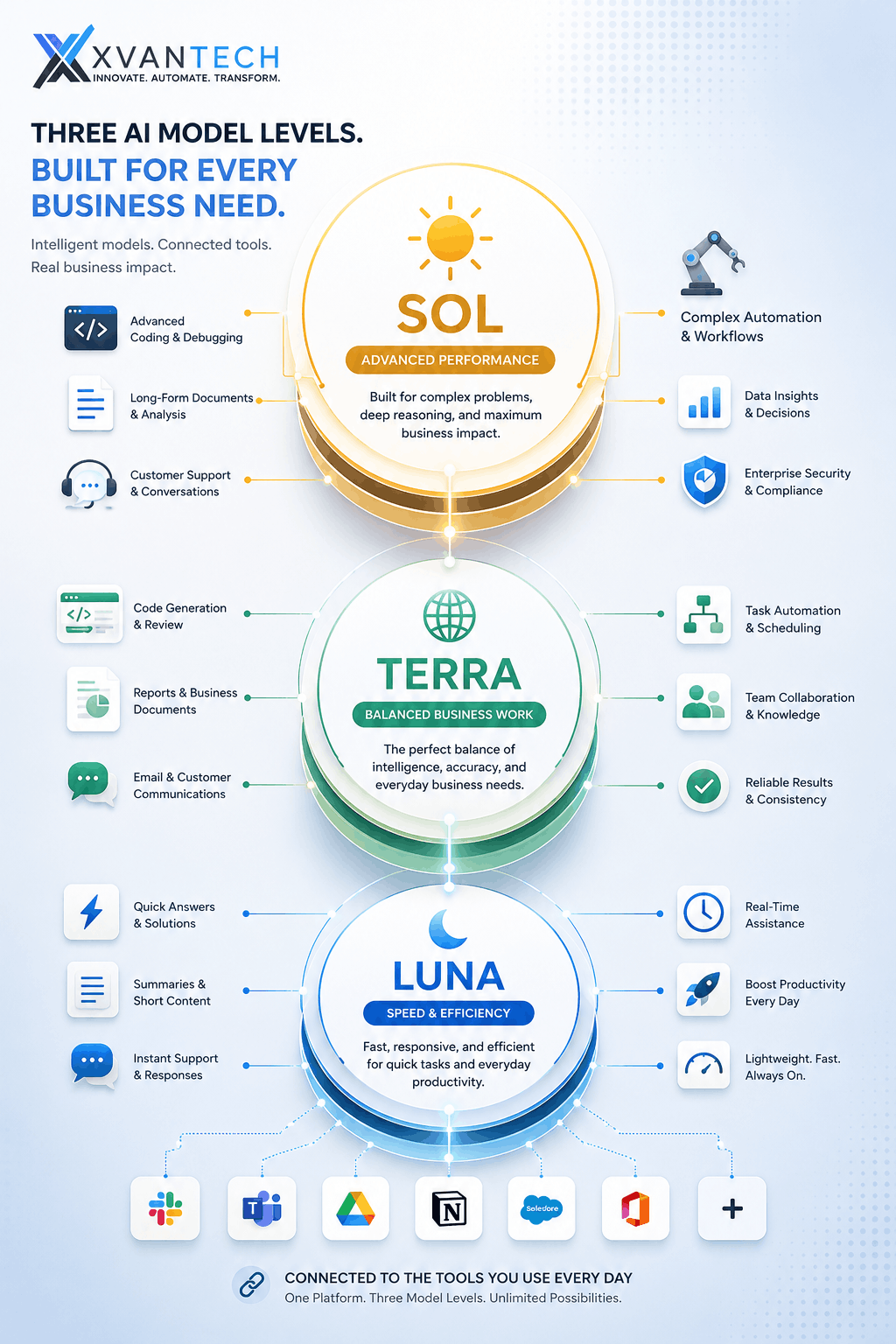
OpenAI officially launched the GPT-5.6 model family on July 9, 2026, introducing three models designed for different levels of performance, speed, and cost.
The new family includes GPT-5.6 Sol, Terra, and Luna. Instead of asking every business to use the same powerful and expensive model, OpenAI is giving companies more control over which level of AI they use for each workflow.
Sol is the flagship model for complex professional work. Terra balances capability and cost, while Luna is designed for fast, high-volume tasks. OpenAI has also introduced Ultra mode for demanding multi-agent workflows and launched ChatGPT Work, an AI agent that can operate across business apps, files, and connected systems.
For business leaders, the most important part of this launch may not be that another advanced AI model is available. The real change is that companies can now match the cost and intelligence of a model to the actual value of the task.
That could make GPT-5.6 for business more practical, scalable, and financially manageable than using a flagship model for everything.
What Is the GPT-5.6 Model Family?
GPT-5.6 is not a single model. It is a family of three models created for different types of work.
OpenAI describes Sol as its flagship model, Terra as a balanced option for everyday work, and Luna as its fastest and most affordable model. The company says the three-tier structure is intended to give users clearer choices across intelligence, speed, and cost.
All three API models support text and image inputs, text outputs, multilingual tasks, vision, tool use, web search, file search, and computer use. Each model also supports a context window of approximately 1.05 million tokens and up to 128,000 output tokens.
This structure addresses a common business problem: not every task requires the highest possible level of reasoning.
A company may need powerful AI for software architecture or complex financial research, but it may only need a fast and affordable model for classifying customer messages or processing routine documents.
The GPT-5.6 family allows businesses to make that distinction.
GPT-5.6 Sol: The Flagship Model for Complex Work
GPT-5.6 Sol is the most capable model in the family. It is designed for demanding tasks that require deeper reasoning, longer workflows, tool use, and careful decision-making.
OpenAI positions Sol as the starting point for complex professional work, advanced coding, cybersecurity, scientific research, and difficult reasoning tasks. Its API price is:
- $5 per million input tokens
- $30 per million output tokens
Sol supports reasoning settings from none through max, allowing developers and professional users to control how much reasoning effort the model applies.
Where Sol May Deliver the Most Value
Businesses may consider GPT-5.6 Sol for work such as:
- Reviewing or improving large software systems
- Investigating technical problems across multiple tools
- Conducting complex financial or market analysis
- Supporting scientific and technical research
- Analyzing cybersecurity risks
- Planning multi-stage business projects
- Working with large collections of documents
- Producing detailed, executive-ready deliverables
The higher price means Sol should not automatically become the default model for every employee or application.
It is better suited to workflows where better reasoning, accuracy, or task completion can justify the additional cost.
For example, using Sol to help review a major software release may be reasonable. Using it to categorize thousands of simple support tickets may not be.
GPT-5.6 Terra: The Balanced Model for Everyday Business Work
GPT-5.6 Terra may be the most important model in the family for many businesses.
OpenAI says Terra offers performance competitive with GPT-5.5 at half the API price. It is designed to balance intelligence and cost for everyday professional work.
Its API pricing is:
- $2.50 per million input tokens
- $15 per million output tokens
Terra is likely to be suitable for common business workflows such as:
- Processing documents
- Summarizing reports and meetings
- Drafting business communications
- Supporting customer service teams
- Analyzing operational data
- Extracting information from contracts or invoices
- Creating internal reports
- Assisting with sales and marketing tasks
- Managing multi-step administrative workflows
Why Terra Could Matter More Than the Flagship Model
Many companies do not struggle because their AI is slightly less intelligent than the most advanced model available.
They struggle because their AI costs become difficult to control when usage grows.
A small difference in token pricing may not seem important during a pilot project. However, that difference becomes significant when a company processes millions of documents, customer interactions, transactions, or internal requests.
Terra gives companies a potential middle ground. It can provide strong professional performance without requiring flagship-level spending for every task.
That could make it a practical default model, with Sol reserved for the most difficult exceptions.
GPT-5.6 Luna: Built for Speed, Volume, and Cost Control
GPT-5.6 Luna is the lowest-cost model in the family. It is designed for fast responses and high-volume workloads where efficiency matters more than maximum reasoning power.
Its API pricing is:
- $1 per million input tokens
- $6 per million output tokens
OpenAI describes Luna as the model for cost-sensitive, high-volume work. Like Sol and Terra, it supports a 1.05-million-token context window and the latest OpenAI tools.
Business Tasks That May Fit Luna
Luna may be suitable for:
- Classifying emails or support tickets
- Extracting standard fields from documents
- Generating short product descriptions
- Routing requests to the correct department
- Moderating or organizing large content libraries
- Producing first drafts for repetitive content
- Tagging customer feedback
- Answering simple internal questions
- Processing large volumes of structured information
A business could use Luna for the first stage of a workflow and only send difficult or uncertain cases to Terra or Sol.
This type of model routing can reduce costs without lowering quality across the entire operation.
Ultra Mode Brings Multi-Agent Workflows to GPT-5.6
One of the most notable GPT-5.6 features is Ultra mode.
Traditional AI workflows generally rely on one model instance working through a task step by step. Ultra mode takes a different approach by coordinating multiple AI agents across parallel workstreams.
OpenAI says the default Ultra configuration uses four agents working in parallel. This can improve performance and reduce the time required for difficult tasks, although it also uses more tokens. Developers can build similar experiences through the multi-agent beta in the Responses API.
How Multi-Agent Work Could Help Businesses
Consider a company preparing to enter a new market.
Instead of one AI model researching everything in sequence, a multi-agent workflow could divide the work:
- One agent researches competitors.
- One reviews market demand.
- One analyzes regulations.
- One estimates financial opportunities and risks.
- The system then combines the findings into one report.
This approach could also support software development, cybersecurity reviews, legal research, financial analysis, product planning, and other projects involving multiple areas of expertise.
However, Ultra mode should be used selectively. It is likely to consume more computing resources and tokens than a standard workflow.
The strongest use case is not “make every task multi-agent.” It is “use multiple agents when parallel work can produce a meaningfully better or faster outcome.”
ChatGPT Work Moves AI From Answers to Finished Work
GPT-5.6 was launched alongside ChatGPT Work, an AI agent created for professional workflows.
ChatGPT Work can gather information across connected apps, break a project into smaller steps, and create finished materials such as spreadsheets, presentations, documents, analyses, and web applications. It can also stay with complex projects for extended periods rather than only responding to a single prompt.
Businesses can connect supported tools and systems, including:
- Slack
- Microsoft Teams
- Gmail and other email services
- Google Drive
- SharePoint
- Calendars
- Customer relationship management systems
- Project management tools
- Local files and desktop applications
Once these tools are connected, ChatGPT Work can gather relevant context and use it to produce or update business materials. OpenAI says users remain in control of access, approvals, and the actions the agent can take.
Practical ChatGPT Work Use Cases
A finance team could ask ChatGPT Work to collect source data, support reconciliations, analyze budget differences, and prepare management slides.
A sales team could use it to review CRM activity, emails, meeting notes, and account data before creating an updated account plan.
A marketing team could turn customer research into a campaign brief, generate supporting assets, and adapt the material for different markets.
An operations team could monitor project updates, identify missing actions, and refresh a recurring management report.
This is an important shift. AI is moving beyond helping employees write faster. It is beginning to coordinate complete workflows across the systems where employees already work.
The Business Problems GPT-5.6 May Help Solve
Companies often invest in AI without first identifying the operational problem they want to solve.
That can lead to expensive subscriptions, disconnected pilots, weak adoption, and unclear returns.
GPT-5.6 for business may help address several common problems.
Rising AI Costs
Using the most expensive model for every request can make large-scale adoption difficult.
The Sol, Terra, and Luna structure allows businesses to choose a lower-cost model when a task does not require maximum intelligence.
Too Much Manual Work
Employees often spend hours transferring information between email, spreadsheets, CRMs, messaging platforms, and reporting tools.
ChatGPT Work is designed to gather context across these systems and help complete multi-step tasks.
Slow Decision-Making
Important information is usually spread across documents, conversations, dashboards, and applications.
AI agents can help collect and organize that information, making it easier for decision-makers to understand what is happening.
Inconsistent AI Output
Different teams may use AI without shared rules, templates, quality checks, or approval processes.
A structured GPT-5.6 implementation can define which model handles each workflow, when human approval is required, and how output should be reviewed.
Challenges Businesses Should Consider
GPT-5.6 offers more options, but more options also create new decisions.
Choosing the Correct Model
Companies need clear criteria for deciding when to use Luna, Terra, Sol, or Ultra.
Without those rules, employees may always select the most powerful option, removing the cost advantage of the model family.
Data Access and Security
Connecting AI to email, files, calendars, and business systems can create real value, but access should be carefully managed.
Organizations need appropriate permissions, governance policies, approval requirements, and monitoring before allowing AI agents to perform sensitive actions.
Measuring Real Return on Investment
Faster output does not always create business value.
Companies should measure results such as:
- Hours saved
- Errors reduced
- Faster response times
- Lower cost per transaction
- Improved completion rates
- Better customer outcomes
- Revenue influenced
- Employee adoption
Maintaining Human Oversight
AI can support decisions, but businesses remain responsible for the final outcome.
Legal, financial, security, employment, and customer-facing decisions may still require expert review.
How to Build a Smarter GPT-5.6 Business Strategy
The best approach is to start with the workflow, not the model.
1. Identify a Costly or Repetitive Process
Look for work that takes too long, involves repeated manual steps, or regularly creates errors.
2. Break the Workflow Into Task Types
Separate simple classification tasks from document analysis, deep reasoning, and final decision-making.
3. Match Each Task to the Right Model
Use Luna for predictable, high-volume work. Use Terra for everyday professional tasks. Reserve Sol for complex reasoning and high-value decisions.
4. Keep Humans at Important Decision Points
Define where employees must review, approve, or correct AI output.
5. Test With Real Business Data
A demonstration may look impressive but still fail in a real workflow. Pilot the system using realistic files, exceptions, and user behavior.
6. Measure Quality and Cost Together
The cheapest model is not always the most economical if it produces more errors. The strongest model is not always the best investment if a smaller model can complete the task successfully.
The goal is to find the lowest-cost model that reliably produces the required result.
Conclusion: GPT-5.6 Makes Model Selection a Business Decision
GPT-5.6 represents more than another increase in AI capability.
The Sol, Terra, and Luna model family gives businesses a clearer way to balance performance, speed, and cost. Ultra mode adds multi-agent support for complex work, while ChatGPT Work brings AI closer to real operational systems and complete business workflows.
The biggest opportunity may come from using the models together.
Luna can handle high-volume routine work. Terra can become the default for professional workflows. Sol can focus on the most difficult and valuable problems. Ultra can support projects where parallel reasoning provides a clear advantage.
The smartest AI strategy is no longer to choose one powerful model and use it everywhere.
It is to understand each workflow, select the right level of intelligence, maintain human oversight, and measure whether the technology is producing real business value.
Turn GPT-5.6 Into a Practical Business Advantage
Adopting a new AI model is easy. Connecting it to a real workflow and producing measurable results is more difficult.
XVanTech helps businesses identify practical AI opportunities, automate repetitive processes, connect business systems, and build solutions that improve efficiency, reporting, and decision-making.
Contact XVanTech to explore how GPT-5.6 and AI agents could support your operations without adding unnecessary cost or complexity.

