

Technology is changing fast, but one of the biggest changes may not be about faster devices, better apps, or smarter screens.
It may be about moving beyond the traditional app experience completely.
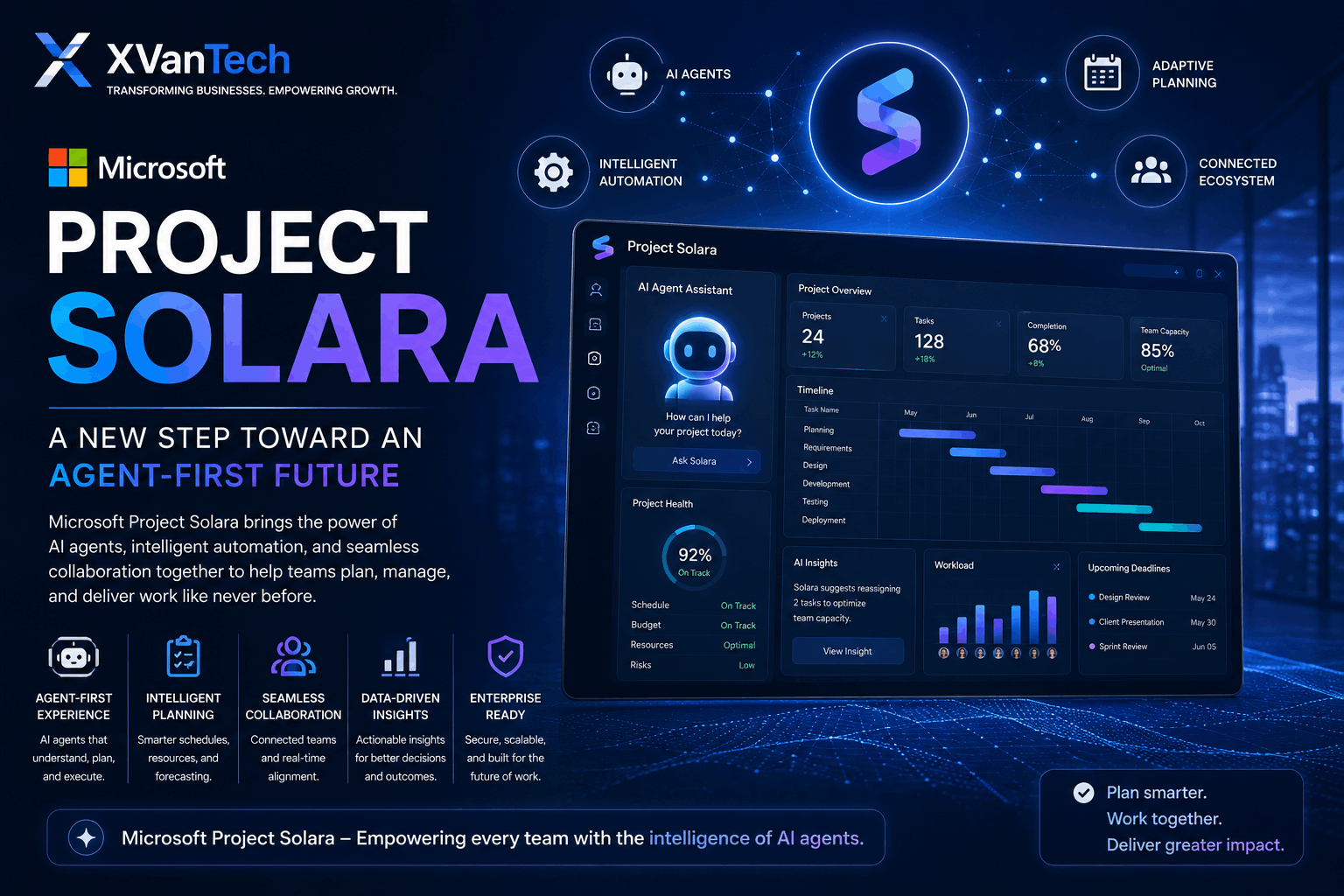
Microsoft Project Solara signals a major shift in how people may use technology in the future. Instead of opening separate apps, clicking through menus, or searching for the right tool, users may simply interact with AI agents that understand their needs and take action.
Announced at Build 2026, Microsoft Project Solara is described as an Android-based operating system designed for an agent-first future. In this model, AI agents become the main way users interact with devices, services, and workflows.
For businesses, this is more than just another technology update. It could change how teams work, how customers interact with digital platforms, and how companies think about productivity.
What Is Microsoft Project Solara?
Microsoft Project Solara is an operating system concept built around AI agents rather than traditional apps.
In simple terms, instead of users opening different applications for email, calendar, documents, customer support, reporting, or communication, they may work through intelligent AI agents that understand what needs to be done.
These agents could help users complete tasks faster by managing information, tools, and actions in the background.
For example, instead of opening a calendar app, checking availability, writing an email, and sending a meeting invite, a user could ask an AI agent to schedule a meeting. The agent would understand the request, check the right details, and complete the task.
That is the core idea behind an agent-first operating system.
Why Microsoft Project Solara Matters
The way people use technology has remained mostly app-based for many years. We open apps, switch between tabs, manage notifications, and manually move information from one tool to another.
This creates friction.
For businesses, that friction often leads to:
- Wasted time
- Lower productivity
- More manual work
- Slower decision-making
- Poor user experience
- Tool overload
- Employee burnout
Microsoft Project Solara aims to reduce that friction by making technology more focused on user intent.
Instead of asking, “Which app should I open?” users may simply ask, “What do I need to get done?”
That difference is important.
The Role of AI Agents in Project Solara
AI agents are at the center of Microsoft Project Solara.
An AI agent is not just a chatbot. It is a digital assistant that can understand context, make decisions, and perform actions based on a user’s goal.
In a business setting, AI agents could support tasks such as:
- Preparing reports
- Managing schedules
- Summarizing meetings
- Handling customer queries
- Tracking project updates
- Organizing documents
- Automating repetitive work
- Supporting sales and marketing teams
The main value is that users do not need to manually move between different systems. The AI agent can act as the connecting layer between the user and the tools.
What Is a Just-in-Time UI?
One of the most interesting parts of Microsoft Project Solara is its “just-in-time UI.”
A just-in-time UI means the interface changes based on what the AI agent is doing at that moment.
Instead of showing a fixed home screen full of icons, the system presents only the tools, buttons, information, or actions that are relevant to the current task.
For example, if the AI agent is helping with a meeting, the interface may show calendar details, attendee information, notes, and suggested next steps.
If the agent is helping with customer support, the interface may show customer history, ticket status, response options, and recommended actions.
This makes the experience more:
- Context-aware
- Task-focused
- Personalized
- Simple to use
- Less distracting
For businesses, this could improve workflow efficiency and reduce the time employees spend searching for information.
Business Pain Points Microsoft Project Solara Could Solve
Modern businesses use many tools every day. While these tools are useful, they also create complexity.
Employees often switch between email, CRM systems, project management platforms, messaging apps, dashboards, and document tools. This constant switching reduces focus and wastes time.
Microsoft Project Solara could help solve several common business pain points.
1. App Overload
Many companies rely on too many apps. Each app has its own interface, login, settings, and learning curve.
This slows teams down.
An agent-first operating system could reduce the need to manually navigate multiple apps by allowing AI agents to handle tasks across systems.
2. Lost Productivity
Employees spend a large part of their day searching, switching, copying, pasting, and checking information.
With Microsoft Project Solara, AI agents could handle many of these repetitive steps, allowing employees to focus on higher-value work.
3. Poor User Experience
Traditional software often requires users to learn how the system works.
An agent-first experience reverses that idea. The system learns what the user wants and adapts around the task.
This could make digital tools easier for both employees and customers.
4. Slow Decision-Making
Businesses need fast access to accurate information. But when data is spread across multiple tools, decision-making becomes slower.
AI agents could collect, summarize, and present the right information at the right time.
5. Manual Workflow Management
Many workflows still depend on manual follow-ups, reminders, updates, and approvals.
With an agent-first system, these actions could become more automated and proactive.
Benefits of Microsoft Project Solara for Businesses
Microsoft Project Solara could offer several benefits if its agent-first approach becomes widely adopted.
Better Productivity
AI agents can help users complete tasks faster. Instead of spending time navigating apps, users can focus on outcomes.
This can improve productivity across departments such as sales, marketing, operations, HR, and customer support.
More Personalized Workflows
The just-in-time UI can adapt based on context. This means each user may get a more personalized experience based on their role, task, and needs.
A sales manager may see pipeline updates, meeting notes, and client insights. A support agent may see ticket history, response suggestions, and customer sentiment.
Less Digital Friction
One of the biggest advantages of Microsoft Project Solara is reducing friction.
When technology becomes easier to use, teams can move faster and make fewer mistakes.
Smarter Customer Experiences
Agent-first systems are not only useful for internal teams. They could also improve customer-facing experiences.
Customers may no longer need to navigate complex websites or apps. Instead, AI agents could guide them directly to the right answer, product, service, or support option.
Improved Automation
Businesses are already investing in automation. Microsoft Project Solara could make automation more natural by placing AI agents at the center of the user experience.
This could help companies automate routine work without making systems feel complicated.
Challenges Businesses Should Consider
While Microsoft Project Solara sounds promising, businesses must also think carefully about the challenges.
Data Privacy
AI agents need access to information to be useful. This raises important questions about data privacy, permissions, and security.
Businesses must ensure that sensitive information is protected.
User Trust
Employees and customers may not immediately trust AI agents to make decisions or take actions.
Companies will need to introduce these systems gradually and clearly explain how they work.
Integration With Existing Tools
Most businesses already use many platforms. An agent-first operating system must connect smoothly with existing tools, databases, and workflows.
Without strong integration, the experience may feel incomplete.
Accuracy and Control
AI agents must provide accurate results. If an agent misunderstands a task or takes the wrong action, it could create business risks.
Human oversight will still be important, especially for sensitive decisions.
Change Management
New technology often fails when teams are not trained properly.
Businesses will need to prepare employees for a new way of working, especially if the shift moves away from traditional apps.
How Businesses Can Prepare for an Agent-First Future
Even if Microsoft Project Solara is still an emerging concept, businesses can start preparing now.
Review Current Workflows
Companies should identify where employees waste the most time.
Common areas include:
- Manual reporting
- Repetitive data entry
- Internal approvals
- Customer support responses
- Meeting summaries
- Document management
These areas are often strong candidates for AI-agent support.
Improve Data Quality
AI agents are only as useful as the information they can access.
Businesses should organize their data, remove outdated information, and improve system documentation.
Invest in AI Readiness
Teams should learn how AI tools work and where they can create value.
This does not mean replacing people. It means helping people work better with intelligent systems.
Focus on Security
Before adopting agent-first systems, businesses should define clear rules for data access, permissions, and approvals.
Security must be part of the strategy from the beginning.
Start Small
Companies do not need to transform everything at once.
A good approach is to start with one department or one workflow, test the results, and then expand.
What Microsoft Project Solara Means for the Future of Apps
The biggest question around Microsoft Project Solara is whether AI agents could eventually replace traditional apps.
The answer may not be simple.
Apps may not disappear completely, but their role could change. Instead of being the main way users interact with technology, apps may work more in the background while AI agents manage the user experience.
This means the future may not be app-first.
It may be intent-first.
Users may not care which app completes the task. They may only care that the task is completed quickly, accurately, and securely.
That is a major mindset shift for software companies, device makers, and business leaders.
Why Business Leaders Should Pay Attention
Microsoft Project Solara is important because it reflects a larger technology trend.
The industry is moving toward systems that are more intelligent, adaptive, and user-focused.
For business leaders, this creates both opportunity and pressure.
Companies that understand this shift early may be able to improve productivity, customer experience, and operational efficiency. Companies that ignore it may struggle with outdated systems and slower workflows.
The businesses that benefit most will be the ones that ask practical questions:
- Where are our teams losing time?
- Which workflows can be simplified?
- How can AI agents support our employees?
- What data and security policies do we need?
- How can we improve customer experience with smarter systems?
These questions matter because agent-first technology is not just about innovation. It is about solving real business problems.
Conclusion
Microsoft Project Solara shows where technology may be heading: toward a future where AI agents become the main interface between people and digital systems.
By using an Android-based operating system, AI agents, and a just-in-time UI, Microsoft is exploring a new way for users to interact with devices. Instead of forcing people to move through apps, menus, and icons, the system adapts around user intent.
For businesses, this could mean better productivity, smoother workflows, improved customer experiences, and less digital friction.
However, success will depend on trust, security, integration, and proper implementation.
The future of technology may not be about having more apps. It may be about having smarter systems that understand what users need and help them get it done.
Ready to Prepare Your Business for the Agent-First Future?
If your business wants to stay ahead of the next digital shift, now is the time to explore how AI agents, automation, and smarter workflows can improve productivity and customer experience. Contact XVanTech Today
Start by reviewing your current processes, identifying repetitive tasks, and building an AI-ready strategy that supports your team and your customers.
The companies that prepare today will be better positioned for the technology landscape of tomorrow.

