


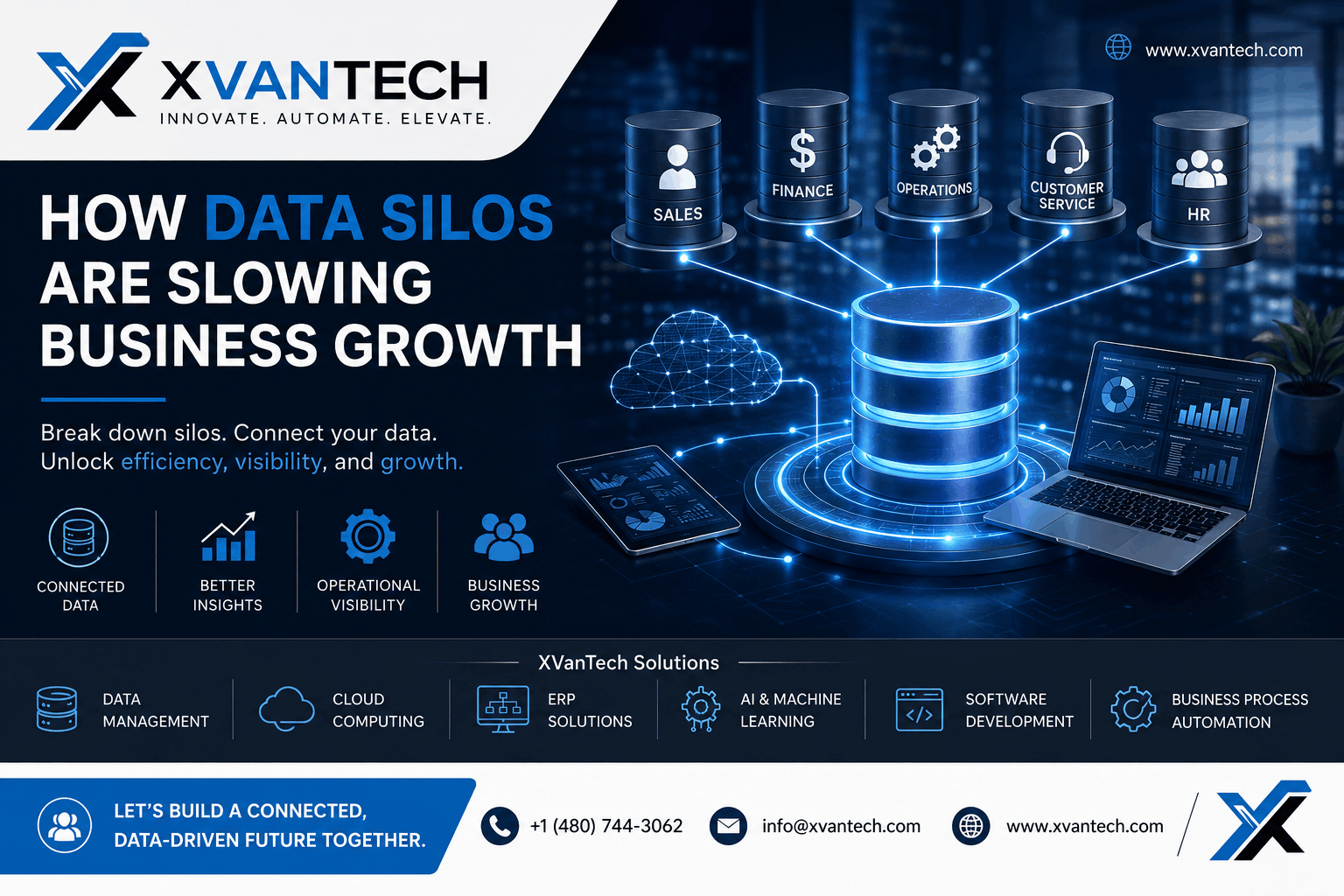
As businesses grow, they generate more data than ever before. Customer records, financial reports, sales information, inventory data, project updates, employee information, and operational metrics all become essential parts of daily decision-making.
In theory, more data should lead to better decisions.
In reality, many organizations struggle to use their data effectively because it is scattered across different systems, departments, spreadsheets, and software platforms. This problem is commonly known as data silos in business.
Data silos occur when information exists in separate locations and cannot be easily shared, accessed, or analyzed across the organization. While this may seem like a technical issue, the impact goes far beyond technology.
Data silos affect:
- Decision-making
- Operational efficiency
- Customer experience
- Financial reporting
- Business intelligence
- Automation initiatives
- Artificial intelligence projects
Many businesses do not realize they have a data silo problem until growth begins to slow. Teams start working with different versions of information. Reports produce conflicting results. Departments become disconnected. Leadership loses visibility into operations.
The result is often slower growth, increased costs, and reduced competitiveness.
Understanding how data silos form, why they damage business performance, and how organizations can eliminate them is becoming increasingly important for companies pursuing digital transformation and long-term scalability.
What Are Data Silos?
A data silo is a collection of information that exists in isolation from the rest of the organization.
Instead of being accessible across departments, systems, or teams, the information remains trapped within a specific application, database, or business unit.
For example:
- The finance team uses one system.
- Sales uses another platform.
- Operations manages spreadsheets.
- Customer support uses a separate database.
- HR relies on its own software.
Each department may have valuable information, but because the systems are disconnected, the business lacks a complete picture of what is happening.
Consider a growing company trying to answer a simple question:
Which customers generate the highest profit?
To answer this accurately, the organization may need:
- Sales data
- Customer service information
- Operational costs
- Financial reporting
- Project delivery data
If each department stores information separately, gathering a reliable answer becomes difficult and time-consuming.
This is one of the most common examples of data silos in business.
How Data Silos Develop
Most data silos are not created intentionally.
They develop gradually as businesses grow.
A company may start with only a few employees using simple tools. As operations expand, new software solutions are added to solve immediate problems.
Over time, organizations adopt:
- CRM systems
- Accounting software
- ERP platforms
- Inventory systems
- HR applications
- Marketing tools
- Customer support software
Each system generates valuable information.
However, if these systems are not integrated properly, information becomes fragmented.
Several factors contribute to the growth of data silos:
Rapid Business Growth
Companies often prioritize growth before infrastructure.
New systems are implemented quickly without considering long-term integration requirements.
Departmental Independence
Different teams frequently select tools that meet their specific needs without considering company-wide data sharing.
Legacy Systems
Older platforms may not integrate effectively with modern applications.
Spreadsheet Dependence
Many organizations continue using spreadsheets alongside enterprise software, creating multiple versions of the same information.
Poor Data Governance
Without clear data management policies, information becomes inconsistent and difficult to maintain.
As these issues accumulate, operational visibility decreases and decision-making becomes more challenging.
The Hidden Cost of Data Silos
One of the biggest problems with data silos is that their costs are rarely obvious.
Unlike equipment failures or revenue losses, data silos create gradual inefficiencies that build over time.
These hidden costs often include:
Slower Decision-Making
Leaders spend more time gathering information and less time acting on it.
Duplicate Work
Multiple teams collect, update, and verify the same information.
Reporting Delays
Creating reports becomes more complicated because information exists in multiple systems.
Increased Errors
Manually transferring information between systems introduces mistakes.
Reduced Productivity
Employees waste valuable time searching for data instead of performing high-value work.
Poor Customer Experience
Customer-facing teams lack access to complete information, resulting in inconsistent service.
These inefficiencies may seem small individually, but together they can significantly affect business performance.
How Data Silos Affect Finance Teams
Finance departments are often among the first to experience the consequences of data silos in business.
Accurate financial reporting depends on reliable information from multiple parts of the organization. Sales teams generate revenue data, operations teams track costs, procurement teams manage purchasing, and customer support teams influence retention and service-related expenses.
When this information exists across disconnected systems, finance teams face significant challenges.
For example, imagine a growing company where:
- Sales uses a CRM platform.
- Operations relies on spreadsheets.
- Inventory is managed separately.
- Accounting uses different software.
At the end of the month, the finance department must combine information from all these sources to create reports.
This process often leads to:
- Reporting delays
- Manual data entry
- Reconciliation issues
- Inconsistent financial information
- Increased risk of human error
Instead of focusing on strategic planning, finance teams spend valuable time gathering and validating information.
Over time, these inefficiencies affect forecasting, budgeting, and overall financial visibility.
This is why many organizations invest in centralized business systems and ERP solutions to improve financial accuracy and reduce operational friction.
How Data Silos Impact Customer Experience
Customer experience is another area where data silos create hidden problems.
Modern customers expect businesses to understand their needs, respond quickly, and provide consistent service across multiple channels.
However, this becomes difficult when customer information is fragmented across different systems.
Consider a typical example.
A customer contacts support regarding a recent purchase. The support representative may have access to service records but not billing information. The sales team may know the customer’s history but not recent support interactions.
As a result:
- Customers repeat information multiple times.
- Response times increase.
- Service quality becomes inconsistent.
- Frustration grows.
From the customer’s perspective, it appears that the business is disorganized.
From the organization’s perspective, the problem is often a lack of connected data.
Businesses that eliminate data silos gain a major advantage because teams can access complete customer information from a single source of truth.
This improves:
- Customer satisfaction
- Response speed
- Personalization
- Retention rates
- Operational efficiency
In competitive industries, these improvements can have a direct impact on revenue growth.
Why Data Silos Slow Decision-Making
Business leaders rely on accurate information to make effective decisions.
Unfortunately, data silos often create situations where different departments are working with different versions of reality.
A sales manager may see one number.
A finance manager may see another.
Operations may have a completely different view.
When leadership teams cannot trust the data they receive, decision-making slows down.
Instead of discussing strategy, meetings become focused on validating information.
Questions such as:
- Which report is correct?
- Why are these numbers different?
- Where did this data come from?
become common.
This creates decision latency.
Decision latency occurs when organizations take longer to make decisions because information is incomplete, inconsistent, or difficult to access.
In rapidly changing markets, slow decisions can become expensive.
Businesses that operate with connected data systems can respond more quickly because everyone is working from the same information.
This improves agility, responsiveness, and overall business performance.
Why AI and Automation Fail Without Connected Data
Many businesses are currently investing in artificial intelligence, automation, and advanced analytics.
However, one of the biggest misconceptions about AI is that it can solve poor data management.
The reality is exactly the opposite.
AI systems depend on:
- Accurate data
- Structured information
- Consistent reporting
- Connected workflows
When data silos exist, AI tools often produce unreliable results.
For example:
A company may implement an AI-powered forecasting system.
If inventory data is stored separately from sales data, and customer information is incomplete, the forecasts generated by the AI system will be flawed.
The same principle applies to:
- Business intelligence dashboards
- Automation platforms
- Predictive analytics
- Operational reporting systems
The phrase “garbage in, garbage out” remains true.
Organizations that want to maximize the value of AI must first eliminate data silos and improve data quality.
This is becoming increasingly important as businesses move toward AI-powered operations and intelligent business systems.
How ERP Systems and Cloud Infrastructure Eliminate Data Silos
One of the most effective ways to eliminate data silos in business is through system integration and centralized infrastructure.
As organizations grow, they often accumulate multiple software platforms that were implemented at different times to solve different problems. While each system may perform its intended function, the lack of connectivity between them creates operational challenges.
This is where ERP systems become valuable.
Enterprise Resource Planning (ERP) systems are designed to connect critical business functions into a single operational environment. Instead of maintaining separate systems for finance, inventory, procurement, reporting, and operations, organizations can centralize information and create a single source of truth.
When ERP systems are implemented correctly, businesses gain:
- Improved operational visibility
- Consistent reporting
- Better data accuracy
- Reduced manual work
- Faster decision-making
- Improved collaboration between departments
Cloud infrastructure further strengthens this approach.
Cloud-based platforms allow teams to access information from anywhere while ensuring that data remains synchronized across the organization.
For example, a sales team can update customer information in real time, while finance teams, operations managers, and customer support representatives all have access to the same information.
This eliminates duplicate records, reduces reporting delays, and improves overall efficiency.
The combination of ERP systems, cloud infrastructure, and strong data management practices creates a connected business environment where information flows freely across departments.
Building a Data-Driven Organization
Eliminating data silos is only the first step.
The ultimate goal is to become a data-driven organization.
A data-driven business uses reliable information to guide decisions, improve performance, and identify opportunities for growth.
Rather than relying on assumptions or fragmented reports, leadership teams can make decisions based on real-time operational intelligence.
Building a data-driven organization requires several key elements:
Centralized Data Management
Data should be accessible, accurate, and consistent across the business.
Standardized Processes
Teams should follow consistent workflows that improve data quality and reporting reliability.
Connected Systems
Business platforms should communicate with one another rather than operate independently.
Operational Visibility
Leadership teams need access to meaningful dashboards and reporting tools.
Data Governance
Organizations should establish clear policies for data ownership, quality, and security.
Businesses that successfully implement these practices often experience significant improvements in:
- Productivity
- Decision-making
- Customer service
- Financial performance
- Scalability
More importantly, they create a foundation for future technologies such as artificial intelligence, predictive analytics, and intelligent automation.
The Future of Connected Business Operations
The future of business operations is increasingly connected, intelligent, and data-driven.
Organizations are generating more information than ever before. At the same time, customer expectations continue to increase, competition becomes more intense, and operational complexity grows.
Businesses that continue operating with fragmented systems may find it increasingly difficult to compete.
Connected operations offer several advantages:
- Faster access to information
- Improved customer experiences
- Better operational visibility
- Enhanced collaboration
- More accurate forecasting
- Stronger scalability
Emerging technologies such as AI-powered analytics, intelligent automation, and predictive business intelligence will further increase the importance of connected data environments.
These technologies depend on high-quality data.
Organizations that eliminate data silos today will be better positioned to take advantage of tomorrow’s opportunities.
Final Thoughts
Data silos in business are often overlooked because they develop gradually over time.
However, their impact can be significant.
Disconnected systems create reporting delays, operational inefficiencies, inconsistent customer experiences, and slower decision-making. They also limit the effectiveness of automation, business intelligence, and artificial intelligence initiatives.
As businesses continue to grow, connected data becomes a strategic advantage.
Organizations that invest in centralized business systems, cloud infrastructure, ERP solutions, and strong data management practices gain greater visibility into operations and improve their ability to scale efficiently.
The goal is not simply to collect more data.
The goal is to ensure that the right information reaches the right people at the right time.
By eliminating data silos and building connected operational environments, businesses can improve efficiency, support innovation, and create a stronger foundation for long-term growth.
Ready to Break Down Data Silos?
If your organization is struggling with disconnected systems, inconsistent reporting, or limited operational visibility, addressing data silos should be a priority.
At XVanTech, we help businesses build connected operational environments through data management, ERP implementation, cloud infrastructure, software development, and AI-powered solutions.
Whether you’re looking to improve reporting, streamline workflows, or prepare your business for future growth, our team can help you create a scalable foundation built on connected data and operational intelligence.
Contact XVanTech today to learn how your business can eliminate data silos and unlock the full value of its information.

