
Artificial intelligence has rapidly evolved from simple chatbots into intelligent systems capable of supporting enterprise operations, automating workflows, and assisting with complex decision-making. However, one of the biggest challenges organizations face is ensuring that AI systems generate accurate, reliable, and up-to-date information based on their own business knowledge.
Traditional Large Language Models (LLMs) are trained on enormous amounts of public data, allowing them to answer a wide range of questions. While this makes them incredibly capable, it also introduces a significant limitation—they do not inherently understand your organization’s internal knowledge, policies, documentation, or real-time business information.
An AI model cannot accurately answer questions about your company’s products, procedures, pricing, contracts, customer records, or proprietary processes unless that information is made available during the interaction.
This is where Retrieval-Augmented Generation (RAG) transforms enterprise AI.
Rather than relying solely on what a language model learned during training, RAG enables AI systems to retrieve relevant information from trusted business knowledge sources before generating a response. This approach dramatically improves accuracy, reduces hallucinations, strengthens explainability, and allows organizations to leverage their own knowledge securely without retraining foundation models.
Today, Retrieval-Augmented Generation has become one of the foundational technologies behind enterprise AI assistants, intelligent search platforms, AI customer support systems, digital knowledge workers, and autonomous AI agents.
For organizations seeking to deploy AI responsibly at scale, understanding RAG is no longer optional it’s essential.
In this guide, we’ll explain how Retrieval-Augmented Generation works, why it has become the preferred architecture for enterprise AI, and how organizations can successfully implement it using the XVanTech Enterprise RAG Framework™.
What Is Retrieval-Augmented Generation (RAG)?
Retrieval-Augmented Generation (RAG) is an AI architecture that combines the reasoning capabilities of Large Language Models with real-time retrieval of trusted information from external knowledge sources.
Instead of asking an AI model to answer questions solely from its training data, RAG first retrieves the most relevant documents, policies, records, or knowledge from an organization’s information systems. The AI model then uses this retrieved context to generate an accurate and informed response.
In simple terms:
Traditional AI says:
“I’ll answer based on what I remember.”
RAG says:
“I’ll first look up the most relevant information, then answer using verified business knowledge.”
This seemingly simple change fundamentally transforms how enterprise AI systems operate.
Instead of depending on static knowledge that may be outdated or incomplete, organizations gain AI systems capable of accessing current information whenever a question is asked.
Why Traditional AI Models Are Not Enough
Large Language Models are remarkable at understanding language, generating text, summarizing information, and reasoning through problems.
However, they face several limitations within enterprise environments.
They Don’t Know Your Business
An LLM has no inherent understanding of:
- Internal company policies.
- Customer contracts.
- Product documentation.
- Employee handbooks.
- Standard Operating Procedures (SOPs).
- Pricing models.
- Internal knowledge bases.
- Project documentation.
- Meeting notes.
- Confidential business information.
Without access to this information, even the most advanced AI model cannot provide reliable business-specific answers.
Knowledge Becomes Outdated
Foundation models are trained on data available at a specific point in time.
Business information changes constantly.
Examples include:
- Product releases.
- Updated policies.
- Regulatory changes.
- New pricing.
- Inventory updates.
- Customer agreements.
- Technical documentation.
Retraining an LLM every time organizational knowledge changes is expensive, time-consuming, and impractical.
Hallucinations Create Business Risk
One of the most widely discussed limitations of LLMs is hallucination—the generation of incorrect or fabricated information presented with confidence.
In enterprise environments, hallucinations can result in:
- Incorrect customer advice.
- Compliance violations.
- Operational mistakes.
- Financial losses.
- Poor decision-making.
- Damage to organizational trust.
RAG significantly reduces these risks by grounding AI responses in verified business knowledge.
Why RAG Matters for Modern Enterprises
Enterprise AI should not simply produce impressive answers—it should produce trustworthy answers.
That distinction is critical.
Organizations adopting AI expect systems to:
- Access current documentation.
- Follow internal policies.
- Understand company terminology.
- Reference approved procedures.
- Protect sensitive information.
- Deliver consistent responses.
- Support regulatory compliance.
RAG enables these capabilities without requiring organizations to retrain foundation models.
Instead, AI retrieves trusted knowledge directly from enterprise systems whenever information is needed.
The result is faster implementation, improved scalability, lower costs, and significantly higher confidence in AI-generated outputs.
How Retrieval-Augmented Generation Works
Although the underlying technology is sophisticated, the overall workflow follows a straightforward process.
Step 1 – User Asks a Question
For example:
“What is our travel reimbursement policy for international employees?”
Step 2 – Intelligent Retrieval
Instead of immediately generating an answer, the AI searches relevant enterprise knowledge sources, including:
- HR documentation.
- Company policies.
- Employee handbook.
- Internal knowledge base.
- SharePoint.
- Document management systems.
The system identifies the most relevant content related to the user’s request.
Step 3 – Context Is Added
The retrieved information is provided to the Large Language Model as contextual information.
Rather than relying solely on pre-trained knowledge, the AI now has access to the organization’s verified documentation.
Step 4 – Response Generation
The LLM combines:
- User intent.
- Retrieved enterprise knowledge.
- Language understanding.
- Reasoning capabilities.
The result is a response grounded in trusted business information.
Step 5 – Explainable Answers
Many enterprise RAG systems also reference the source documents used to generate responses.
This improves:
- Transparency.
- Trust.
- Verification.
- Regulatory compliance.
Employees can immediately see where the answer originated instead of relying on unsupported AI outputs.
Retrieval-Augmented Generation vs Traditional Large Language Models
Although both approaches use powerful language models, their capabilities differ significantly.
| Traditional LLM | Retrieval-Augmented Generation |
|---|---|
| Uses pre-trained knowledge | Uses real-time enterprise knowledge |
| Limited awareness of company information | Accesses internal business documents |
| Knowledge becomes outdated | Always retrieves current information |
| Greater risk of hallucinations | Lower hallucination risk |
| Difficult to verify responses | Responses can reference source documents |
| Requires retraining for new knowledge | Simply update the knowledge base |
| Limited personalization | Context-aware enterprise responses |
For enterprise organizations, these differences are substantial.
Rather than replacing language models, RAG enhances them by connecting AI reasoning with trusted organizational knowledge.
Retrieval-Augmented Generation vs Fine-Tuning
A common misconception is that organizations should fine-tune a language model using their company data.
While fine-tuning has specific use cases, it solves a different problem than RAG.
Fine-Tuning
Fine-tuning modifies a model’s behavior by training it on additional datasets.
It is useful when organizations need to:
- Adapt writing style.
- Improve domain-specific language.
- Follow specialized terminology.
- Standardize response formats.
However, fine-tuning does not continuously update business knowledge.
If company policies change tomorrow, the model remains unaware until it is retrained.
Retrieval-Augmented Generation
RAG leaves the underlying model unchanged.
Instead, it retrieves current business information whenever a request is made.
Organizations simply update their knowledge sources.
The AI immediately benefits from the latest information without retraining.
Which Approach Is Better?
The answer depends on the objective.
Fine-tuning changes how the model communicates.
Retrieval-Augmented Generation changes what the model knows during each interaction.
For most enterprise knowledge applications, RAG offers greater flexibility, lower costs, easier maintenance, and improved scalability.
Many mature enterprise AI systems combine both techniques—using fine-tuning to optimize behavior and RAG to deliver accurate, up-to-date knowledge.
Benefits of Retrieval-Augmented Generation
Organizations implementing enterprise RAG typically experience benefits across multiple business areas.
Higher Accuracy
Responses are based on trusted company knowledge rather than assumptions.
Reduced Hallucinations
Grounding AI in verified documentation significantly reduces fabricated or misleading information.
Real-Time Knowledge
As business documents change, AI responses automatically reflect updated information without retraining.
Stronger Compliance
AI systems can reference approved policies, regulatory documentation, and governance standards during every interaction.
Improved Employee Productivity
Employees spend less time searching for information and more time applying it.
Better Customer Experiences
Customer-facing AI systems provide faster, more consistent, and more accurate responses based on current product information and policies.
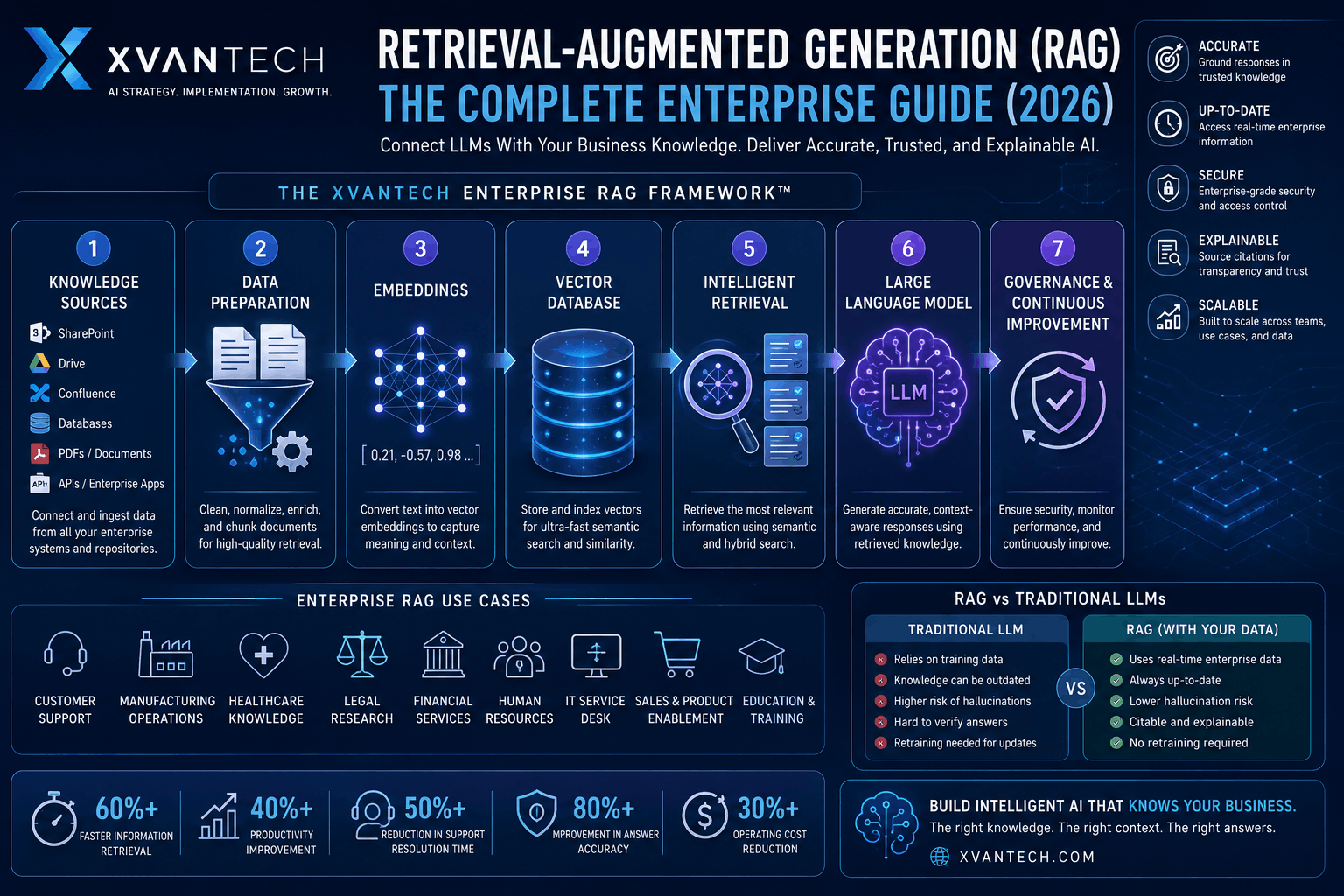
The XVanTech Enterprise RAG Framework™
Successful enterprise RAG implementation requires much more than connecting a chatbot to a collection of documents.
Organizations need a structured architecture that ensures knowledge quality, security, governance, scalability, and long-term maintainability.
The XVanTech Enterprise RAG Framework™ provides a practical methodology for building enterprise knowledge systems that support trustworthy AI at scale.
The framework consists of seven interconnected components.
1. Knowledge Sources
Every successful RAG implementation begins with high-quality enterprise knowledge.
Typical sources include:
- Standard Operating Procedures (SOPs)
- Employee handbooks
- Product documentation
- Customer support articles
- Technical manuals
- CRM systems
- ERP platforms
- Internal Wikis
- Policies and procedures
- Regulatory documentation
The quality of AI responses depends directly on the quality of these knowledge sources.
2. Data Preparation
Enterprise information rarely exists in a format suitable for AI retrieval.
Documents must be:
- Cleaned.
- Standardized.
- Organized.
- Deduplicated.
- Structured.
- Classified.
- Updated.
High-quality preparation ensures consistent retrieval and more accurate responses.
3. Embeddings
Documents are converted into mathematical representations known as embeddings, allowing AI systems to understand semantic meaning rather than relying solely on exact keyword matches.
This enables the system to retrieve relevant information even when users phrase questions differently from the original documentation.
4. Vector Database
Embeddings are stored inside a vector database that supports fast semantic search across large collections of enterprise knowledge.
Rather than scanning documents one by one, the AI retrieves the most relevant information in milliseconds.
5. Intelligent Retrieval
When users ask questions, the retrieval engine searches the vector database and identifies the most relevant knowledge based on meaning, context, and intent.
Only the most useful information is passed to the language model.
6. Large Language Model
The LLM combines:
- User intent.
- Retrieved enterprise knowledge.
- Context.
- Reasoning.
It then generates a natural, conversational response grounded in verified business information.
7. Governance & Continuous Improvement
Enterprise RAG systems should continuously monitor:
- Knowledge quality.
- Retrieval accuracy.
- User satisfaction.
- Security.
- Compliance.
- Performance.
- Business outcomes.
Regular optimization ensures the knowledge ecosystem remains reliable as organizational information evolves.
Together, these seven components create a scalable architecture that enables organizations to build AI systems that are not only intelligent, but also accurate, trustworthy, secure, and aligned with business objectives.
Building an Enterprise RAG System
Retrieval-Augmented Generation is much more than connecting a language model to a collection of documents. High-performing enterprise RAG systems require carefully designed architectures that retrieve the right information, provide it to the AI model efficiently, and continuously improve over time.
Organizations that invest in a robust RAG architecture benefit from higher accuracy, faster responses, stronger security, and lower operational costs.
This section explores the core technical components that power enterprise-grade Retrieval-Augmented Generation.
Enterprise RAG Architecture
Every enterprise RAG system follows a similar information flow.
User Question
↓
Query Understanding
↓
Knowledge Retrieval
↓
Relevant Context Selection
↓
Large Language Model (LLM)
↓
Response Generation
↓
Source Attribution & Monitoring
Although the workflow appears simple, each stage plays a critical role in determining the quality of AI responses.
Step 1 – Knowledge Ingestion
Before AI can retrieve information, enterprise knowledge must first be collected from multiple sources.
Typical enterprise knowledge repositories include:
- Microsoft SharePoint
- Google Drive
- Confluence
- Notion
- CRM systems
- ERP platforms
- Product documentation
- Standard Operating Procedures (SOPs)
- Employee handbooks
- Technical manuals
- PDFs
- Emails
- Internal Wikis
- Customer support articles
- Knowledge portals
One of the greatest advantages of RAG is that organizations do not need to move all information into a single database.
Instead, enterprise connectors continuously synchronize knowledge from existing systems.
This allows AI to access current business information while preserving existing workflows.
Step 2 – Data Cleaning & Preparation
Enterprise data is rarely AI-ready.
Documents often contain:
- Duplicate content.
- Outdated versions.
- Formatting inconsistencies.
- Broken tables.
- Scanned PDFs.
- Missing metadata.
- Irrelevant information.
Before indexing, organizations should:
- Remove duplicate files.
- Standardize formatting.
- Correct OCR errors.
- Classify documents.
- Remove obsolete content.
- Define ownership.
- Tag sensitive information.
Poor knowledge quality directly reduces AI accuracy.
One of the most common reasons enterprise AI projects underperform is not because of weak AI models, but because of poorly managed business data.
Step 3 – Document Chunking
Large Language Models cannot efficiently process hundreds of pages simultaneously.
Instead, documents are divided into smaller sections called chunks.
Chunking allows AI systems to retrieve only the information relevant to a user’s question.
For example, a 300-page employee handbook might become hundreds of searchable chunks.
Rather than retrieving the entire handbook, the system retrieves only the section discussing annual leave, travel reimbursement, or remote work policies.
Chunking Strategies
Different business documents require different chunking methods.
Fixed-Length Chunking
Documents are divided into equal-sized sections.
Advantages:
- Simple implementation.
- Fast indexing.
- Predictable processing.
Disadvantages:
- May separate related information.
- Context can be lost between chunks.
Semantic Chunking
Instead of splitting by length, semantic chunking groups information based on meaning.
Entire concepts remain together.
Benefits include:
- Better retrieval quality.
- Improved context.
- Higher response accuracy.
Semantic chunking has become the preferred approach for enterprise knowledge systems.
Hierarchical Chunking
Large documents are divided into sections, subsections, and paragraphs while preserving document structure.
This works particularly well for:
- Legal documents.
- Technical manuals.
- Product documentation.
- Policies.
- Research papers.
Hierarchical chunking maintains relationships between different sections of information.
Step 4 – Embeddings
Once documents are prepared and chunked, they are converted into numerical representations called embeddings.
Embeddings allow computers to understand semantic meaning rather than exact words.
Consider these questions:
“How many vacation days do employees receive?”
and
“What is our annual leave policy?”
Although the wording differs, the intent is identical.
Traditional keyword search may struggle to connect these queries.
Embedding models recognize their semantic similarity and retrieve the same relevant documentation.
This dramatically improves search quality.
Understanding Semantic Search
Traditional enterprise search relies heavily on keyword matching.
If a user searches for:
“Laptop reimbursement”
the system may miss documents titled:
“Technology Equipment Allowance.”
Semantic search understands concepts rather than exact words.
This enables AI systems to retrieve information based on intent, context, and meaning.
Benefits include:
- Better search accuracy.
- Improved employee experience.
- Reduced dependency on exact terminology.
- Higher-quality AI responses.
Semantic search is one of the defining advantages of enterprise RAG.
Step 5 – Vector Databases
After embeddings are created, they must be stored efficiently.
This is the role of a vector database.
Unlike traditional relational databases that organize rows and columns, vector databases organize mathematical representations of information.
This allows enterprise AI systems to search millions of documents in milliseconds.
Popular enterprise vector databases include:
- Pinecone
- Weaviate
- Milvus
- Qdrant
- Chroma
- pgvector (PostgreSQL)
The choice depends on scalability requirements, infrastructure preferences, security policies, and integration needs.
Metadata: The Hidden Power of RAG
Many organizations focus only on document content.
However, metadata significantly improves retrieval quality.
Examples include:
- Department.
- Author.
- Creation date.
- Last updated.
- Security classification.
- Document type.
- Region.
- Product category.
- Language.
- Approval status.
Imagine an employee asking:
“Show me the latest travel policy.”
Without metadata, AI might retrieve an outdated document.
With metadata filtering, the system retrieves only the newest approved version.
Metadata improves accuracy while supporting governance and compliance.
Hybrid Search
The most effective enterprise RAG systems combine multiple search methods.
This is known as hybrid search.
Hybrid search combines:
Keyword Search
Excellent for:
- Product codes.
- Invoice numbers.
- Employee IDs.
- Policy numbers.
- Exact terminology.
Semantic Search
Excellent for:
- Natural language.
- Conceptual questions.
- Similar meanings.
- Contextual understanding.
Together, these approaches produce significantly better retrieval accuracy than either method alone.
Retrieval Pipelines
Knowledge retrieval involves much more than searching documents.
Enterprise retrieval pipelines typically perform several steps.
Query Understanding
The system analyzes user intent.
Query Expansion
Additional related terms improve search quality.
For example:
“Vacation”
may also search for:
- Annual leave
- Paid leave
- Time off
- Holiday policy
Retrieval
Relevant document chunks are identified.
Ranking
The most useful information is prioritized.
Filtering
Security rules determine which documents users may access.
Context Assembly
The highest-quality information is combined before being passed to the language model.
Each stage improves response quality while reducing unnecessary information.
Enterprise Security in RAG
Because enterprise knowledge often contains confidential information, security must be built into every layer of the RAG architecture.
Organizations should implement:
- Role-Based Access Control (RBAC).
- Single Sign-On (SSO).
- Multi-Factor Authentication (MFA).
- Encryption at rest and in transit.
- Secure API authentication.
- Audit logging.
- Data masking.
- Document-level permissions.
- User authentication.
- Continuous monitoring.
AI should never retrieve information users are not authorized to access.
Strong access controls are essential for protecting sensitive business data.
Multi-Tenant Enterprise RAG
Organizations serving multiple customers—such as SaaS providers, managed service providers, and consulting firms—often require multi-tenant RAG architectures.
In these environments, each customer’s knowledge must remain completely isolated.
For example:
Customer A’s AI assistant should never retrieve documents belonging to Customer B.
Multi-tenant architectures use:
- Tenant isolation.
- Separate indexes.
- Access policies.
- Namespace separation.
- Dedicated encryption.
- Permission-based retrieval.
These safeguards help maintain confidentiality and build trust.
The XVanTech Enterprise RAG Maturity Model™
Organizations typically progress through four stages as they adopt Retrieval-Augmented Generation.
Level 1 – Experimental
Characteristics:
- Small document collections.
- Manual uploads.
- Basic chatbot.
- Limited governance.
- No integrations.
Level 2 – Operational
Characteristics:
- Centralized knowledge base.
- Vector database.
- Department-level deployments.
- Basic security.
- Improved retrieval accuracy.
Level 3 – Enterprise
Characteristics:
- Organization-wide knowledge.
- Multiple data sources.
- Semantic search.
- Hybrid retrieval.
- Governance framework.
- Enterprise monitoring.
- API integrations.
Level 4 – Intelligent Knowledge Ecosystem
Characteristics:
- Real-time knowledge synchronization.
- Multi-agent collaboration.
- Continuous optimization.
- Automated indexing.
- Predictive knowledge delivery.
- Enterprise analytics.
- Advanced governance.
- AI-driven knowledge management.
Organizations should treat this maturity model as a roadmap for long-term capability building rather than a checklist to complete immediately.
Best Practices for Enterprise RAG
Organizations implementing Retrieval-Augmented Generation should follow several guiding principles:
- Begin with a well-defined business use case rather than indexing every document.
- Establish data ownership and governance before ingesting knowledge.
- Keep documentation accurate, current, and version controlled.
- Use semantic chunking where possible to preserve context.
- Combine semantic and keyword search through hybrid retrieval.
- Enforce strict access controls to protect confidential information.
- Monitor retrieval accuracy and user feedback continuously.
- Measure success using business outcomes, not only technical metrics.
Successful RAG systems are not defined by the size of their knowledge base but by their ability to deliver accurate, relevant, and trustworthy information at the moment it is needed.
Enterprise RAG Use Cases
Retrieval-Augmented Generation is no longer an experimental technology reserved for AI research labs. It has become one of the most practical and valuable enterprise AI architectures because it enables organizations to combine the reasoning capabilities of Large Language Models with trusted business knowledge.
Rather than asking employees to search through hundreds of documents or depend on institutional knowledge, enterprise RAG systems deliver accurate answers in seconds while maintaining security, governance, and explainability.
The most successful organizations don’t deploy RAG simply to answer questions—they use it to improve productivity, accelerate decision-making, enhance customer experiences, and reduce operational costs.
Customer Support Knowledge Assistants
Customer service departments often manage thousands of support articles, troubleshooting guides, warranty policies, FAQs, and product manuals.
Finding the correct information quickly can be difficult, particularly for new employees.
Enterprise RAG transforms customer support by providing AI systems with instant access to verified knowledge.
Enterprise Use Cases
A Customer Support Knowledge Assistant can:
- Retrieve troubleshooting procedures.
- Explain warranty policies.
- Access product documentation.
- Guide customers through technical issues.
- Recommend appropriate support articles.
- Summarize previous customer interactions.
- Provide multilingual support.
- Escalate unresolved cases.
Because responses are generated from approved documentation, customers receive more accurate and consistent information.
Case Study – Electronics Manufacturer
Challenge
Support agents spent excessive time searching product manuals while customers waited.
Documentation existed across multiple systems, leading to inconsistent responses.
Enterprise RAG Solution
The organization centralized:
- Product manuals.
- Warranty documentation.
- Repair procedures.
- Technical bulletins.
- Frequently asked questions.
The AI assistant retrieved relevant documentation before generating responses.
Business Results
- Faster response times.
- Improved first-contact resolution.
- Reduced employee training time.
- Higher customer satisfaction.
- Greater consistency across support teams.
Manufacturing Knowledge Systems
Manufacturing companies generate enormous volumes of technical documentation.
Examples include:
- Machine specifications.
- Maintenance manuals.
- Safety procedures.
- Quality standards.
- Production documentation.
- Equipment troubleshooting guides.
Traditional search often makes finding the correct document difficult.
Enterprise RAG enables engineers and technicians to access relevant knowledge instantly.
Manufacturing Example
An engineer asks:
“Why is Machine 14 displaying Error Code E-203?”
Instead of searching hundreds of PDF manuals, the AI assistant retrieves:
- Equipment documentation.
- Maintenance history.
- Known failure patterns.
- Previous repairs.
- Manufacturer recommendations.
The engineer receives contextual guidance within seconds.
Healthcare Knowledge Retrieval
Healthcare organizations rely on continuously evolving medical knowledge.
Doctors, nurses, and administrators require access to:
- Clinical guidelines.
- Treatment protocols.
- Hospital procedures.
- Medical documentation.
- Insurance policies.
- Patient education materials.
Enterprise RAG enables healthcare professionals to retrieve trusted information quickly while maintaining appropriate security controls.
Importantly, RAG supports clinical decision-making but does not replace professional medical judgment.
Healthcare Example
A clinician asks:
“What is our current protocol for post-operative infection monitoring?”
The AI retrieves the latest approved hospital policy rather than relying on outdated training data.
This improves consistency while supporting evidence-based care.
Legal Knowledge Assistants
Legal professionals work with extensive collections of:
- Contracts.
- Regulations.
- Compliance documentation.
- Case summaries.
- Corporate policies.
- Internal legal guidance.
Enterprise RAG dramatically reduces research time.
Enterprise Applications
Legal assistants can:
- Summarize contracts.
- Locate relevant clauses.
- Compare document versions.
- Retrieve compliance requirements.
- Explain regulatory changes.
- Search internal legal precedents.
Human lawyers remain responsible for legal interpretation and final decisions.
Financial Services Knowledge Systems
Financial institutions operate in highly regulated environments where policies change frequently.
Enterprise RAG helps employees retrieve:
- Compliance procedures.
- Lending policies.
- Risk management guidelines.
- Internal controls.
- Regulatory documentation.
- Investment policies.
Because responses are based on approved documentation, organizations reduce operational risk while improving consistency.
Human Resources Knowledge Assistants
HR teams receive repetitive questions every day.
Employees frequently ask about:
- Leave policies.
- Benefits.
- Travel reimbursement.
- Remote work.
- Performance reviews.
- Payroll.
- Learning programs.
Instead of manually answering every request, HR assistants powered by RAG retrieve current company policies instantly.
Employees receive faster answers while HR professionals focus on strategic initiatives.
IT Service Desk Knowledge Systems
Enterprise IT departments manage thousands of technical documents.
Examples include:
- Configuration guides.
- Security procedures.
- Network documentation.
- Password policies.
- Software manuals.
- Troubleshooting articles.
Enterprise RAG enables service desk agents to resolve incidents faster by retrieving relevant technical knowledge during each interaction.
IT Case Study
Challenge
Support engineers spent valuable time searching internal documentation.
Knowledge existed across SharePoint, Confluence, PDFs, and legacy systems.
Enterprise RAG Solution
The organization built a centralized enterprise knowledge platform using Retrieval-Augmented Generation.
The AI assistant retrieved relevant documentation regardless of where it was originally stored.
Results
- Faster incident resolution.
- Reduced ticket escalation.
- Improved employee productivity.
- Better documentation utilization.
The XVanTech Enterprise RAG Decision Matrix™
Not every knowledge problem requires a Retrieval-Augmented Generation solution.
Organizations should evaluate potential projects using four business criteria.
Business Impact
Ask:
Will improving knowledge access significantly affect:
- Revenue?
- Productivity?
- Customer satisfaction?
- Compliance?
- Operational efficiency?
High-impact opportunities should receive priority.
Knowledge Quality
Successful RAG depends on trusted information.
Organizations should assess:
- Accuracy.
- Completeness.
- Document ownership.
- Update frequency.
- Version control.
Poor knowledge produces poor AI.
User Demand
Organizations should identify areas where employees repeatedly search for information.
Examples include:
- Customer support.
- HR.
- Legal.
- IT.
- Operations.
- Finance.
High-demand knowledge delivers the fastest return on investment.
Governance Requirements
Sensitive information requires stronger controls.
Organizations should evaluate:
- Privacy.
- Compliance.
- Security.
- Access permissions.
- Audit requirements.
The greater the sensitivity, the stronger the governance should be.
Common Enterprise RAG Implementation Mistakes
Many organizations assume that uploading documents into an AI tool automatically creates an effective knowledge assistant.
In reality, successful RAG implementations require thoughtful planning.
Common mistakes include:
- Uploading outdated documentation.
- Ignoring document ownership.
- Poor chunking strategies.
- Weak metadata.
- No access controls.
- Lack of governance.
- No monitoring.
- Choosing technology before defining business objectives.
- Failing to measure business outcomes.
- Expecting AI to compensate for poor knowledge management.
Technology cannot solve disorganized information.
Knowledge quality remains the foundation of enterprise RAG.
Governance for Enterprise RAG
Enterprise knowledge systems require the same governance discipline applied to other critical business systems.
Organizations should establish policies for:
- Document ownership.
- Knowledge review cycles.
- Version control.
- Security classifications.
- User permissions.
- Audit logging.
- Data retention.
- Regulatory compliance.
- AI usage guidelines.
Governance ensures AI retrieves approved information while protecting sensitive organizational knowledge.
Measuring the Business Value of RAG
Enterprise leaders should evaluate Retrieval-Augmented Generation using measurable business outcomes rather than technical metrics alone.
Operational KPIs
- Knowledge retrieval accuracy.
- Average search time.
- Employee productivity.
- First-answer resolution.
- Ticket deflection rate.
- Time saved per employee.
Customer Experience KPIs
- Customer Satisfaction (CSAT).
- First-contact resolution.
- Average handling time.
- Response consistency.
- Self-service adoption.
Financial KPIs
- Support cost reduction.
- Reduced training costs.
- Faster employee onboarding.
- Productivity improvements.
- Return on Investment (ROI).
- Operational efficiency gains.
Governance KPIs
- Document freshness.
- Compliance adherence.
- Security incidents.
- Unauthorized access attempts.
- Knowledge coverage.
- Audit completion rates.
Organizations that consistently monitor these indicators are better positioned to refine their knowledge systems and maximize long-term value.
RAG as the Foundation of Enterprise AI
Many organizations initially view Retrieval-Augmented Generation as a search enhancement technology.
In reality, RAG is much more.
It provides the trusted knowledge layer that powers:
- Enterprise AI assistants.
- AI agents.
- Customer support automation.
- Intelligent search.
- Knowledge management platforms.
- Executive decision support.
- Workflow automation.
- Digital employees.
Without reliable knowledge retrieval, even the most advanced AI models struggle to deliver consistent business value.
As enterprise AI adoption accelerates, Retrieval-Augmented Generation is becoming the foundation upon which intelligent, secure, and trustworthy AI ecosystems are built.
XVanTech 90-Day Enterprise RAG Implementation Roadmap™
Implementing Retrieval-Augmented Generation is not simply about deploying a vector database or connecting a Large Language Model to company documents. Successful enterprise RAG initiatives require strategic planning, disciplined knowledge management, governance, and continuous optimization.
The XVanTech 90-Day Enterprise RAG Implementation Roadmap™ provides a structured approach that minimizes risk while maximizing long-term business value.
Phase 1 (Days 1–30): Assess & Prepare
The first month should focus on understanding your organization’s knowledge ecosystem rather than implementing technology.
Many RAG projects struggle because organizations attempt to ingest every document without first evaluating quality, ownership, or business relevance.
Objectives
- Identify high-value business use cases.
- Audit existing knowledge repositories.
- Define document ownership.
- Remove outdated or duplicate content.
- Establish governance policies.
- Assess security requirements.
- Define business KPIs.
Deliverables
- Enterprise knowledge audit.
- Prioritized RAG use cases.
- Governance framework.
- Data quality assessment.
- Security requirements.
- Success metrics.
A strong foundation significantly improves retrieval accuracy and long-term maintainability.
Phase 2 (Days 31–60): Build & Validate
Once the knowledge foundation has been established, organizations can begin developing a pilot RAG solution.
Rather than attempting enterprise-wide deployment immediately, organizations should focus on one department or business process.
Recommended pilot projects include:
- Internal knowledge assistant.
- HR policy assistant.
- Customer support knowledge base.
- IT service desk assistant.
- Product documentation assistant.
- Legal document search.
Activities
- Prepare and chunk documents.
- Generate embeddings.
- Build the vector database.
- Configure semantic search.
- Integrate the Large Language Model.
- Test retrieval accuracy.
- Validate security permissions.
- Collect employee feedback.
Success should be measured using both technical performance and business outcomes.
Phase 3 (Days 61–90): Scale & Optimize
After validating the pilot, organizations can gradually expand the RAG platform across departments.
Areas of focus include:
- Integrating additional knowledge sources.
- Automating document synchronization.
- Improving metadata quality.
- Implementing hybrid search.
- Expanding security controls.
- Monitoring user adoption.
- Measuring ROI.
Expected Outcomes
- Improved knowledge accessibility.
- Faster employee decision-making.
- Reduced support workloads.
- Better customer experiences.
- Increased productivity.
- Stronger organizational trust in AI.
The XVanTech Enterprise RAG Scorecard™
Enterprise RAG systems should be evaluated regularly to ensure they continue delivering measurable business value.
| Category | Assessment Question |
|---|---|
| Business Strategy | Are RAG initiatives aligned with business objectives? |
| Knowledge Quality | Is enterprise knowledge accurate, current, and complete? |
| Data Governance | Are document ownership and lifecycle management clearly defined? |
| Retrieval Accuracy | Are users consistently receiving relevant information? |
| Security | Are access controls protecting sensitive knowledge? |
| Technology | Are vector databases and integrations performing efficiently? |
| User Adoption | Are employees actively using the system? |
| Compliance | Does the platform support regulatory requirements? |
| Analytics | Are usage patterns and KPIs continuously monitored? |
| Continuous Improvement | Is feedback driving ongoing optimization? |
Organizations should review this scorecard regularly as knowledge repositories and business requirements evolve.
Key Performance Indicators (KPIs)
Measuring Retrieval-Augmented Generation success requires more than evaluating AI response quality.
Enterprise leaders should focus on business impact.
Knowledge KPIs
- Retrieval accuracy.
- Knowledge coverage.
- Document freshness.
- Source citation accuracy.
- Search success rate.
Operational KPIs
- Average search time.
- Employee productivity.
- Ticket deflection.
- Time saved.
- First-answer resolution.
- Reduced manual research.
Customer Experience KPIs
- Customer Satisfaction (CSAT).
- First-contact resolution.
- Response consistency.
- Self-service adoption.
- Average handling time.
Financial KPIs
- Cost reduction.
- Training cost savings.
- Reduced onboarding time.
- Increased operational efficiency.
- Return on Investment (ROI).
Governance KPIs
- Document review completion.
- Security incidents.
- Unauthorized access attempts.
- Compliance audit success.
- Knowledge ownership coverage.
These metrics help organizations demonstrate that RAG contributes directly to measurable business outcomes rather than simply improving technical capabilities.
The Future of Enterprise RAG
Retrieval-Augmented Generation continues to evolve rapidly alongside advances in artificial intelligence.
Several emerging trends will shape the future of enterprise knowledge management.
Real-Time Knowledge Synchronization
Future RAG platforms will continuously synchronize enterprise knowledge as documents are created, updated, or archived.
Instead of scheduled indexing, AI systems will access the latest approved information almost instantly.
Multimodal RAG
Enterprise knowledge extends far beyond text documents.
Modern RAG systems are increasingly capable of retrieving and understanding:
- Images.
- Engineering drawings.
- Videos.
- Audio recordings.
- Presentations.
- Diagrams.
- Scanned documents.
This enables AI to answer questions using a much broader range of organizational knowledge.
Agentic RAG
The next evolution combines Retrieval-Augmented Generation with autonomous AI agents.
Instead of simply answering questions, AI agents will retrieve information, make informed decisions, execute business workflows, and request human approval when required.
This combination will power intelligent digital workers capable of handling increasingly sophisticated enterprise processes.
Graph RAG
Many organizations are adopting Graph RAG, which combines knowledge graphs with Retrieval-Augmented Generation.
Unlike traditional document retrieval, Graph RAG understands relationships between people, products, departments, policies, and business processes.
This enables AI systems to provide richer, more contextual responses for complex enterprise questions.
Personalized Enterprise Knowledge
Future RAG systems will tailor responses based on:
- User role.
- Department.
- Geographic location.
- Permissions.
- Previous interactions.
- Business context.
Employees will receive information that is both relevant and appropriate for their responsibilities.
Frequently Asked Questions
What is Retrieval-Augmented Generation (RAG)?
Retrieval-Augmented Generation is an AI architecture that enhances Large Language Models by retrieving relevant information from trusted external knowledge sources before generating a response. This enables AI systems to provide more accurate, current, and context-aware answers.
Does RAG replace Large Language Models?
No. RAG complements Large Language Models rather than replacing them. The language model provides reasoning and natural language generation, while RAG supplies current, organization-specific knowledge.
Is RAG better than fine-tuning?
They solve different problems.
Fine-tuning changes how a model behaves or communicates.
RAG changes what information the model can access during each interaction.
Many enterprise AI solutions combine both techniques for optimal results.
Which industries benefit most from RAG?
Organizations across manufacturing, healthcare, financial services, legal, retail, government, education, logistics, and professional services can benefit from Retrieval-Augmented Generation. Any business that relies on large volumes of documentation or knowledge can improve efficiency and decision-making with RAG.
What is the biggest challenge when implementing RAG?
The greatest challenge is rarely the AI technology itself. It is ensuring that enterprise knowledge is accurate, well-organized, properly governed, and continuously maintained. High-quality knowledge is the foundation of every successful RAG implementation.
Conclusion
Retrieval-Augmented Generation has become one of the most important building blocks of modern enterprise AI. By combining the reasoning capabilities of Large Language Models with trusted organizational knowledge, RAG enables businesses to deliver accurate, explainable, and secure AI experiences without the need for constant model retraining.
However, successful implementation requires more than choosing the right technology. Organizations must invest in knowledge quality, governance, security, and continuous improvement to ensure AI systems remain reliable as business information evolves.
The XVanTech Enterprise RAG Framework™ provides a practical roadmap for building scalable, enterprise-grade knowledge systems that support intelligent AI assistants, autonomous AI agents, customer service platforms, and decision-support applications. When implemented effectively, RAG reduces hallucinations, improves productivity, accelerates decision-making, and strengthens organizational trust in AI.
As enterprises continue to adopt AI at scale, those that build a strong knowledge foundation today will be best positioned to unlock the full potential of intelligent automation and data-driven innovation.

