


Introduction
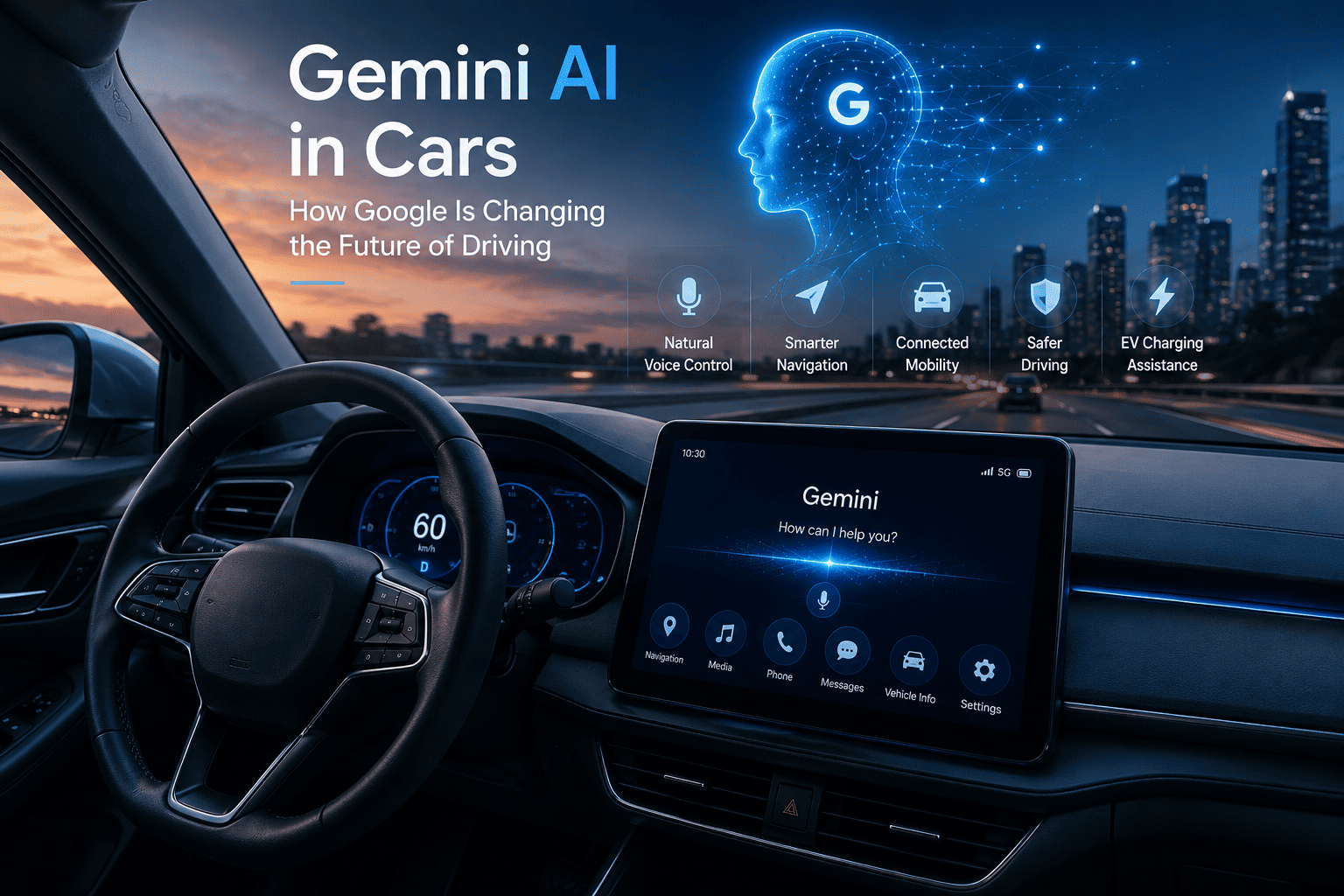
Gemini AI in cars is Google’s move toward making vehicles smarter, more conversational, and easier to use. Instead of depending on fixed voice commands or touchscreen menus, drivers can speak naturally to manage navigation, messages, music, vehicle information, and connected services.
Google has started bringing Gemini into cars with Google built-in, replacing Google Assistant in supported vehicles. The update is designed to help drivers interact with their cars in a more natural and useful way.
This matters because cars are no longer just mechanical products. They are becoming software-driven digital spaces. Drivers now expect their vehicles to connect with apps, understand their needs, support safer interaction, and improve over time through updates.
For businesses, automakers, software companies, and everyday drivers, Gemini AI in cars is a clear sign of where mobility is heading: smarter vehicles, better user experiences, and more connected digital services.
What Is Gemini AI in Cars?
Gemini AI in cars refers to Google’s integration of its Gemini artificial intelligence assistant into vehicles that support Google built-in and Android automotive experiences.
In simple terms, it allows drivers to talk to their car more naturally.
Instead of saying a short command like:
“Navigate to nearest gas station.”
A driver may be able to say:
“I’m low on fuel and need a quick stop before my next meeting.”
Gemini can understand the request, consider the context, and help the driver take action.
It can support tasks such as:
- Finding destinations
- Sending or summarizing messages
- Playing music
- Answering vehicle-related questions
- Helping with settings or features
- Finding fuel or charging stations
- Providing information from the car’s manual
This makes the vehicle feel less like a machine that only follows commands and more like a smart assistant built into the driving experience.
For example, a driver could ask:
- “What does this warning light mean?”
- “How do I prepare my car for a car wash?”
- “Where is the nearest EV charging station?”
- “Can you play relaxing music for the drive home?”
- “Will this large box fit in my trunk?”
These are practical, everyday questions. Gemini’s value is not only in answering general questions, but in making the car easier to understand and use.
Why AI Is Moving From Phones Into Cars
For many years, smartphones were the main place people used digital assistants. We asked phones for directions, reminders, messages, weather, and music.
But while driving, using a phone can be distracting and unsafe.
That is why AI is moving into the vehicle itself. The car is becoming another important digital environment, just like the phone, laptop, or smart home.
There are three major reasons this shift is happening.
1. Drivers Need Less Screen Tapping
Modern vehicles often have large touchscreens. They look advanced, but they can also make simple actions harder while driving.
Changing music, checking maps, replying to messages, or adjusting settings can pull attention away from the road.
Gemini AI can reduce this problem by allowing drivers to use voice instead of tapping through menus. A driver can simply ask for what they need.
This can make the experience smoother and more focused.
2. Cars Are Becoming Software Platforms
Today’s vehicles are increasingly software-driven. Many cars now support apps, cloud services, digital dashboards, connected navigation, and over-the-air updates.
This means new features can be added after the car is purchased.
Google has said that Android Auto is supported by more than 250 million cars, and more than 50 car models already have Google built-in. This shows how large the connected-car ecosystem has become.
Just as smartphones improved through apps and updates, cars are now following a similar path. AI can become part of the vehicle experience over time.
3. Voice Is More Natural While Driving
Voice makes sense in a car because drivers need their hands and eyes for the road.
Older voice assistants often required exact commands. If the driver used the wrong words, the system failed.
Gemini is designed to understand more natural language. That means drivers can speak more like humans, not like machines.
This is one of the biggest improvements. Gemini is not only about voice control. It is about conversational AI that understands context and helps the driver complete tasks more easily.
Real-World Examples of Gemini AI in Cars
Gemini AI in cars is already becoming part of the automotive technology landscape.
Google Built-In Vehicles
Google is rolling Gemini into cars with Google built-in. These vehicles already use Google services such as Maps, Assistant, and Play Store directly through the car’s system.
With Gemini, the experience becomes more conversational and intelligent.
Android Auto
Gemini is also being introduced into Android Auto, which allows Android phone users to connect their devices to compatible vehicles.
This is important because Android Auto is used across a wide range of car brands and models. Bringing Gemini to Android Auto helps Google reach drivers beyond only new vehicles with Google built-in.
Volvo and Google Partnership
Volvo has been one of the automakers closely connected with Google’s in-car technology. Volvo vehicles have used Android Automotive technology, and the company has been highlighted in relation to Gemini integration.
This shows how automakers and technology companies are working together to build smarter in-car experiences.
Everyday Driving Examples
Gemini could help in many daily driving situations.
For example:
- A commuter asks for the fastest route to work and a coffee stop along the way.
- An EV driver asks for the nearest charging station with available chargers.
- A parent asks Gemini to send a message saying they are running late.
- A driver sees a dashboard warning light and asks what it means.
- A fleet driver asks for the next stop or delivery instruction.
- A road traveler asks for restaurants near the route instead of searching manually.
These examples show how AI can support real needs during a trip.
Why This Matters for Safety
Driver distraction is one of the biggest concerns in modern mobility.
In the United States, thousands of people die every year in crashes involving distracted drivers. According to the National Highway Traffic Safety Administration, 3,208 people were killed in crashes involving distracted drivers in 2024.
AI will not remove every safety risk. Drivers must always remain responsible and alert. However, better voice interaction can reduce the need to look at screens or handle phones during common tasks.
For example, instead of typing a destination, scrolling through music, or manually reading a message, the driver can ask Gemini for help.
A safe AI driving experience should:
- Reduce unnecessary screen use
- Give short and clear answers
- Avoid overwhelming the driver
- Confirm important actions
- Keep the driver in control
- Limit certain features while the vehicle is moving
The goal is not to make drivers depend completely on AI. The goal is to use AI as a helpful assistant that supports safer and simpler interaction.
Business Pain Points Gemini AI Can Help Solve
Gemini AI in cars is not only useful for consumers. It also solves real business challenges for automakers, mobility companies, software providers, and connected service platforms.
Poor In-Car User Experience
Many vehicle systems are still difficult to use. Menus can be confusing, voice assistants may misunderstand commands, and drivers often prefer using their phones instead of built-in systems.
This is a problem for automakers.
A poor digital experience can make even a high-quality vehicle feel outdated.
Gemini can help make the experience more intuitive. Drivers do not need to remember exact commands or search through long menus. They can simply ask.
Driver Distraction
Businesses in automotive technology must balance convenience with safety.
Customers want maps, apps, music, messages, and connected services. But every extra screen interaction can increase distraction.
AI voice interaction gives businesses a better way to deliver digital features while reducing the need for manual input.
Lack of Personalization
Most vehicle systems still feel generic. They do not fully understand the driver’s habits, routes, preferences, or daily routine.
AI can help create more personalized experiences.
Gemini could support features such as:
- Suggesting routes based on travel patterns
- Finding preferred food or coffee stops
- Recommending EV charging based on battery level
- Adjusting music based on time of day
- Summarizing important messages
- Helping with vehicle settings in plain language
Personalization is becoming a major business advantage. Customers no longer want technology that only works. They want technology that feels helpful and relevant.
Weak Connection Between Digital Life and Driving
People already use Google Maps, calendars, messages, apps, and connected devices throughout the day. But the car experience often feels separate.
Gemini can help connect these experiences.
For example, if a driver has a meeting on the calendar, AI could help plan the route, suggest when to leave, find a charging stop, and summarize key messages before the trip.
This creates a smoother connection between daily life and mobility.
Benefits of Gemini AI in Cars
Gemini AI in cars creates value for drivers, automakers, and businesses.
Benefits for Drivers
For drivers, Gemini can make the car easier and more useful.
Key benefits include:
- More natural voice control
- Less screen tapping
- Easier navigation
- Faster access to vehicle information
- Better message and music management
- Help finding fuel, charging, food, or service locations
- A more personalized driving experience
Instead of learning complicated controls, drivers can simply ask for help.
Benefits for Automakers
For automakers, the digital experience is becoming part of the brand.
Buyers are no longer comparing only design, performance, fuel efficiency, or battery range. They are also comparing software, screens, apps, connectivity, and ease of use.
Gemini can help automakers:
- Improve customer satisfaction
- Make vehicles feel more modern
- Reduce frustration with vehicle features
- Strengthen brand loyalty
- Support software-led innovation
- Offer better post-purchase experiences
A smooth AI-powered interface can make a car feel more premium and future-ready.
Benefits for Businesses
AI inside vehicles opens new opportunities for many industries, including:
- Automotive software
- Fleet management
- EV charging
- Insurance
- Navigation
- Food and retail ordering
- Maintenance and repair
- Smart city platforms
- IoT and connected devices
As cars become connected digital platforms, businesses can build services around real-time driver needs.
For example, an EV charging company could integrate with in-car AI to help drivers find available chargers. A maintenance company could support voice-based service booking. A fleet platform could help drivers receive route updates or delivery instructions hands-free.
Challenges Businesses Must Consider
Gemini AI in cars is promising, but it also brings important challenges.
Data Privacy
Cars can collect sensitive information, including location, routes, contacts, voice interactions, and driving behavior.
Businesses must be transparent about:
- What data is collected
- Why it is needed
- How it is stored
- Whether it is shared
- How users can control it
Trust will be critical. If drivers feel watched or unsafe, they may reject AI features.
Accuracy and Reliability
AI must be reliable in a driving environment.
A wrong answer on a website may be annoying. A wrong or confusing answer in a moving vehicle can be more serious.
AI systems need clear limits. They should know when to answer, when to ask for confirmation, and when not to interfere.
Driver Over-Reliance
There is also a risk that drivers may depend too much on AI.
Businesses should design Gemini-powered features as assistance, not as a replacement for driver attention or responsibility.
The driver must always remain in control.
Integration Complexity
Adding AI to vehicles is more complex than adding an app to a phone.
Automotive systems must meet strict safety, privacy, quality, and compatibility standards. Cars also have long production cycles, so automakers and technology companies need strong testing, partnerships, and long-term support.
Practical Solutions for Businesses
Businesses that want to benefit from AI in mobility should focus on useful, safe, and customer-centered solutions.
Start With Real Driver Needs
AI should solve actual problems, such as:
- Drivers being distracted by screens
- Customers not understanding vehicle features
- Fleet drivers needing faster support
- EV users needing better charging guidance
- Commuters needing smarter route planning
- Service teams needing better diagnostics
The best AI solutions are practical, not just impressive.
Keep the Experience Simple
In-car AI should be easy to use. Drivers should not need training.
Short answers, simple prompts, and clear actions are more valuable than complex features.
Design for Safety First
Every AI feature should be reviewed through a safety lens.
Businesses should ask:
- Does this reduce distraction?
- Is the response short enough?
- Should this feature work only while parked?
- Does the driver stay in control?
- Should the AI summarize instead of reading everything?
Safety should guide every product decision.
Be Transparent About Data
Privacy communication should be simple and clear.
Businesses should avoid hiding important details in long policy documents. Clear data practices can become a competitive advantage.
Build Useful Integrations
The real value of Gemini AI in cars will grow when it connects with useful services.
Examples include:
- Navigation plus calendar
- EV charging plus battery level
- Maintenance reminders plus service booking
- Food ordering plus route planning
- Fleet tools plus driver support
- Insurance tools plus safe-driving insights
- Smart home controls plus arrival time
The future is not just AI in the dashboard. It is AI connected to the full mobility ecosystem.
What This Means for the Future of Driving
Gemini AI in cars is part of a larger shift from traditional vehicles to intelligent digital spaces.
This does not mean every car will become fully autonomous immediately. Instead, the change is happening step by step.
Drivers will expect vehicles that can:
- Understand natural language
- Provide useful answers
- Connect with apps and services
- Personalize the journey
- Support safer digital interaction
- Improve through software updates
For businesses, the message is clear.
The future of mobility is not only about engines, batteries, or design. It is also about software, AI, customer experience, data, and connected services.
Companies that understand this shift early will be better positioned to create products and services for the next generation of driving.
Conclusion
Gemini AI in cars shows how quickly artificial intelligence is entering everyday life.
It is no longer limited to phones, search engines, or office tools. AI is now becoming part of the vehicle, one of the most important spaces in modern life.
For drivers, Gemini can make navigation, messaging, music, vehicle support, and connected services easier to use. For businesses, it creates new opportunities in automotive technology, smart mobility, fleet management, customer experience, and AI-powered software.
But success will depend on more than adding AI. Companies must focus on safety, privacy, trust, accuracy, and real usefulness.
The businesses that win will be those that use AI to solve practical problems in a clear and human way.
Gemini AI in cars is not just another software update. It is a sign that the next generation of mobility will be smarter, more conversational, and more connected.
Ready to Bring Smarter AI Solutions Into Your Business?
AI is changing how people work, travel, communicate, and make decisions.
Whether you are in automotive, retail, logistics, software, or professional services, now is the time to explore how AI can improve your customer experience and business operations.
If your business wants to build practical AI solutions, improve digital workflows, or create smarter automation, our team can help you develop a clear and future-ready strategy.
Contact us today to discuss how AI can move your business forward.

