


Introduction
As businesses grow, managing operations becomes significantly more complex.
What once worked through spreadsheets, emails, shared folders, and disconnected software tools often becomes difficult to control as teams expand and operational demands increase. Many businesses experience serious inefficiencies because their systems cannot keep up with growth.
One of the biggest operational problems growing companies face today is poor data management.
Data now drives almost every part of modern business operations, including:
- finance
- customer management
- payroll
- reporting
- inventory
- HR operations
- project tracking
- automation
- analytics
- decision-making
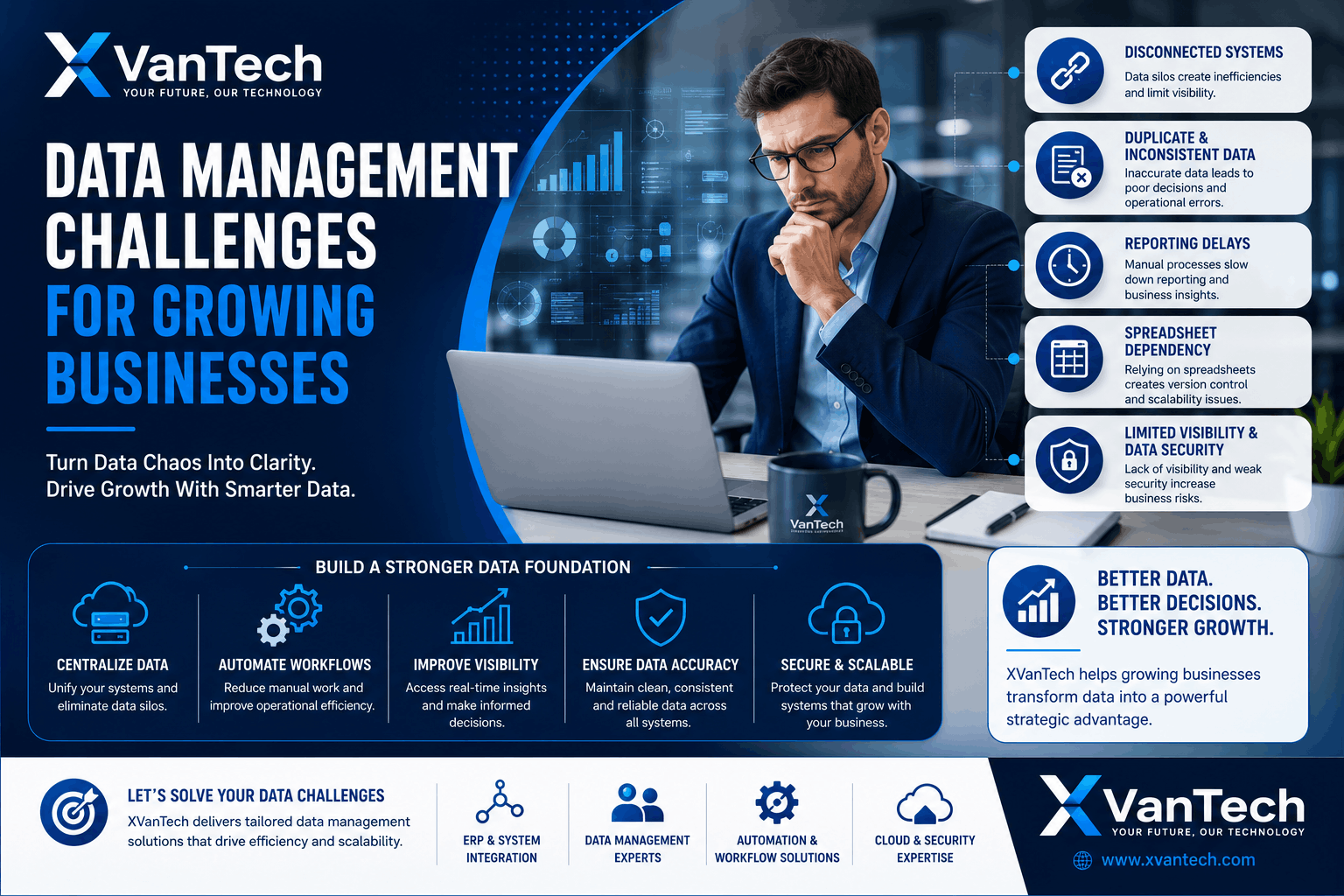
Without organized systems, businesses struggle with inaccurate information, disconnected workflows, reporting delays, duplicated records, operational confusion, and reduced visibility across departments.
These issues quietly slow growth over time.
This is why data management challenges for growing businesses are becoming increasingly important.
Modern businesses require reliable operational visibility, centralized systems, and scalable infrastructure to support long-term growth.
Poor data management is no longer simply an IT issue.
It directly affects operational efficiency, customer experience, profitability, scalability, and business performance.
Why Data Management Becomes Difficult During Growth
In early stages, businesses usually operate with relatively simple systems.
Small teams often manage operations through:
- spreadsheets
- email communication
- manual reporting
- shared drives
- disconnected tools
At small scale, these workflows may appear manageable.
However, as businesses grow:
- teams expand
- departments become specialized
- customer data increases
- operational complexity rises
- reporting requirements become larger
- systems become fragmented
Without structured infrastructure, information becomes difficult to organize and maintain.
This creates operational inefficiencies across the company.
Many growing businesses eventually discover that their operational systems were never designed for scale.
The Most Common Data Management Challenges for Growing Businesses
1. Disconnected Operational Systems
One of the biggest challenges businesses face is disconnected systems.
Different departments often use separate software platforms for:
- accounting
- CRM
- payroll
- inventory
- project management
- customer support
- HR operations
When these systems do not communicate effectively, operational visibility decreases.
Employees spend excessive time manually transferring information between tools, increasing inefficiency and risk of human error.
Disconnected systems create operational silos.
This limits collaboration and slows decision-making.
2. Duplicate and Inconsistent Data
As operational complexity increases, duplicate records become common.
Examples include:
- repeated customer records
- outdated financial data
- inconsistent inventory information
- conflicting reports
- duplicate supplier entries
Inconsistent information damages trust in operational reporting.
Teams begin questioning whether reports are accurate, which weakens confidence in decision-making.
Businesses cannot scale efficiently without reliable operational data.
3. Reporting Delays and Visibility Problems
Many growing businesses struggle with slow reporting processes.
Leadership teams often depend on:
- manually prepared spreadsheets
- disconnected exports
- delayed financial reports
- inconsistent dashboards
This creates serious visibility problems.
Without real-time operational insights, businesses become reactive instead of strategic.
Leadership teams struggle to identify:
- operational inefficiencies
- financial trends
- workforce performance
- customer behavior
- scaling risks
Poor visibility limits growth.
4. Manual Workflow Dependency
Many businesses continue relying heavily on manual workflows long after operational complexity increases.
Examples include:
- manual reporting
- spreadsheet consolidation
- invoice processing
- approval tracking
- customer data updates
- operational coordination
Manual processes create:
- inefficiency
- delays
- human error
- operational overload
As businesses scale, manual systems become increasingly difficult to maintain.
5. Spreadsheet Dependency
Spreadsheets remain useful tools, but many businesses over-rely on them for critical operational functions.
Growing companies often use spreadsheets for:
- financial tracking
- operational reporting
- inventory management
- workforce planning
- customer tracking
This creates several problems:
- version confusion
- inconsistent data
- security risks
- reporting limitations
- scalability issues
Spreadsheet-heavy operations eventually become operational bottlenecks.
6. Lack of Centralized Operational Visibility
Many growing businesses lack centralized operational dashboards.
Without centralized visibility, leadership teams struggle to understand:
- business performance
- operational bottlenecks
- financial efficiency
- workforce productivity
- customer trends
This reduces operational control.
Businesses cannot improve what they cannot clearly measure.
How Poor Data Management Affects Business Growth
Many companies underestimate how deeply operational data affects performance.
Poor data management creates problems across multiple areas.
Reduced Operational Efficiency
Employees waste significant time:
- searching for information
- correcting records
- manually updating systems
- resolving inconsistencies
This reduces productivity across departments.
Slower Decision-Making
Leadership teams need accurate operational visibility to make informed decisions.
Delayed or inconsistent reporting slows strategic execution.
Financial Reporting Problems
Poor financial data management affects:
- forecasting
- budgeting
- cash flow visibility
- operational planning
Inaccurate reporting increases business risk.
Customer Experience Issues
Poor customer data organization often leads to:
- delayed communication
- inconsistent support
- service disruptions
- customer frustration
Customer experience suffers when operational systems are fragmented.
Increased Operational Costs
Operational inefficiencies increase:
- labor costs
- reporting overhead
- administrative workload
- workflow inefficiency
These hidden operational costs quietly reduce profitability.
Why Operational Visibility Matters
Modern businesses rely heavily on operational visibility.
Leadership teams need real-time access to:
- performance metrics
- financial reports
- workforce insights
- operational dashboards
- workflow tracking
- customer information
Without visibility, businesses become reactive.
Strong data infrastructure improves:
- planning
- forecasting
- operational control
- scalability
- decision-making speed
Operational visibility is now a competitive advantage.
The Role of ERP Systems in Data Management
Many growing businesses eventually adopt ERP systems to improve operational coordination.
ERP platforms help businesses:
- centralize data
- reduce duplication
- automate workflows
- improve reporting
- increase operational visibility
ERP systems connect multiple departments into one operational environment.
This improves coordination between:
- finance
- HR
- operations
- payroll
- inventory
- customer management
Businesses with centralized systems typically operate more efficiently.
How Automation Improves Data Management
Automation reduces operational inefficiency significantly.
Businesses can automate:
- reporting workflows
- invoice processing
- payroll synchronization
- customer updates
- operational approvals
- inventory tracking
Automation improves:
- consistency
- speed
- scalability
- reporting accuracy
As operational complexity increases, automation becomes increasingly valuable.
Cloud Systems and Scalable Infrastructure
Cloud platforms are transforming how businesses manage operational information.
Cloud-based systems allow businesses to:
- access data remotely
- improve collaboration
- centralize operations
- scale infrastructure efficiently
- strengthen operational flexibility
Cloud infrastructure often provides greater scalability than traditional manual systems.
Data Security and Compliance Risks
Poor data management also creates security risks.
Businesses managing sensitive operational data must consider:
- access controls
- system security
- data backups
- compliance requirements
- operational continuity
Weak systems increase the risk of:
- data loss
- operational disruption
- security breaches
- compliance failures
As businesses scale, data governance becomes increasingly important.
Signs Your Business Has Data Management Problems
Common warning signs include:
- duplicate records
- reporting delays
- spreadsheet dependency
- disconnected systems
- operational confusion
- inconsistent dashboards
- manual workflow overload
- poor reporting accuracy
- low operational visibility
These are indicators that infrastructure improvements are needed.
How Growing Businesses Can Improve Data Management
Centralize Operational Systems
Businesses should reduce operational fragmentation by improving system integration and centralized visibility.
Reduce Manual Workflows
Manual operational processes become difficult to scale efficiently.
Automation reduces workload and improves consistency.
Improve Reporting Infrastructure
Businesses need reliable dashboards and reporting systems for operational visibility.
Standardize Data Processes
Clear operational standards improve consistency and reporting accuracy.
Invest in Scalable Infrastructure
Growing businesses should adopt systems designed to support long-term operational complexity.
Why Strong Data Infrastructure Creates Competitive Advantage
Businesses increasingly compete through:
- operational speed
- reporting visibility
- scalability
- workflow efficiency
- decision-making quality
Companies with organized operational systems gain major advantages over businesses still relying heavily on fragmented workflows and manual processes.
Strong data infrastructure improves:
- productivity
- customer experience
- operational control
- scalability
- long-term business performance
The Future of Data Management for Businesses
As technology adoption increases, businesses will continue relying more heavily on:
- automation
- cloud systems
- centralized operations
- AI-driven reporting
- integrated workflows
- operational analytics
Businesses that modernize operational infrastructure early position themselves for stronger long-term scalability.
The future belongs to businesses with organized, visible, scalable systems.
Final Thoughts
Data management challenges for growing businesses continue increasing as operational complexity expands.
Businesses that rely heavily on disconnected systems, spreadsheets, manual workflows, and inconsistent reporting often struggle with inefficiency, limited visibility, and scaling limitations.
Modern data management requires:
- centralized systems
- operational visibility
- automation
- scalable infrastructure
- integrated workflows
- reliable reporting systems
Companies that improve operational infrastructure position themselves for stronger efficiency, better decision-making, and long-term business growth.
Looking to Improve Data Management and Operational Visibility?
XVanTech helps businesses improve operational systems, workflow visibility, ERP infrastructure, reporting efficiency, and scalable data management solutions.
Whether your business is struggling with disconnected systems, reporting delays, operational inefficiencies, or fragmented workflows, our team can help build smarter operational infrastructure for long-term growth.
Contact XVanTech today to learn how stronger data management systems can improve business efficiency and scalability.

