


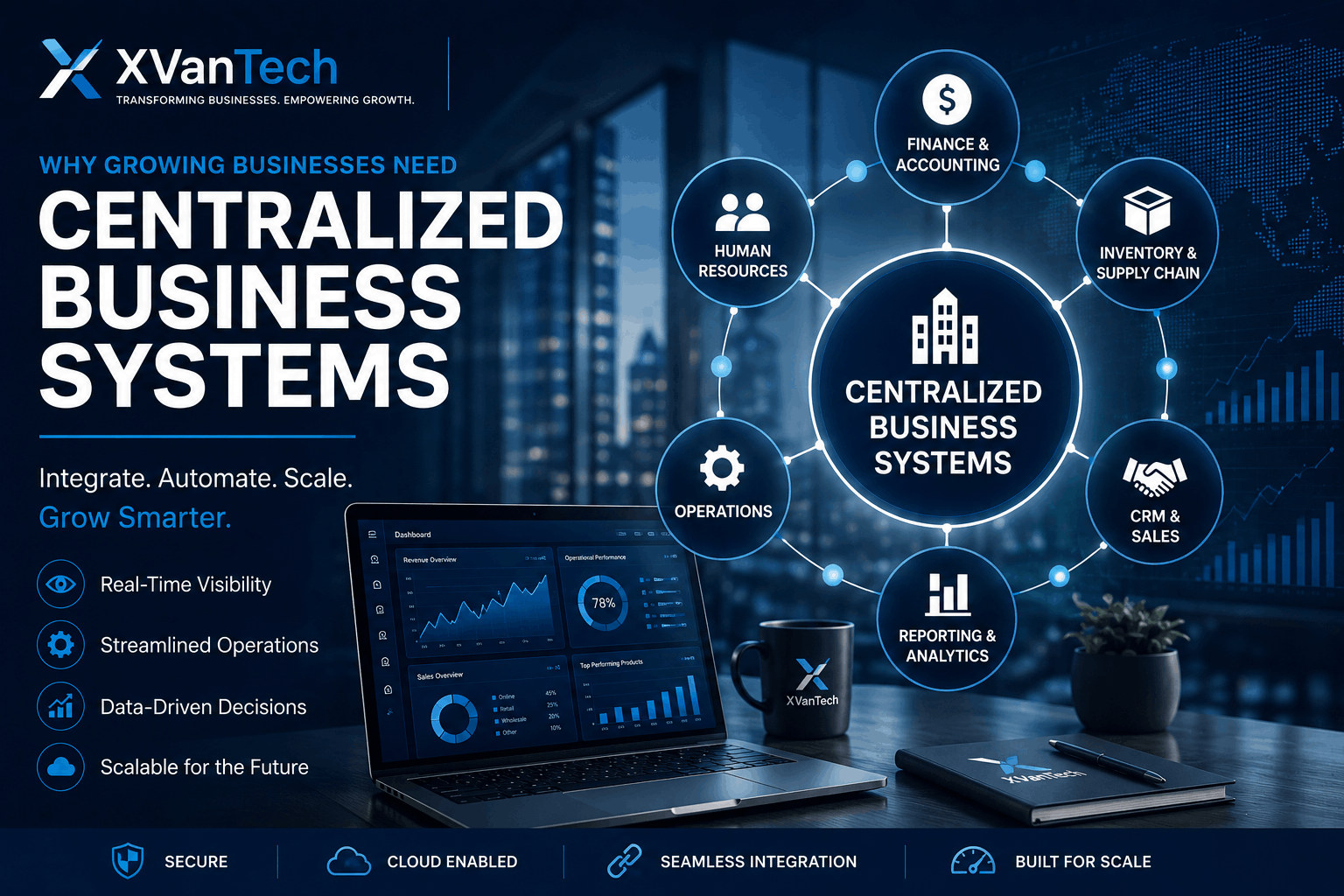
As businesses grow, operations become more complicated. Teams expand, workflows increase, departments begin using different software tools, and reporting becomes harder to manage. What once worked for a small business with a handful of employees suddenly becomes difficult to control at scale. Many organizations eventually reach a point where operational complexity begins slowing growth instead of supporting it.
This is where centralized business systems become critical.
Many growing companies struggle with disconnected operations without realizing how deeply these inefficiencies affect performance. Financial reporting becomes inconsistent, teams lose visibility into workflows, communication slows down, approvals become delayed, and business leaders can no longer see operations clearly in real time. The problem is not always a lack of effort or talent. In many cases, the problem is fragmented operational infrastructure.
Modern businesses rely heavily on technology. However, technology alone is not enough. The real advantage comes from how connected and centralized those systems are across the organization.
Centralized business systems help organizations bring together operational data, reporting, finance, workflows, communication, and infrastructure into a connected operational environment. This improves visibility, scalability, efficiency, and long-term decision-making.
Today, businesses are increasingly investing in:
- ERP implementation
- cloud infrastructure
- operational automation
- data management systems
- AI-powered reporting
- workflow integration
- centralized operational dashboards
The goal is no longer simply digitization. The goal is operational alignment and scalable business infrastructure.
At XVanTech, centralized business systems are approached as part of a larger operational modernization strategy designed to help businesses reduce fragmentation, improve visibility, streamline workflows, and build scalable operational foundations for long-term growth.
What Happens When Businesses Scale Without Centralized Systems
In the early stages of business growth, disconnected systems often seem manageable.
A company may use:
- spreadsheets for reporting
- email approvals for workflows
- separate accounting software
- independent HR systems
- disconnected CRM platforms
- manual inventory tracking
- isolated cloud applications
Initially, these tools may function adequately because operational complexity is relatively low.
However, as the business grows:
- departments expand
- operational data increases
- customer interactions multiply
- financial reporting becomes more complex
- workflows become harder to monitor
- operational bottlenecks begin appearing
Without centralized business systems, organizations often lose operational visibility during growth.
For example, imagine a growing logistics company managing operations through disconnected systems:
- finance operates through accounting software
- HR manages payroll separately
- inventory teams use spreadsheets
- operations teams rely on manual reporting
- customer service teams use independent communication tools
At first, each department functions independently. But over time:
- reports become inconsistent
- approvals slow down
- duplicate work increases
- communication gaps appear
- operational decisions become reactive
The business continues operating, but scalability weakens.
This is one of the most common operational problems growing businesses face today.
The Hidden Cost of Disconnected Business Systems
Many organizations underestimate the hidden cost of fragmented operations.
Disconnected business systems create inefficiencies that are often difficult to measure directly. Unlike obvious financial losses, operational inefficiencies slowly accumulate over time through:
- delayed workflows
- reporting inconsistencies
- duplicated work
- communication gaps
- human error
- inefficient approvals
- manual data transfers
These operational inefficiencies eventually become a major barrier to scalability.
Consider a mid-sized company where departments use completely separate systems:
- accounting teams cannot access operational reporting easily
- sales data is disconnected from inventory systems
- customer support lacks visibility into operational workflows
- HR systems operate independently from finance
As a result:
- leadership loses operational clarity
- reporting becomes slower
- forecasting becomes less reliable
- employees spend unnecessary time gathering information manually
This operational fragmentation often creates what many experts now refer to as operational debt.
Operational debt occurs when outdated or disconnected systems continue functioning temporarily but create increasing inefficiencies as business complexity grows.
Businesses experiencing operational debt usually notice symptoms such as:
- slow decision-making
- inconsistent reporting
- delayed customer responses
- operational confusion
- scaling difficulties
- workflow breakdowns
Without centralized business systems, operational debt increases significantly over time.
Why Operational Visibility Matters for Growing Businesses
Operational visibility has become one of the most important competitive advantages for modern organizations.
Businesses that can see operations clearly in real time are able to:
- respond faster
- optimize workflows
- reduce inefficiencies
- improve forecasting
- identify bottlenecks quickly
- improve customer experience
However, businesses operating through disconnected systems often struggle with limited operational visibility.
For example, leadership teams may not have real-time insight into:
- operational performance
- workforce productivity
- financial status
- project timelines
- inventory movement
- service delivery performance
Without centralized business systems, operational data becomes fragmented across departments and platforms.
This creates situations where:
- finance teams use outdated reports
- operations teams rely on incomplete information
- managers make decisions without accurate visibility
- departments operate independently without coordination
Modern centralized business systems improve operational visibility by bringing data and workflows together into connected operational environments.
This is why businesses increasingly invest in:
- ERP systems
- business intelligence dashboards
- centralized reporting infrastructure
- operational automation
- cloud-based workflow systems
The ability to see operations clearly is no longer optional for scaling businesses.
Why Many Businesses Outgrow Spreadsheets
Spreadsheets remain one of the most widely used operational tools in business. They are flexible, inexpensive, and easy to use during early growth stages.
However, spreadsheets become increasingly problematic as operational complexity grows.
Many organizations continue relying heavily on spreadsheets for:
- financial tracking
- inventory management
- workforce planning
- operational reporting
- project management
- forecasting
Initially, this may seem manageable. But over time, spreadsheet dependency creates major operational risks.
Common problems include:
- version inconsistencies
- manual errors
- duplicated information
- reporting delays
- poor collaboration
- limited scalability
For example, a growing retail business may use multiple spreadsheets across departments:
- inventory teams maintain stock spreadsheets
- finance teams track expenses separately
- sales teams manage forecasting manually
- operations teams monitor logistics independently
As operations grow, data becomes increasingly inconsistent across the organization.
Teams spend more time:
- updating spreadsheets
- reconciling reports
- correcting errors
- transferring information manually
This creates operational inefficiency rather than scalability.
Centralized business systems reduce spreadsheet dependency by integrating operational workflows into connected systems with centralized reporting and real-time visibility.
How ERP Systems Centralize Business Operations
ERP systems play a major role in operational centralization.
ERP stands for Enterprise Resource Planning. These systems help businesses connect departments, workflows, operational reporting, finance, inventory, customer data, and business processes into centralized operational infrastructure.
Modern ERP systems improve:
- operational visibility
- workflow management
- reporting consistency
- inventory tracking
- financial management
- resource planning
However, ERP implementation should not be approached as simply installing software.
Many ERP projects fail because businesses underestimate operational alignment.
Successful ERP implementation requires:
- workflow analysis
- operational planning
- infrastructure integration
- reporting standardization
- process optimization
- scalability planning
For example, imagine a manufacturing company struggling with disconnected operational systems:
- procurement uses one platform
- finance uses another
- warehouse teams rely on spreadsheets
- customer support lacks operational visibility
Implementing a centralized ERP system allows departments to:
- share operational data
- standardize workflows
- centralize reporting
- improve communication
- reduce duplicate work
The result is operational efficiency and stronger scalability.
At XVanTech, ERP implementation strategies focus on operational alignment and connected infrastructure rather than simply software deployment.
Why Cloud Infrastructure Matters in Centralized Business Systems
Cloud infrastructure has become one of the most important components of modern centralized business systems.
Cloud computing allows businesses to:
- scale infrastructure more efficiently
- improve accessibility
- centralize operational systems
- improve collaboration
- reduce infrastructure limitations
However, cloud migration alone does not automatically improve operations.
Many businesses move systems into cloud environments while maintaining fragmented workflows and disconnected operational structures.
This often creates cloud-based inefficiency instead of modernization.
Effective cloud infrastructure strategies should support:
- centralized workflows
- operational visibility
- scalable reporting
- connected systems
- real-time collaboration
For example, a growing consulting firm may struggle with:
- scattered operational files
- inconsistent reporting
- remote workforce coordination
- fragmented communication
By implementing centralized cloud infrastructure:
- teams gain shared access to operational systems
- reporting becomes centralized
- collaboration improves
- workflows become easier to monitor
Cloud infrastructure should function as part of a connected operational strategy rather than simply a hosting solution.
Why Data Management Is Becoming Critical for Modern Businesses
Data management is now one of the most important foundations of scalable operations.
Businesses generate massive amounts of operational data every day:
- financial transactions
- customer interactions
- inventory records
- employee information
- operational metrics
- workflow reporting
Without centralized business systems, this data becomes fragmented across:
- departments
- software platforms
- spreadsheets
- disconnected databases
Fragmented data creates operational confusion and weakens decision-making.
Businesses often experience:
- reporting inconsistencies
- duplicate records
- inaccurate forecasting
- delayed operational insight
- unreliable business intelligence
Modern centralized data management systems improve:
- operational visibility
- reporting accuracy
- AI readiness
- workflow optimization
- business intelligence capabilities
As AI and automation continue expanding, data quality becomes even more important.
AI systems rely heavily on:
- structured data
- centralized reporting
- operational consistency
- connected workflows
Without strong data management infrastructure, AI initiatives often produce unreliable or inconsistent results.
This is why centralized business systems are becoming essential for future-ready operational infrastructure.
How Automation Improves Operational Efficiency
Workflow automation is another major advantage of centralized business systems.
Many businesses still rely heavily on:
- manual approvals
- repetitive administrative work
- disconnected communication
- spreadsheet updates
- email-based workflows
These processes create:
- delays
- human error
- inefficiencies
- operational inconsistency
Automation helps organizations:
- streamline workflows
- improve response times
- reduce repetitive workload
- improve operational consistency
- increase scalability
For example, a finance department handling invoice approvals manually may experience:
- delayed payments
- approval bottlenecks
- inconsistent tracking
- reporting confusion
Automation systems can centralize and streamline these workflows through:
- automated approvals
- centralized notifications
- workflow tracking
- integrated reporting
This improves operational efficiency significantly.
However, automation should always align with broader operational infrastructure.
Disconnected automation systems often create additional complexity instead of operational improvement.
Why Businesses Need Connected Operational Infrastructure
Connected operational infrastructure is becoming increasingly important for businesses operating in competitive environments.
Modern organizations rely on:
- finance systems
- operational reporting
- customer platforms
- inventory management
- HR systems
- cloud infrastructure
- AI-powered analytics
When these systems remain disconnected, operational inefficiencies increase rapidly.
Connected operational infrastructure allows businesses to:
- centralize workflows
- improve collaboration
- improve visibility
- strengthen forecasting
- improve scalability
- optimize operations
This is especially important for growing businesses experiencing rapid operational complexity.
Organizations with centralized business systems are generally better equipped to:
- scale operations
- respond to market changes
- optimize workflows
- improve customer experience
- support remote operations
- implement automation effectively
Disconnected systems often create operational bottlenecks that slow growth significantly.
Why Digital Transformation Often Fails
Digital transformation is one of the most misunderstood concepts in modern business.
Many companies believe digital transformation simply means:
- purchasing software
- moving to cloud systems
- implementing AI tools
- automating workflows
However, digital transformation fails when businesses modernize technology without modernizing operations.
For example, businesses often:
- implement ERP systems without workflow planning
- adopt cloud platforms without operational alignment
- automate inefficient processes
- deploy AI without structured data
The result is fragmented modernization rather than connected operational transformation.
Successful digital transformation requires:
- centralized infrastructure
- operational consistency
- connected systems
- workflow optimization
- scalable reporting
- strong data management
Centralized business systems create the operational foundation required for successful modernization.
Real-World Example of Operational Fragmentation
Imagine a growing healthcare services company with multiple departments operating independently.
The organization uses:
- separate payroll software
- independent scheduling systems
- spreadsheets for operational reporting
- disconnected finance tools
- manual communication processes
As the company grows:
- reporting delays increase
- staff coordination becomes difficult
- customer response times slow down
- operational visibility weakens
Leadership struggles to understand:
- workforce performance
- financial efficiency
- operational bottlenecks
- scheduling conflicts
By implementing centralized business systems:
- operational data becomes connected
- reporting becomes centralized
- workflows become automated
- departments collaborate more effectively
This improves operational efficiency and scalability significantly.
Why AI and Business Intelligence Depend on Centralized Systems
AI and business intelligence systems are becoming increasingly important for operational decision-making.
Businesses now rely on:
- predictive analytics
- AI-powered reporting
- operational dashboards
- automated forecasting
- workflow intelligence
However, these technologies require centralized business systems to function effectively.
AI systems cannot produce reliable operational insights when:
- data is fragmented
- workflows are disconnected
- reporting is inconsistent
- systems operate independently
This is why businesses investing in AI modernization often first focus on:
- centralized infrastructure
- connected systems
- structured operational data
- workflow standardization
Centralized business systems improve the quality and reliability of AI-driven operational insights significantly.
The Future of Centralized Business Operations
Business operations will continue becoming more complex as organizations scale.
Companies relying on fragmented systems will increasingly struggle with:
- operational inefficiency
- reporting confusion
- scalability limitations
- workflow breakdowns
- poor operational visibility
Future-ready businesses are increasingly investing in:
- ERP modernization
- cloud infrastructure
- centralized reporting
- workflow automation
- AI-powered operations
- business intelligence systems
The goal is no longer simply operational survival.
The goal is scalable operational intelligence.
Businesses that centralize operations effectively are generally better positioned to:
- scale sustainably
- improve efficiency
- optimize decision-making
- improve customer experience
- modernize infrastructure
- support long-term growth
Final Thoughts
Growing businesses need centralized business systems because operational complexity increases rapidly during expansion.
Disconnected systems may function temporarily, but over time they create:
- operational inefficiency
- reporting inconsistency
- workflow delays
- scalability limitations
- visibility problems
Centralized business systems help organizations:
- improve operational visibility
- streamline workflows
- connect departments
- improve reporting
- support automation
- strengthen scalability
Modern operational success increasingly depends on connected infrastructure rather than isolated technology tools.
At XVanTech, centralized business systems are approached as part of a broader operational modernization strategy focused on helping businesses improve infrastructure, visibility, scalability, and long-term operational efficiency through connected technology solutions.

