


Artificial Intelligence is rapidly reshaping how businesses operate. From intelligent customer support and predictive analytics to AI-powered software development and autonomous decision-making, organizations across every industry are investing heavily in AI to improve efficiency, reduce costs, and gain a competitive advantage.
However, successful AI adoption is no longer defined by simply deploying new technology. As AI systems become more powerful and integrated into critical business operations, organizations must ensure those systems are trustworthy, secure, transparent, and aligned with business objectives.
This is where AI governance becomes essential.
Many organizations focus their attention on selecting AI platforms, building automation workflows, or training large language models. Far fewer invest in the governance structures required to manage these technologies responsibly. The result is often fragmented AI adoption, inconsistent decision-making, regulatory risks, security vulnerabilities, duplicated investments, and declining stakeholder trust.
Enterprise leaders are increasingly recognizing that AI governance is not a technical exercise delegated solely to IT teams. It is a strategic business capability that requires executive leadership, cross-functional collaboration, and continuous oversight.
Organizations that establish governance early are better positioned to scale AI confidently, respond to evolving regulations, maintain customer trust, and maximize long-term business value.
Those that neglect governance frequently discover that the greatest risks associated with AI are not technological—they are organizational.
This guide explores how modern enterprises can build a comprehensive AI governance framework that supports innovation while maintaining accountability, compliance, security, and ethical responsibility. Whether your organization is beginning its AI journey or managing dozens of enterprise AI initiatives, implementing effective governance is critical to achieving sustainable success.
What Is AI Governance?
AI governance is the structured framework of policies, processes, standards, technologies, and organizational responsibilities that guide how artificial intelligence is developed, deployed, monitored, and continuously improved throughout its lifecycle.
Its primary purpose is to ensure AI systems remain aligned with business objectives while operating responsibly, securely, ethically, and in compliance with applicable regulations.
Unlike traditional software, AI systems learn from data, evolve over time, and often make recommendations or decisions that directly affect customers, employees, and business operations. This dynamic nature introduces new challenges that require governance beyond conventional IT controls.
An effective AI governance program establishes clear accountability for:
- AI strategy and executive oversight
- Responsible AI development
- Data quality and governance
- Security and privacy protection
- Risk management
- Regulatory compliance
- Model monitoring and performance
- Human oversight and accountability
- Ethical decision-making
- Continuous improvement
Rather than slowing innovation, governance creates the confidence required to expand AI adoption across the enterprise. It enables organizations to innovate faster because expectations, responsibilities, and controls are clearly defined from the beginning.
Simply put, AI governance transforms AI from isolated experiments into a trusted enterprise capability.
Why AI Governance Has Become a Board-Level Priority
Only a few years ago, AI projects were typically confined to innovation teams or research departments. Today, artificial intelligence influences decisions across virtually every business function.
Organizations are using AI to:
- Automate customer support
- Generate marketing content
- Improve financial forecasting
- Detect fraud
- Optimize supply chains
- Screen job applicants
- Analyze contracts
- Support healthcare professionals
- Predict equipment failures
- Assist software developers
As AI becomes embedded within business-critical processes, the consequences of poor governance become significantly greater.
Consider an organization where individual departments independently adopt different AI platforms without centralized oversight. Marketing may upload confidential campaign data into one generative AI platform while legal teams use another provider with entirely different security controls. HR may implement AI-assisted recruitment software without addressing fairness or bias, while finance relies on predictive models that lack proper documentation or validation.
Although each department may achieve short-term productivity gains, the organization as a whole inherits fragmented governance, inconsistent security standards, duplicated technology investments, increased compliance exposure, and operational inefficiencies.
Without enterprise-wide governance, AI adoption often scales faster than organizational readiness.
This is why boards of directors, executive leadership teams, regulators, and investors are placing increasing emphasis on AI governance.
Modern governance enables organizations to answer fundamental executive questions such as:
- Who is accountable for AI decisions?
- Which AI systems are approved for enterprise use?
- How do we ensure AI outputs remain accurate?
- How do we protect sensitive data?
- What happens when an AI model makes an incorrect recommendation?
- How do we comply with emerging AI regulations?
- How do we continuously monitor AI performance?
Organizations that can confidently answer these questions are far better positioned to scale AI responsibly.
AI Governance vs. AI Management
These two concepts are frequently confused, yet they represent distinct responsibilities within an enterprise AI program.
AI Governance defines the strategic direction, policies, accountability structures, and decision-making framework that determine how AI should be used across the organization.
Governance addresses questions such as:
- Which AI initiatives should be approved?
- What ethical principles should guide AI development?
- Who owns AI-related risks?
- How should AI systems be monitored?
- What standards must every AI project follow?
AI Management, on the other hand, focuses on operational execution.
It includes activities such as:
- Model deployment
- Infrastructure management
- Performance optimization
- Maintenance
- System monitoring
- User support
- Model retraining
- Incident response
A simple way to distinguish the two is:
- Governance decides what should happen and why.
- Management ensures it happens effectively.
Successful enterprises require both. Strong governance without effective management creates bureaucracy. Effective management without governance creates uncontrolled growth and increased risk.
AI Governance vs. Traditional IT Governance
Many organizations initially assume their existing IT governance framework is sufficient for AI initiatives.
While traditional IT governance provides a valuable foundation, AI introduces challenges that conventional governance models were never designed to address.
Traditional IT governance primarily focuses on:
- Infrastructure reliability
- Cybersecurity
- Software lifecycle management
- Technology investments
- Operational efficiency
- Service delivery
AI governance expands beyond these responsibilities by addressing issues unique to intelligent systems.
These include:
- Model bias and fairness
- Explainability of AI decisions
- Responsible use of generative AI
- Prompt security
- Hallucinations and misinformation
- Model drift over time
- Continuous validation
- Human oversight
- AI accountability
- Ethical decision-making
- Transparency
- Regulatory compliance for AI-specific legislation
For example, a CRM system may function exactly as designed for years with relatively predictable behavior. A generative AI assistant, however, continuously produces new outputs based on changing prompts, evolving data, and updated foundation models. That dynamic behavior requires ongoing governance rather than one-time approval.
As AI capabilities continue advancing, organizations increasingly require governance models designed specifically for intelligent systems rather than extending legacy IT frameworks.
Why AI Projects Fail Without Governance
Despite growing investments in artificial intelligence, many organizations struggle to achieve sustainable business value from AI initiatives.
The underlying problem is rarely the technology itself.
Instead, failures often result from weak governance, unclear accountability, and inconsistent organizational practices.
Common causes include:
Lack of Executive Ownership
AI initiatives frequently begin within individual departments without enterprise-wide sponsorship. Without executive alignment, projects compete for resources, priorities shift, and long-term adoption suffers.
Poor Data Governance
AI systems depend on reliable, secure, and well-managed data. Inconsistent data quality, fragmented ownership, and inadequate governance significantly reduce model accuracy.
Security and Privacy Risks
Employees may unknowingly expose confidential business information by using unauthorized AI tools. Without governance, organizations lose visibility into how sensitive data is processed and stored.
Unclear Policies
Employees often lack guidance regarding acceptable AI use, intellectual property protection, prompt security, human review, and regulatory compliance.
Limited Monitoring
Many organizations successfully deploy AI models but fail to continuously monitor accuracy, bias, performance degradation, or changing business conditions.
Resistance to Change
Without executive communication and structured change management, employees may distrust AI systems or avoid adopting them altogether.
Successful AI transformation requires more than advanced algorithms.
It requires disciplined governance that creates consistency, accountability, transparency, and organizational confidence.
The XVanTech Enterprise AI Governance Framework™
Many governance models focus primarily on compliance and risk management.
While these are essential, modern enterprises require a broader framework—one that enables innovation while protecting the organization from evolving operational, legal, ethical, and security risks.
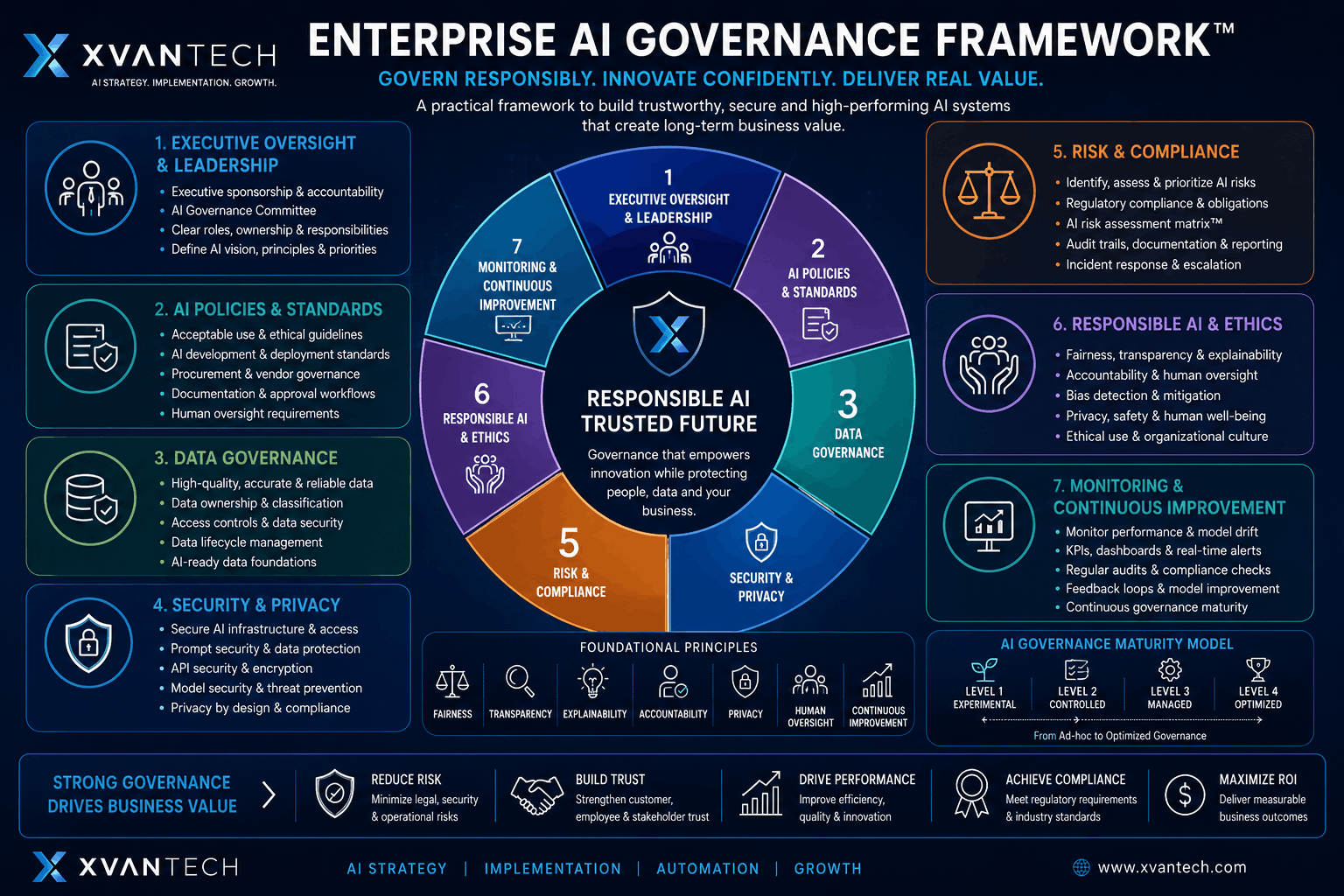
The XVanTech Enterprise AI Governance Framework™ is designed to help organizations build AI capabilities that are scalable, trustworthy, and strategically aligned with business objectives.
The framework consists of seven interconnected pillars:
1. Executive Oversight & Leadership
Establish executive sponsorship, governance committees, accountability structures, and strategic decision-making processes.
2. AI Policies & Standards
Create standardized policies governing AI development, procurement, deployment, acceptable use, documentation, and operational procedures.
3. Data Governance
Ensure enterprise data remains accurate, secure, accessible, compliant, and fit for AI applications.
4. Security & Privacy
Protect AI infrastructure, models, prompts, APIs, and enterprise information from cyber threats, misuse, and unauthorized access.
5. Risk & Compliance
Identify, assess, monitor, and mitigate legal, operational, financial, reputational, and regulatory risks associated with AI adoption.
6. Responsible AI & Ethics
Promote fairness, transparency, explainability, accountability, human oversight, and responsible decision-making throughout the AI lifecycle.
7. Monitoring & Continuous Improvement
Continuously evaluate AI performance, detect model drift, audit governance effectiveness, measure business outcomes, and improve governance policies as technologies and regulations evolve.
Together, these seven pillars create a governance ecosystem that balances innovation with accountability. Rather than restricting AI adoption, they provide the structure enterprises need to scale AI confidently, maintain stakeholder trust, and achieve sustainable business value.
Pillar 1: Executive Oversight & Leadership
Successful AI governance begins with leadership.
One of the most common reasons AI initiatives fail is the assumption that governance belongs exclusively to the IT department. In reality, AI affects every business function—from finance and legal to HR, operations, marketing, and customer service. As a result, governance requires executive ownership and cross-functional collaboration.
Without executive oversight, organizations often experience fragmented AI adoption, duplicate technology investments, inconsistent policies, and conflicting business priorities.
Why Executive Leadership Matters
Enterprise AI influences decisions that impact revenue, customer trust, regulatory compliance, and corporate reputation. These are business risks, not just technical risks.
Executive leadership should define:
- Enterprise AI vision
- Governance objectives
- Risk tolerance
- Investment priorities
- AI adoption roadmap
- Success metrics
- Ethical principles
When executives actively sponsor AI governance, departments are more likely to align around shared standards rather than pursuing isolated AI initiatives.
Establish an AI Governance Committee
Every enterprise implementing AI at scale should establish a cross-functional governance committee.
Rather than controlling every AI decision, the committee provides strategic oversight, policy direction, and accountability.
Typical members include:
- Chief Executive Officer (CEO)
- Chief Information Officer (CIO)
- Chief Technology Officer (CTO)
- Chief Information Security Officer (CISO)
- Chief Data Officer (CDO)
- Head of Legal & Compliance
- HR Leadership
- Operations Leadership
- Business Unit Representatives
- AI Program Manager
Depending on organizational maturity, external advisors or ethics specialists may also participate.
Responsibilities of the AI Governance Committee
The committee should oversee:
- Enterprise AI strategy
- AI investment approval
- Vendor evaluation
- AI procurement standards
- Risk management
- Compliance reviews
- Policy approval
- Data governance alignment
- Responsible AI initiatives
- AI performance reporting
- Incident management
- Continuous governance improvement
Instead of reviewing every AI project individually, the committee establishes consistent governance principles that all projects must follow.
Define Clear Accountability
One of the biggest governance challenges is uncertainty regarding ownership.
Questions such as:
- Who approves AI systems?
- Who owns AI-generated content?
- Who is responsible for AI failures?
- Who investigates incidents?
- Who validates model performance?
must be answered before large-scale AI adoption.
Organizations should assign clear ownership for:
| Governance Area | Primary Owner |
|---|---|
| AI Strategy | Executive Leadership |
| AI Policies | Governance Committee |
| Data Governance | Chief Data Officer |
| Security | CISO |
| Compliance | Legal & Compliance |
| AI Infrastructure | IT Department |
| AI Operations | AI Program Manager |
| Business Outcomes | Department Leaders |
Clearly defined ownership eliminates confusion during both routine operations and critical incidents.
Pillar 2: AI Policies & Standards
Policies create consistency across the organization.
Without documented standards, employees make individual decisions regarding AI usage, often introducing unnecessary security, legal, and operational risks.
Enterprise AI policies should establish clear expectations regarding how AI systems are selected, deployed, monitored, and used.
Core AI Policies Every Organization Needs
Acceptable Use Policy
Defines:
- Approved AI tools
- Restricted AI applications
- Employee responsibilities
- Sensitive information handling
- Human review requirements
Employees should clearly understand what data can—and cannot—be shared with AI systems.
AI Procurement Policy
Many organizations unknowingly create “Shadow AI” when departments independently purchase AI solutions.
An AI procurement policy ensures every AI vendor undergoes evaluation for:
- Security
- Privacy
- Compliance
- Integration
- Vendor reliability
- Scalability
- Cost
This reduces duplication while improving enterprise-wide consistency.
AI Development Standards
Organizations building custom AI applications should standardize:
- Documentation
- Testing
- Version control
- Prompt engineering practices
- Model validation
- Security testing
- Deployment approvals
These standards improve quality while reducing operational risk.
Human Oversight Policy
Not every AI decision should be fully autonomous.
Organizations should define:
- High-risk decisions requiring human approval
- Escalation procedures
- Manual review thresholds
- Audit requirements
- Exception handling
This is particularly important in healthcare, finance, insurance, and legal services.
AI Documentation Standards
Every enterprise AI system should include documentation covering:
- Purpose
- Training data
- Business owner
- Technical owner
- Approved users
- Known limitations
- Security controls
- Performance metrics
- Update history
Good documentation improves transparency while simplifying audits and compliance reviews.
Pillar 3: Data Governance
Artificial intelligence is only as effective as the data supporting it.
Poor data governance remains one of the leading causes of unsuccessful AI initiatives.
Organizations often focus heavily on selecting AI platforms while overlooking the quality, availability, and governance of enterprise data.
Without trusted data, even the most advanced AI models produce unreliable outputs.
Why Data Governance Matters
Enterprise AI depends upon data that is:
- Accurate
- Complete
- Consistent
- Secure
- Accessible
- Compliant
- Well-documented
Weak governance results in:
- Inaccurate predictions
- Hallucinated responses
- Duplicate records
- Compliance violations
- Poor customer experiences
- Reduced executive confidence
Strong governance transforms organizational data into a reliable strategic asset.
The Five Dimensions of Enterprise Data Governance
1. Data Quality
Organizations should continuously measure:
- Accuracy
- Completeness
- Timeliness
- Consistency
- Duplicate records
- Missing values
Poor-quality data directly reduces AI reliability.
2. Data Ownership
Every critical dataset requires a designated business owner responsible for:
- Quality
- Security
- Accessibility
- Compliance
- Lifecycle management
Without ownership, governance quickly deteriorates.
3. Data Classification
Information should be categorized according to sensitivity.
Typical classifications include:
- Public
- Internal
- Confidential
- Restricted
Classification determines how data may be used within AI systems.
4. Data Access Control
Not every employee should access every dataset.
Role-based access ensures:
- Least privilege
- Better security
- Improved compliance
- Reduced insider risk
5. Data Lifecycle Management
Organizations should define:
- Collection
- Storage
- Retention
- Archiving
- Deletion
This becomes increasingly important as AI systems process growing volumes of enterprise information.
Building an AI-Ready Data Foundation
Organizations frequently ask:
“Do we need perfect data before implementing AI?”
The answer is no.
However, organizations should establish a minimum level of data maturity before scaling enterprise AI.
Characteristics of AI-ready organizations include:
- Centralized knowledge repositories
- Well-managed business documentation
- Clean customer data
- Integrated business systems
- Standardized terminology
- Reliable APIs
- Secure cloud infrastructure
- Consistent metadata
The objective is not perfection but trustworthiness.
Pillar 4: Security & Privacy
Security becomes significantly more complex once AI enters the enterprise.
Traditional cybersecurity protects applications, infrastructure, and networks.
AI security must also protect:
- Models
- Prompts
- Training datasets
- Knowledge bases
- APIs
- AI agents
- Generated outputs
Every new AI capability introduces new attack surfaces.
Enterprise AI Security Priorities
Successful organizations build security directly into every stage of AI implementation.
Critical priorities include:
Identity & Access Management
Only authorized personnel should access:
- AI platforms
- Prompt libraries
- Training datasets
- Model configurations
- Administrative settings
Multi-factor authentication and role-based permissions should be mandatory.
Prompt Security
Generative AI introduces risks that traditional applications never faced.
Employees may unintentionally expose:
- Customer information
- Financial records
- Source code
- Intellectual property
- Legal documentation
Organizations should implement prompt guidelines, user education, and technical controls to reduce these risks.
API Security
Most enterprise AI solutions rely heavily on APIs connecting:
- CRM systems
- ERP platforms
- Knowledge bases
- Customer portals
- Internal applications
These integrations should include:
- Authentication
- Encryption
- Rate limiting
- Monitoring
- Logging
- Access controls
Model Security
AI models themselves require protection against:
- Unauthorized modification
- Model theft
- Prompt injection attacks
- Data poisoning
- Adversarial inputs
- Model extraction attacks
Regular security testing should become part of the AI lifecycle.
Privacy by Design
Privacy should never be added after deployment.
Organizations should embed privacy considerations into AI projects from the beginning by:
- Minimizing personal data collection
- Applying anonymization where appropriate
- Encrypting sensitive information
- Defining retention periods
- Conducting privacy impact assessments
- Monitoring regulatory obligations
Privacy by design strengthens customer trust while reducing compliance risk.
The XVanTech AI Governance Maturity Model™
Most organizations progress through governance in predictable stages.
Level 1 – Experimental
- Individual teams use AI independently.
- Few formal policies exist.
- Governance is largely reactive.
Level 2 – Controlled
- Initial AI policies are introduced.
- Leadership begins overseeing key AI projects.
- Data governance and security practices improve.
Level 3 – Managed
- Governance is standardized across departments.
- AI investments follow defined approval processes.
- Enterprise-wide policies and accountability are established.
Level 4 – Optimized
- AI governance is fully integrated into business operations.
- Continuous monitoring, auditing, and performance measurement are routine.
- Governance evolves alongside changing technologies and regulations.
Organizations should aim to progress steadily through these stages rather than attempting to implement every governance practice simultaneously.
Pillar 5: Risk & Compliance
Every AI initiative introduces a unique combination of operational, legal, financial, cybersecurity, and reputational risks. Unlike conventional software, AI systems continuously evolve through new data, changing user behavior, and model updates. As a result, risk management must become an ongoing business function rather than a one-time approval process.
Organizations that fail to proactively identify and manage AI-related risks often face regulatory scrutiny, customer distrust, inaccurate decision-making, and unnecessary financial losses.
The objective of AI governance is not to eliminate every risk—innovation always carries some uncertainty—but to ensure risks are understood, monitored, and mitigated before they become business problems.
Understanding Enterprise AI Risks
AI risks extend far beyond technology. Executive leaders should evaluate AI from multiple perspectives to understand its potential impact across the organization.
Strategic Risks
Poor AI investments can divert significant financial resources away from higher-value initiatives. Organizations may adopt AI because competitors are doing so rather than because it solves a meaningful business problem.
Typical strategic risks include:
- Investing without measurable business objectives
- Selecting technology before defining the problem
- Vendor dependency
- Unrealistic ROI expectations
- Lack of executive alignment
Strong governance ensures every AI initiative supports broader organizational goals.
Operational Risks
Operational risks arise when AI systems disrupt existing business processes or fail to perform as expected.
Examples include:
- Incorrect recommendations
- System downtime
- Model performance degradation
- Integration failures
- Inconsistent outputs
- Poor user adoption
Continuous monitoring helps organizations identify operational issues before they affect customers or employees.
Legal & Regulatory Risks
Governments worldwide are introducing legislation governing AI transparency, privacy, accountability, and consumer protection.
Organizations must consider:
- Data protection laws
- Industry regulations
- Intellectual property rights
- Consumer protection requirements
- Contractual obligations
- Record retention policies
Waiting until regulations become mandatory is rarely an effective strategy. Organizations that establish governance early can adapt far more efficiently as legal requirements evolve.
Cybersecurity Risks
Generative AI and enterprise AI platforms create entirely new attack surfaces.
Examples include:
- Prompt injection attacks
- Model manipulation
- API abuse
- Credential theft
- Sensitive data exposure
- Unauthorized model access
Security teams should treat AI infrastructure as critical enterprise assets rather than isolated applications.
Reputational Risks
AI decisions directly influence customer trust.
Poor recommendations, biased hiring decisions, inaccurate financial advice, or misleading AI-generated content can damage an organization’s reputation far more quickly than traditional software failures.
Executive leaders should ask:
- Would we be comfortable explaining this AI decision publicly?
- Could this output damage customer trust?
- Can we explain how this recommendation was produced?
If the answer is uncertain, additional governance is required.
The XVanTech AI Risk Assessment Matrix™
One-size-fits-all governance rarely works because not every AI application carries the same level of risk.
The XVanTech AI Risk Assessment Matrix™ categorizes AI initiatives according to business impact and organizational risk.
Low-Risk AI
Examples:
- Internal knowledge assistants
- Meeting summarization
- Content brainstorming
- Employee productivity tools
Governance focus:
- Acceptable use policies
- Data security
- User education
Medium-Risk AI
Examples:
- Customer support chatbots
- Sales assistants
- Marketing personalization
- Workflow automation
Governance focus:
- Human review
- Performance monitoring
- Security controls
- Customer transparency
High-Risk AI
Examples:
- Financial approvals
- Healthcare recommendations
- Recruitment screening
- Fraud detection
- Credit scoring
Governance focus:
- Executive approval
- Regulatory compliance
- Explainability
- Human oversight
- Independent validation
- Comprehensive auditing
Organizations should allocate governance resources proportionally rather than treating every AI system equally.
Pillar 6: Responsible AI & Ethics
Responsible AI has become one of the defining characteristics of successful enterprise AI programs.
Employees, customers, regulators, and investors increasingly expect organizations to demonstrate that AI systems are fair, transparent, accountable, and aligned with human values.
Responsible AI is not simply about avoiding controversy.
It is about creating systems that people trust.
Principles of Responsible AI
Every enterprise should establish a set of ethical principles that guide AI adoption across all business units.
The XVanTech framework recommends seven foundational principles.
Fairness
AI systems should avoid unjustified discrimination based on race, gender, age, religion, disability, or other protected characteristics.
Organizations should regularly test models for unintended bias before and after deployment.
Transparency
Users should understand when they are interacting with AI and how AI contributes to important decisions.
Transparency increases confidence while reducing misunderstandings.
Explainability
Organizations should be able to explain why AI generated a particular recommendation, prediction, or decision.
Explainability becomes increasingly important in healthcare, finance, insurance, legal services, and government.
If a decision cannot be reasonably explained, executives should question whether AI is appropriate for that application.
Accountability
AI should never replace organizational responsibility.
Every AI initiative must have clearly identified business owners who remain accountable for outcomes regardless of automation.
Accountability cannot be delegated to software.
Privacy
Responsible AI protects personal information throughout the AI lifecycle.
Organizations should minimize unnecessary data collection while ensuring compliance with applicable privacy laws and internal policies.
Human Oversight
AI should support human decision-making rather than completely replacing it in high-impact scenarios.
Critical business decisions should always allow qualified professionals to intervene when necessary.
Continuous Improvement
Responsible AI requires ongoing evaluation.
Models should be monitored for:
- Accuracy
- Fairness
- Drift
- Security
- User feedback
- Regulatory changes
Governance is an ongoing process rather than a project with a fixed end date.
Building an Ethical AI Culture
Technology alone cannot create responsible AI.
Culture plays an equally important role.
Organizations should encourage employees to:
- Question AI outputs
- Report concerns
- Challenge unexpected recommendations
- Escalate ethical issues
- Participate in governance initiatives
Ethical AI becomes sustainable when responsibility is shared across the organization rather than confined to technical teams.
Pillar 7: Monitoring & Continuous Improvement
Many organizations mistakenly assume governance ends once an AI system is deployed.
In reality, deployment marks the beginning of governance.
AI models continuously interact with new data, changing customer behavior, evolving regulations, and shifting business objectives.
Without continuous monitoring, performance inevitably declines.
What Should Organizations Monitor?
An enterprise governance program should continuously evaluate several dimensions of AI performance.
Technical Performance
Monitor:
- Accuracy
- Response quality
- Model latency
- Error rates
- Hallucination frequency
- System availability
Business Performance
Measure:
- Productivity improvements
- Cost reductions
- Revenue impact
- Customer satisfaction
- Employee adoption
- Process efficiency
Governance should demonstrate measurable business value rather than focusing solely on technical metrics.
Risk Indicators
Track:
- Security incidents
- Policy violations
- Data leakage
- Regulatory findings
- Ethical concerns
- User complaints
These indicators provide early warning signs before small issues become significant business problems.
Governance Performance
Organizations should periodically evaluate the governance program itself.
Questions include:
- Are policies still relevant?
- Are employees following governance standards?
- Have new AI risks emerged?
- Do governance committees meet regularly?
- Are audits producing actionable improvements?
Continuous refinement keeps governance aligned with rapidly evolving AI technologies.
Enterprise AI Governance Case Studies
Case Study 1 – Healthcare Provider
Challenge
A regional healthcare organization introduced generative AI to assist clinicians with medical documentation.
Leadership recognized that patient privacy, regulatory compliance, and clinical accuracy were non-negotiable.
Governance Actions
- Established executive oversight committee.
- Restricted AI access to authorized personnel.
- Required clinicians to review every AI-generated document.
- Implemented detailed audit logging.
- Conducted regular privacy assessments.
Results
- Reduced documentation time.
- Improved clinician productivity.
- Maintained patient confidentiality.
- Increased physician confidence in AI-assisted workflows.
Case Study 2 – Financial Services Firm
Challenge
A financial institution implemented AI to improve fraud detection.
False positives created customer frustration while insufficient oversight increased regulatory risk.
Governance Actions
- Introduced human review for high-value transactions.
- Established explainability requirements.
- Performed quarterly model validation.
- Created documented escalation procedures.
Results
- Improved fraud detection accuracy.
- Reduced unnecessary account restrictions.
- Strengthened regulatory compliance.
- Increased executive confidence.
Case Study 3 – Manufacturing Enterprise
Challenge
A manufacturer deployed predictive maintenance models across multiple production facilities.
Different plants adopted inconsistent AI tools and reporting standards.
Governance Actions
- Standardized AI policies.
- Centralized governance.
- Unified data quality standards.
- Established enterprise monitoring dashboards.
Results
- Improved equipment reliability.
- Reduced maintenance costs.
- Consistent reporting across facilities.
- Better executive visibility.
Case Study 4 – Global Law Firm
Challenge
Lawyers began using generative AI independently for legal research and document drafting.
Leadership was concerned about confidentiality, accuracy, and professional responsibility.
Governance Actions
- Approved secure enterprise AI platform.
- Restricted client data usage.
- Required lawyer review before client delivery.
- Implemented mandatory AI usage training.
Results
- Faster legal research.
- Improved document preparation.
- Stronger confidentiality controls.
- Higher client confidence.
Case Study 5 – Retail Organization
Challenge
A retailer implemented AI-powered personalization to improve customer engagement while complying with privacy regulations.
Governance Actions
- Established consent management.
- Strengthened customer data governance.
- Added transparency to AI recommendations.
- Regularly reviewed personalization performance.
Results
- Higher customer engagement.
- Increased online conversions.
- Improved regulatory compliance.
- Greater customer trust.
Common AI Governance Mistakes
Even well-funded AI initiatives can struggle when governance is overlooked.
The most common mistakes include:
- Treating governance as an IT-only responsibility.
- Building AI policies after deployment rather than before.
- Ignoring data quality.
- Failing to define ownership.
- Deploying AI without human oversight.
- Measuring technical performance but not business outcomes.
- Neglecting employee education.
- Assuming governance is a one-time exercise.
- Overlooking emerging regulations.
- Prioritizing speed over responsible adoption.
Organizations that avoid these mistakes are far more likely to scale AI successfully while maintaining trust, compliance, and long-term business value.
Executive AI Governance Checklist
Before expanding AI adoption, executive leadership should confirm that the organization can answer “yes” to the following questions:
- Do we have executive sponsorship for AI governance?
- Have we established an AI governance committee?
- Are AI policies documented and communicated?
- Do we classify enterprise data appropriately?
- Are security controls integrated into every AI initiative?
- Have we assessed legal and regulatory obligations?
- Are high-risk AI decisions subject to human oversight?
- Do we continuously monitor AI performance and risk?
- Are employees trained in responsible AI usage?
- Is governance reviewed and improved on a regular basis?
A positive answer to these questions indicates that governance is becoming an organizational capability rather than simply a compliance requirement.
90-Day Enterprise AI Governance Roadmap
Building an effective AI governance program does not require organizations to implement every policy, committee, and control on day one. The most successful enterprises approach governance as a phased transformation that evolves alongside AI adoption.
The XVanTech 90-Day Enterprise AI Governance Roadmap™ provides a structured approach for establishing a scalable governance foundation while delivering measurable business value.
Phase 1 (Days 1–30): Establish Governance Foundations
The first month focuses on leadership, visibility, and strategic alignment.
Executive Priorities
- Appoint an executive sponsor for AI governance.
- Establish an AI Governance Committee.
- Define enterprise AI objectives.
- Identify current AI tools and initiatives across the organization.
- Conduct an AI risk assessment.
- Develop an enterprise AI governance charter.
Technology Priorities
- Inventory existing AI systems.
- Identify unauthorized AI applications (Shadow AI).
- Review data access controls.
- Assess AI vendors.
- Evaluate current security posture.
Deliverables
- AI Governance Charter
- AI Inventory
- Initial Risk Register
- Executive Governance Structure
- AI Vision Statement
By the end of the first month, organizations should understand how AI is currently being used and who is accountable for governing it.
Phase 2 (Days 31–60): Build Policies & Controls
Once governance leadership has been established, the next step is creating enterprise-wide standards.
Organizations should develop policies covering:
- Acceptable AI Use
- Data Governance
- AI Procurement
- Human Oversight
- Responsible AI
- Security Requirements
- Vendor Management
- Incident Response
- Documentation Standards
During this phase organizations should also:
- Train department leaders.
- Define approval workflows.
- Establish audit procedures.
- Standardize AI documentation.
- Create governance reporting processes.
Deliverables
- Enterprise AI Policy Manual
- Governance Standards
- AI Approval Workflow
- Vendor Assessment Checklist
- AI Security Guidelines
Phase 3 (Days 61–90): Operationalize Governance
The final phase transitions governance from planning into day-to-day business operations.
Organizations should begin:
- Monitoring AI performance.
- Reviewing governance KPIs.
- Auditing AI systems.
- Measuring business outcomes.
- Updating governance policies.
- Expanding governance across departments.
Executive leadership should also conduct its first governance review to identify improvement opportunities.
Deliverables
- Governance Dashboard
- Executive KPI Report
- AI Audit Report
- Continuous Improvement Plan
- Department Governance Reviews
After ninety days, governance should become an operational capability rather than a standalone project.
The XVanTech AI Governance Scorecard™
Governance should be measured just as rigorously as revenue, cybersecurity, or operational performance.
The XVanTech AI Governance Scorecard™ provides executives with a practical framework for evaluating governance maturity across the enterprise.
| Governance Area | Questions Executive Teams Should Ask |
|---|---|
| Leadership | Is executive ownership clearly defined? |
| Policies | Are governance policies documented and consistently applied? |
| Data | Is enterprise data accurate, secure, and governed? |
| Security | Are AI systems protected against emerging threats? |
| Compliance | Are regulatory obligations continuously monitored? |
| Ethics | Are AI systems fair, transparent, and explainable? |
| Monitoring | Are AI models regularly evaluated and audited? |
| Business Value | Is AI delivering measurable business outcomes? |
Organizations should review this scorecard quarterly to identify strengths, gaps, and priorities for continuous improvement.
Key Performance Indicators (KPIs) for AI Governance
Governance programs should measure more than technical metrics. Executive teams need visibility into how governance contributes to business performance.
Recommended KPIs include:
Governance KPIs
- Percentage of AI systems formally approved.
- Percentage of AI projects following governance policies.
- Number of governance reviews completed.
- Policy compliance rate.
- AI training completion rate.
Risk KPIs
- Security incidents involving AI.
- Data privacy violations.
- High-risk AI decisions requiring escalation.
- Compliance findings.
- Audit observations.
Operational KPIs
- AI system availability.
- Model accuracy.
- Model drift incidents.
- Time to resolve AI-related issues.
- User adoption rates.
Business KPIs
- Productivity improvements.
- Cost savings.
- Customer satisfaction.
- Revenue influenced by AI.
- Employee efficiency gains.
- Return on AI investments.
Governance should demonstrate business value—not merely regulatory compliance.
Future Trends in AI Governance
AI governance will continue evolving as technology advances and regulatory expectations increase.
Enterprise leaders should prepare for several important trends.
AI-Specific Regulations
Governments worldwide are introducing dedicated AI legislation focused on transparency, accountability, privacy, and consumer protection.
Organizations with mature governance programs will adapt more efficiently than those starting from scratch.
Governance for AI Agents
Autonomous AI agents are capable of planning tasks, interacting with enterprise systems, and making operational decisions.
As adoption grows, governance frameworks will need to address:
- Agent permissions
- Autonomous decision limits
- Human intervention thresholds
- Auditability
- Multi-agent coordination
- Security controls
Real-Time AI Monitoring
Future governance platforms will continuously evaluate:
- Model performance
- Regulatory compliance
- Security threats
- Bias detection
- Business impact
- Operational risks
Organizations will increasingly move from periodic governance reviews to continuous governance.
Explainable AI
Customers, regulators, and executives will increasingly demand explanations for AI-generated recommendations.
Explainability will become a competitive advantage rather than simply a compliance requirement.
Governance by Design
Just as cybersecurity embraced “Security by Design,” enterprise AI will increasingly adopt Governance by Design.
Rather than introducing governance after deployment, organizations will embed governance throughout the AI lifecycle—from planning and development to deployment, monitoring, and retirement.
Frequently Asked Questions
What is AI governance?
AI governance is the framework of policies, processes, technologies, and organizational responsibilities that ensures artificial intelligence is developed, deployed, monitored, and used responsibly, securely, and in alignment with business objectives.
Why is AI governance important?
AI governance helps organizations reduce risk, strengthen security, improve compliance, protect customer trust, and ensure AI initiatives deliver measurable business value.
Who is responsible for AI governance?
AI governance is a shared responsibility. Executive leadership provides strategic oversight, while IT, security, legal, compliance, data teams, and business leaders collaborate to implement and maintain governance across the organization.
What industries benefit most from AI governance?
Every industry adopting AI benefits from governance. However, sectors such as healthcare, financial services, manufacturing, legal services, government, insurance, retail, and education often require particularly robust governance because AI decisions can directly affect people, finances, or regulatory compliance.
How often should AI governance policies be reviewed?
Organizations should review governance policies at least annually and whenever significant changes occur, such as new regulations, major AI deployments, evolving security threats, or changes to business strategy.
Final Thoughts
Artificial intelligence is transforming the way organizations operate, compete, and innovate. Yet long-term success depends on more than deploying advanced models or experimenting with new technologies. It requires the discipline to govern AI responsibly, ensuring that innovation is supported by accountability, transparency, security, and measurable business outcomes.
Organizations that invest in governance early are better positioned to scale AI confidently, adapt to changing regulations, and earn the trust of customers, employees, and stakeholders. Those that delay governance often find themselves addressing preventable risks after AI has already become deeply embedded in critical business processes.
The XVanTech Enterprise AI Governance Framework™ provides a practical foundation for organizations seeking to balance innovation with responsibility. By combining executive leadership, clear policies, robust data governance, security, ethical principles, continuous monitoring, and structured improvement, enterprises can transform AI from isolated initiatives into a trusted strategic capability.
Governance should not be viewed as a barrier to innovation. It is the mechanism that enables organizations to innovate with confidence, scale responsibly, and maximize the long-term value of artificial intelligence.

