


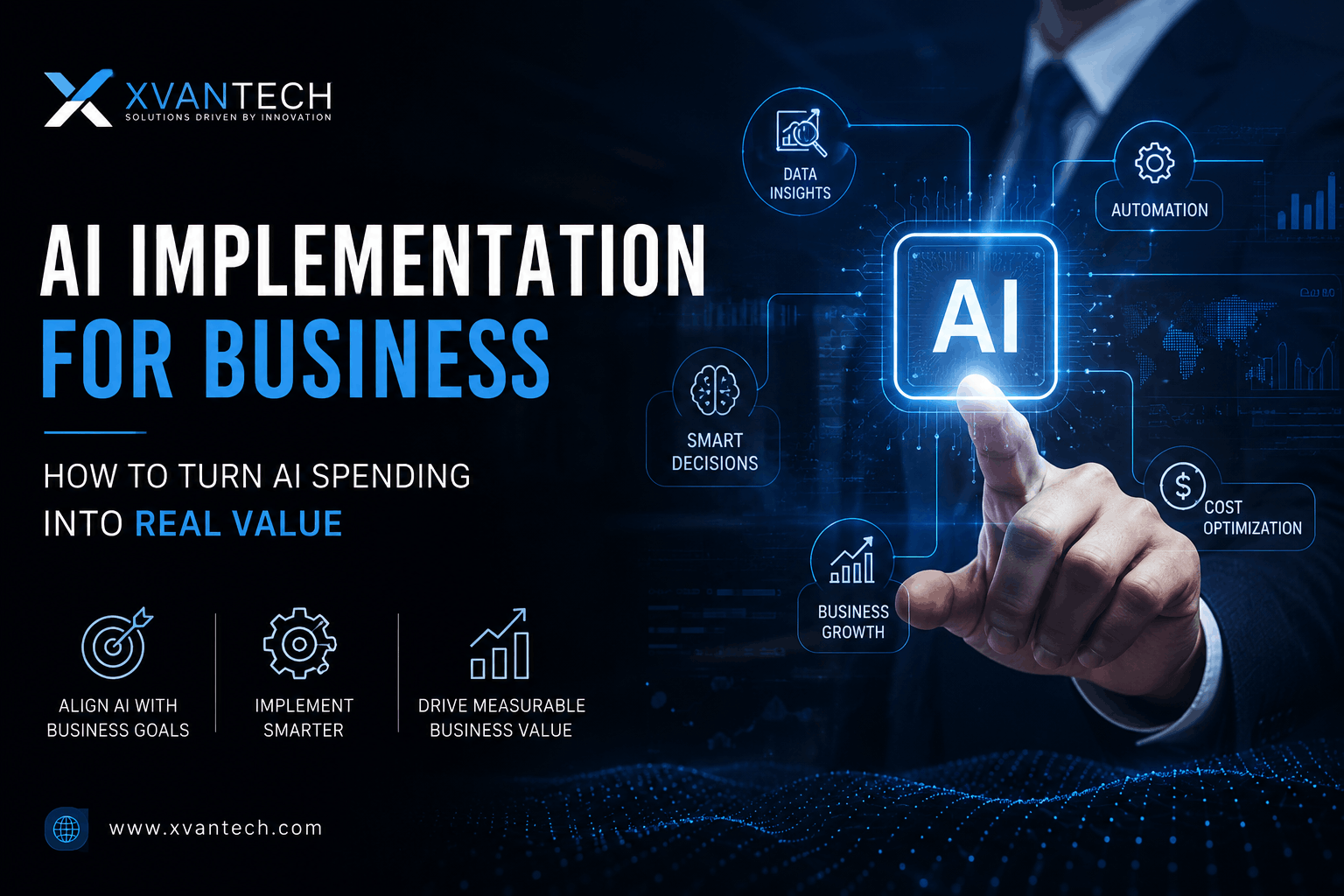
AI spending is rising fast. But for many companies, real business value is not rising at the same speed.
Across industries, leaders are investing in AI tools, automation platforms, dashboards, chatbots, and data systems. The problem is not interest. The problem is execution.
Many businesses are testing AI, but fewer are turning those tests into measurable outcomes. Industry reports continue to show a gap between AI adoption and business impact, with many companies still struggling to move from pilots to scaled results. McKinsey’s 2025 State of AI report also highlights that moving from experimentation to impact remains a challenge for many organizations.
That is why AI implementation for business matters more than AI hype.
The companies that win with AI will not be the ones with the most tools, the biggest dashboards, or the loudest AI strategy. They will be the companies that use AI to solve practical problems, reduce manual work, improve visibility, and make better decisions.
For finance, accounting, operations, and reporting teams, this shift is especially important.
AI should not be treated as a trend. It should be treated as a practical business capability.
Why AI Spending Is Growing Faster Than AI Value
Many companies are investing in AI because they do not want to fall behind. That makes sense. AI can improve speed, accuracy, reporting, customer service, forecasting, and process efficiency.
But buying AI tools is not the same as building value.
A business may subscribe to multiple AI platforms and still have the same problems:
- Manual data entry
- Slow month-end close
- Poor reporting visibility
- Disconnected systems
- Duplicate work across departments
- Inaccurate or delayed dashboards
- Finance teams spending too much time on repetitive tasks
- Leaders making decisions without real-time data
This is where many AI projects fail.
The company has tools, but the workflows are still broken. The team has dashboards, but the data is still messy. The business has automation software, but employees still manually copy information between systems.
AI implementation for business is about fixing that gap.
It is not only about adopting AI. It is about applying AI to the right business problems.
The Real Problem: AI Experiments Without Business Outcomes
A lot of companies start with AI by asking, “Which tool should we use?”
That is the wrong first question.
The better question is, “Which business problem should AI solve first?”
Without a clear use case, AI becomes another expense. Teams test features, attend demos, launch small pilots, and create internal excitement. But after a few months, leadership asks a simple question:
What changed?
If the answer is unclear, the AI investment has not created measurable value.
A successful AI strategy should connect directly to business outcomes such as:
- Saving employee hours
- Reducing errors
- Improving cash flow visibility
- Speeding up reporting
- Shortening the month-end close
- Improving customer response time
- Reducing operational delays
- Increasing team capacity without increasing headcount
This is where AI implementation becomes valuable.
It connects the technology to real work.
What AI Implementation for Business Really Means
AI implementation for business means using artificial intelligence to improve specific workflows, systems, and decisions inside a company.
It is not just using ChatGPT. It is not just adding a chatbot to a website. It is not just creating a dashboard with AI labels.
Real implementation means AI is connected to how the business actually operates.
For example, AI can help:
- Read and classify invoices
- Match payments with open invoices
- Detect unusual finance entries
- Summarize financial reports
- Clean and structure messy data
- Automate repetitive reporting tasks
- Improve Power BI dashboards
- Connect NetSuite with internal reporting tools
- Support AP, AR, and reconciliation workflows
- Help teams find insights faster
The goal is simple: make daily work faster, clearer, and more accurate.
When AI is implemented properly, it becomes part of the workflow. It supports the team instead of creating extra complexity.
Common Business Pain Points AI Can Solve
Many companies do not need a complex AI transformation on day one. They need practical improvements in high-friction areas.
Manual Data Entry
Manual data entry is one of the most common business problems. Employees spend hours moving data from invoices, spreadsheets, emails, accounting systems, and reports.
This creates three major issues:
- It wastes time
- It increases errors
- It slows decision-making
AI can help extract, classify, validate, and move data more efficiently. This is especially useful for finance and accounting teams that deal with large volumes of transactions.
Slow Finance Processes
AP, AR, reconciliations, and month-end close often take longer than they should because information is spread across different tools.
AI can support finance teams by helping with:
- Invoice processing
- Payment matching
- Exception detection
- Report preparation
- Variance explanations
- Transaction categorization
This does not remove the need for finance professionals. It allows them to spend less time on repetitive work and more time on review, analysis, and decision support.
Poor Reporting Visibility
Many businesses have dashboards, but not all dashboards are useful.
Some dashboards are outdated. Some are too complex. Some do not connect to the right systems. Others look good but do not help leadership make decisions.
AI can improve reporting by helping teams identify trends, explain changes, and surface important insights faster.
When combined with Power BI, AI can make dashboards more useful by turning raw data into business-friendly insights.
Disconnected Systems
A common challenge for growing companies is disconnected software.
For example, a business may use NetSuite for ERP, Power BI for reporting, spreadsheets for analysis, and other internal tools for operations.
When these systems do not communicate properly, teams spend too much time reconciling data manually.
AI and automation can help connect systems, clean data, and reduce the manual work required to keep information aligned.
Benefits of Practical AI Implementation
AI creates the most value when it is tied to measurable business improvements.
Better Efficiency
AI can reduce the time employees spend on repetitive tasks. This gives teams more capacity without immediately increasing headcount.
Instead of spending hours preparing reports or checking data manually, employees can focus on review, analysis, and higher-value work.
Fewer Errors
Manual processes often lead to mistakes. A small data entry error can affect reports, invoices, reconciliations, or financial decisions.
AI can help detect inconsistencies, flag unusual items, and reduce the risk of human error.
Faster Decision-Making
Business leaders need timely information. If reports are delayed, decisions are delayed.
AI-powered workflows and smarter dashboards can help leaders see what is happening faster and respond with more confidence.
Stronger Finance Operations
Finance teams are under pressure to close books faster, improve accuracy, and provide better insights.
AI can support finance automation by improving AP, AR, reporting, reconciliations, and month-end close processes.
Improved Visibility
AI can help turn large amounts of business data into clearer insights.
This is especially valuable when teams are using tools like Power BI, NetSuite, and internal reporting systems.
Challenges Businesses Face With AI Implementation
AI implementation is powerful, but it is not automatic. Many companies face real challenges when trying to turn AI into value.
Poor Data Quality
AI depends on data. If the data is incomplete, duplicated, outdated, or inconsistent, AI results will not be reliable.
Before implementing AI, businesses need to review their data structure, reporting logic, and system connections.
Lack of Clear Use Cases
AI projects often fail when companies try to do too much at once.
A better approach is to start with one clear workflow where AI can create visible improvement.
For example:
- Reduce invoice processing time
- Automate one finance report
- Improve one Power BI dashboard
- Streamline one reconciliation process
- Connect one system with another
Small, focused wins build confidence and create momentum.
Tool Overload
Many companies already have too many tools. Adding more software without a clear plan can create confusion.
The solution is not always another platform. Sometimes the better answer is to connect and improve the systems the business already uses.
Employee Adoption
AI implementation only works when people use it.
Teams need clear training, simple workflows, and confidence that AI is helping them rather than replacing them.
The best AI solutions support employees. They do not create fear or unnecessary complexity.
How to Move From AI Experiments to Real Implementation
Businesses need a practical roadmap for AI implementation.
1. Start With Business Problems
Do not start with the tool. Start with the problem.
Ask:
- Which tasks take the most time?
- Where do errors happen most often?
- Which reports are always delayed?
- Which processes depend too much on spreadsheets?
- Where is leadership missing visibility?
- Which finance workflows need automation?
This helps identify where AI can create immediate value.
2. Choose High-Impact, Low-Complexity Use Cases
The first AI project should not be the most complicated project in the company.
Start with a workflow that is repetitive, measurable, and painful enough to matter.
Good starting points include:
- Invoice data extraction
- Report automation
- Power BI dashboard improvement
- AP or AR workflow support
- Month-end close task tracking
- NetSuite reporting enhancement
3. Connect AI With Existing Systems
AI should not sit outside the business. It should connect with the tools your team already uses.
For many companies, this may include:
- NetSuite
- Power BI
- Excel
- Accounting systems
- CRM platforms
- Internal databases
- Reporting tools
The more connected the workflow is, the more useful AI becomes.
4. Measure the Results
Every AI project should have a measurable outcome.
Examples include:
- Hours saved per week
- Reduction in manual entries
- Faster report delivery
- Fewer reconciliation errors
- Shorter close cycle
- Improved dashboard usage
- Better visibility into cash flow or performance
If AI does not improve a measurable business process, it is not creating enough value.
5. Improve and Scale
Once one workflow is working well, the business can expand AI into other areas.
This creates a practical AI roadmap instead of a random collection of experiments.
Why Finance and Reporting Are Strong Starting Points
Finance is one of the best areas for AI implementation because the work is process-heavy, data-driven, and measurable.
Finance teams deal with invoices, payments, reports, reconciliations, forecasts, and compliance-related tasks. Many of these workflows involve repeated steps that AI can support.
Power BI dashboards are also a strong use case because businesses already rely on them for visibility. AI can help improve how data is prepared, analyzed, and explained.
NetSuite users can also benefit from AI and automation when workflows are connected properly. Instead of exporting data manually and rebuilding reports in spreadsheets, businesses can create cleaner reporting pipelines and more automated processes.
This is where AI becomes practical.
It does not replace the finance team. It helps the finance team work better.
The Future of AI in Business Is Measurable
AI is no longer just a technology conversation. It is a business performance conversation.
Executives are going to ask harder questions:
- What value did AI create?
- Which workflow improved?
- How much time did we save?
- Did reporting become faster?
- Did errors decrease?
- Did the team become more productive?
- Did leadership get better visibility?
These are the questions that matter.
AI implementation for business should always connect back to value. The goal is not to use AI because everyone else is using it. The goal is to solve problems that affect cost, speed, accuracy, and decision-making.
Conclusion
AI spending is rising, but spending alone does not create value.
Many companies are testing AI, but the real winners will be the businesses that move from experiments to implementation. That means choosing practical use cases, improving real workflows, connecting systems, and measuring results.
For finance, accounting, reporting, and operations teams, AI can create major value when it is applied correctly.
It can reduce manual work, improve Power BI dashboards, streamline AP and AR, support month-end close, connect NetSuite with reporting tools, and give leaders better visibility into the business.
AI only matters when it creates value the business can measure.
Ready to Turn AI Into Measurable Business Value?
At XVanTech, we help companies move from AI experiments to real implementation.
Our focus is on practical business solutions that save time, reduce errors, improve visibility, and support better decisions.
Whether your business needs finance automation, smarter Power BI dashboards, NetSuite reporting support, or AI-powered workflow automation, the right implementation strategy can turn AI from a cost into a measurable business advantage.
If your team is ready to stop testing AI and start using it to solve real business problems, XVanTech can help you take the next step.

