

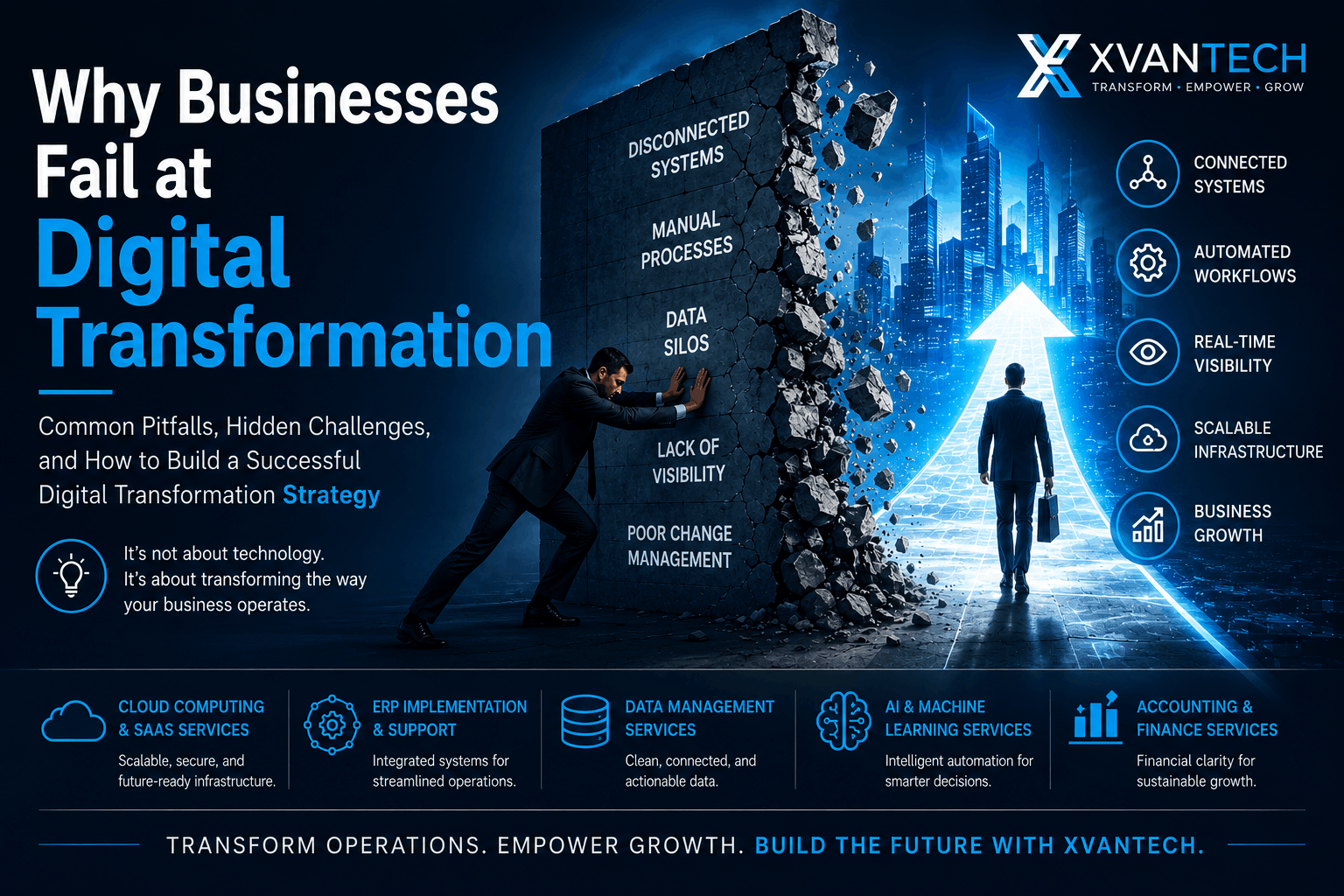
Why Businesses Fail at Digital Transformation
Digital transformation has become one of the most discussed topics in modern business. Why Businesses fail at digital transformation? Companies everywhere are investing in cloud systems, automation platforms, ERP solutions, artificial intelligence, business intelligence dashboards, and digital workflows in an effort to modernize operations and improve scalability. Yet despite billions spent globally on technology initiatives every year, a surprising number of businesses still fail at digital transformation.
The reason is not usually the technology itself.
Most businesses fail because they attempt to modernize tools without modernizing operations.
They invest in software without fixing fragmented systems. They implement automation without operational structure. They move to cloud platforms while still relying on disconnected workflows, spreadsheets, manual approvals, and outdated reporting systems. In many organizations, digital transformation becomes a surface-level technology project instead of a deeper operational transformation strategy.
As businesses grow, operational complexity increases rapidly. Teams become disconnected, reporting slows down, departments use different systems, financial visibility weakens, and decision-making becomes reactive instead of strategic. Without connected infrastructure, businesses often lose operational visibility as they scale.
This is where many companies begin experiencing the hidden operational problems that technology alone cannot solve.
Successful digital transformation requires more than purchasing software. It requires operational alignment, connected systems, centralized visibility, scalable infrastructure, and long-term business process modernization.
At XVanTech, digital transformation is approached as a business operations and infrastructure challenge rather than simply an IT upgrade. Through services such as ERP implementation, cloud computing solutions, data management systems, accounting and finance support, AI-powered automation, and operational technology consulting, businesses can modernize operations strategically instead of implementing disconnected tools that create even more operational complexity.
The Biggest Misunderstanding About Digital Transformation
Many businesses assume digital transformation means:
- implementing new software
- adopting cloud systems
- automating workflows
- introducing AI tools
- migrating data
- replacing legacy applications
While these technologies are important, they do not automatically solve operational problems.
In fact, businesses often create larger problems when they introduce technology into already fragmented environments.
For example:
- finance teams use disconnected accounting systems
- HR departments rely on separate payroll software
- operations teams track workflows manually
- reporting is spread across spreadsheets
- cloud systems do not communicate with ERP platforms
- business intelligence data becomes inconsistent
The result is operational fragmentation instead of operational transformation.
Technology should improve visibility, simplify operations, centralize reporting, and reduce inefficiencies. When businesses fail to align systems operationally, digital transformation becomes expensive complexity rather than scalable modernization.
Why Businesses Struggle With Operational Visibility
One of the most common reasons businesses fail at digital transformation is poor operational visibility.
As organizations grow, information becomes fragmented across:
- departments
- software platforms
- spreadsheets
- reporting systems
- communication tools
- cloud environments
Leadership teams often lose visibility into:
- operational performance
- financial reporting
- workforce productivity
- project timelines
- customer workflows
- inventory movement
- business forecasting
Without centralized visibility, businesses make slower and less informed decisions.
This is why modern ERP implementation and data management strategies are becoming increasingly important for growing companies.
Centralized operational systems allow businesses to:
- connect departments
- unify reporting
- automate workflows
- improve forecasting
- reduce manual dependency
- improve scalability
Businesses that lack operational visibility often experience:
- reporting delays
- duplicate work
- financial inconsistencies
- communication gaps
- operational bottlenecks
- customer experience issues
Digital transformation fails when businesses cannot see their operations clearly.
The Hidden Cost of Disconnected Business Systems
Disconnected systems are one of the largest operational risks in modern organizations.
Many businesses use:
- separate finance platforms
- independent HR systems
- disconnected CRM tools
- manual reporting spreadsheets
- outdated databases
- siloed cloud applications
These disconnected systems create operational friction across the business.
Employees spend unnecessary time:
- transferring data manually
- correcting reporting errors
- duplicating work
- chasing approvals
- verifying inconsistent information
Over time, these inefficiencies become operational debt.
The business may continue functioning, but growth becomes increasingly difficult because operations cannot scale efficiently.
This is why modern businesses increasingly invest in:
- ERP implementation
- cloud infrastructure modernization
- centralized business intelligence systems
- operational automation
- integrated data management platforms
At XVanTech, operational modernization focuses on connecting systems strategically to reduce fragmentation and improve scalability across business operations.
Why Many ERP Implementations Fail
ERP systems are often viewed as the foundation of digital transformation. However, ERP implementation itself frequently fails because businesses underestimate operational readiness.
An ERP system cannot solve:
- broken workflows
- unclear operational processes
- poor data quality
- disconnected departments
- inconsistent reporting structures
Businesses often implement ERP software without first understanding:
- operational bottlenecks
- reporting dependencies
- departmental workflows
- process inefficiencies
- organizational scalability challenges
As a result, the ERP platform becomes another disconnected system instead of a centralized operational solution.
Successful ERP implementation requires:
- workflow mapping
- operational analysis
- infrastructure planning
- process alignment
- user adoption strategies
- long-term scalability planning
This is why ERP modernization should always be approached as an operational transformation initiative rather than simply a software installation project.
Cloud Infrastructure Does Not Automatically Solve Business Problems
Cloud computing has become a major part of digital transformation strategies for growing businesses. However, cloud migration alone does not fix operational inefficiencies.
Many businesses move systems into cloud environments while maintaining:
- fragmented workflows
- poor reporting structures
- disconnected departments
- outdated operational processes
The result is cloud-based operational inefficiency.
Modern cloud infrastructure should improve:
- scalability
- accessibility
- operational flexibility
- data visibility
- business continuity
- system integration
Businesses that approach cloud modernization strategically can significantly improve operational performance. However, businesses that move to cloud systems without operational planning often recreate the same inefficiencies in a different environment.
This is why cloud computing and SaaS modernization must align with:
- operational goals
- reporting requirements
- workflow optimization
- centralized data strategies
Data Fragmentation Is Quietly Destroying Operational Efficiency
Data fragmentation is one of the least discussed but most damaging business problems.
Many organizations store information across:
- spreadsheets
- local systems
- cloud platforms
- CRM tools
- finance software
- disconnected databases
This creates inconsistent reporting and unreliable decision-making.
When business leaders cannot trust operational data, digital transformation efforts begin failing quickly.
Centralized data management systems improve:
- operational visibility
- reporting accuracy
- forecasting
- business intelligence
- AI readiness
- automation reliability
Data quality is now directly connected to operational scalability.
Businesses increasingly rely on AI-driven reporting, automation systems, predictive analytics, and operational dashboards. Without structured and centralized data systems, these technologies become ineffective.
This is why data management is becoming one of the most important foundations of modern digital transformation.
Why Manual Processes Slow Business Growth
Manual workflows are another major reason businesses fail at digital transformation.
Many organizations still rely heavily on:
- spreadsheets
- email approvals
- manual reporting
- disconnected communication
- repetitive administrative tasks
- paper-based workflows
These processes create:
- delays
- inefficiencies
- operational inconsistency
- human error
- scalability limitations
As businesses grow, manual operations become increasingly difficult to manage.
Business automation systems help reduce operational inefficiencies by:
- automating workflows
- improving reporting speed
- reducing manual dependency
- centralizing communication
- improving operational consistency
Automation should not eliminate operational control. Instead, it should improve operational visibility while reducing repetitive workload across departments.
Why Businesses Need Operational Intelligence Systems
Modern businesses require more than software tools. They require operational intelligence systems.
Operational intelligence combines:
- centralized data
- workflow automation
- reporting visibility
- ERP systems
- cloud infrastructure
- AI-driven insights
- business intelligence dashboards
This allows organizations to:
- monitor operations in real time
- improve decision-making
- identify bottlenecks faster
- optimize resource allocation
- improve scalability
Businesses that fail at digital transformation often lack operational intelligence entirely.
Instead of connected systems, they operate through fragmented technology environments that prevent leadership from seeing operational performance clearly.
Operational intelligence is becoming one of the most important competitive advantages for growing businesses.
AI Without Operational Structure Creates More Problems
Artificial intelligence is now heavily influencing digital transformation strategies across industries. However, many businesses misunderstand how AI should be implemented operationally.
AI systems rely heavily on:
- structured data
- centralized reporting
- connected workflows
- operational consistency
Without these foundations, AI initiatives often fail.
Businesses cannot expect AI systems to produce reliable operational insights when:
- data is fragmented
- reporting is inconsistent
- workflows are disconnected
- systems are outdated
This is why AI modernization must align with:
- data management
- cloud infrastructure
- operational visibility
- ERP systems
- workflow automation
At XVanTech, AI and operational automation strategies focus on improving business infrastructure rather than simply introducing standalone AI tools into fragmented environments.
Digital Transformation Requires Operational Alignment
The businesses that succeed at digital transformation are usually the ones that focus on operational alignment first.
Successful modernization requires:
- connected systems
- centralized visibility
- scalable infrastructure
- operational consistency
- strategic workflow planning
- reliable reporting systems
Technology should support business operations, not complicate them.
Businesses that modernize successfully usually prioritize:
- operational visibility
- infrastructure scalability
- process optimization
- workflow efficiency
- centralized reporting
- cross-department connectivity
Digital transformation is ultimately an operational transformation challenge.
The Future of Business Operations
As businesses continue scaling, operational complexity will continue increasing.
Organizations that rely on fragmented systems, manual workflows, and disconnected infrastructure will struggle to compete effectively in modern digital environments.
Future-ready businesses are increasingly investing in:
- ERP modernization
- cloud infrastructure
- operational intelligence
- AI-driven reporting
- centralized data management
- automation systems
- scalable operational architecture
The goal is no longer simply digitization.
The goal is operational visibility, scalability, efficiency, and long-term business resilience.
Final Thoughts
Businesses fail at digital transformation because they focus too heavily on technology and not enough on operational structure.
Software alone cannot solve fragmented operations.
Successful modernization requires:
- connected infrastructure
- operational visibility
- centralized systems
- workflow optimization
- strategic automation
- scalable business architecture
Businesses that align technology with operational strategy are far more likely to improve scalability, efficiency, reporting, and long-term growth.
At XVanTech, digital transformation is approached as a connected operational infrastructure strategy designed to help businesses modernize systems, improve visibility, reduce inefficiencies, and build scalable business operations for long-term growth.

