


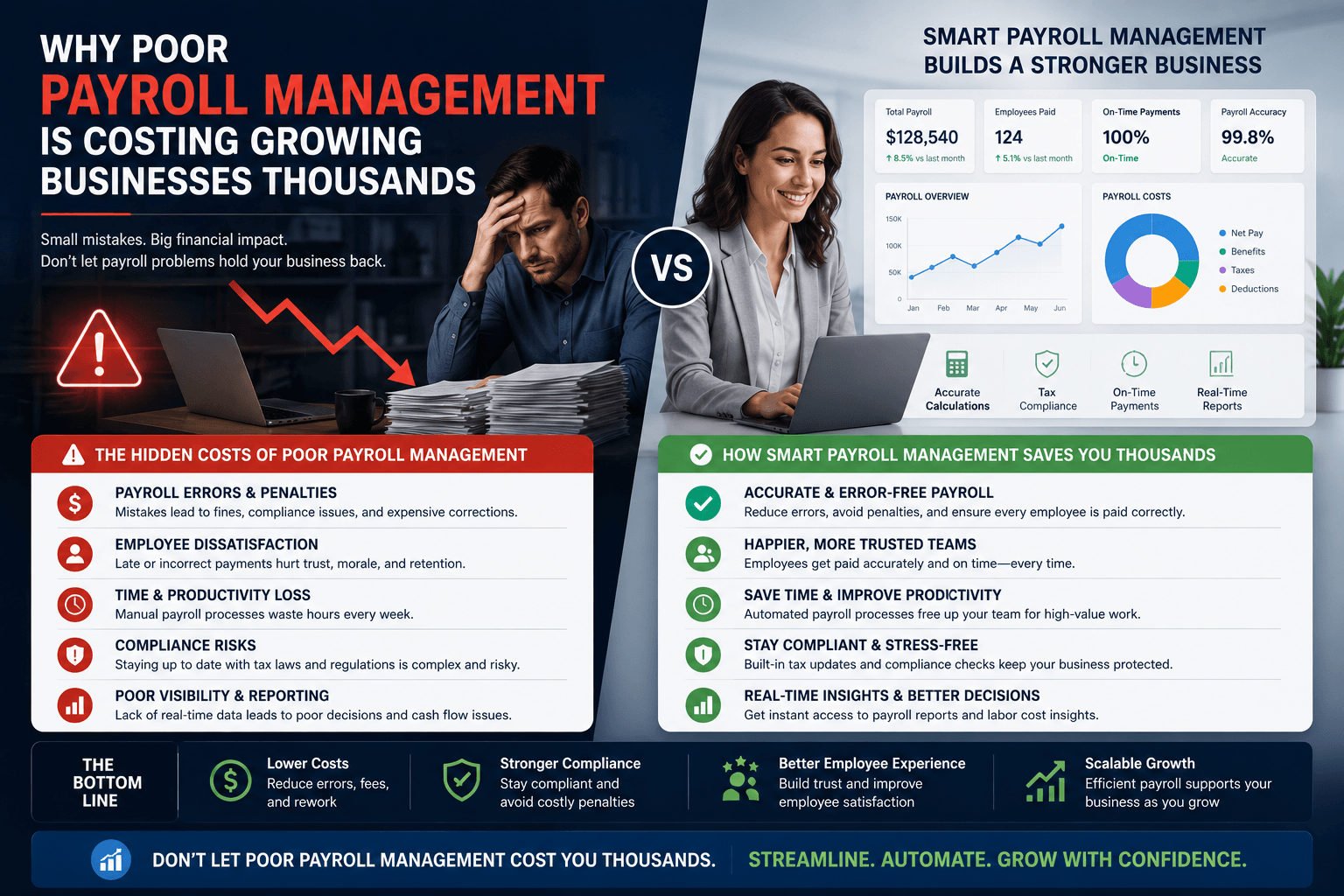
Introduction
For many growing businesses, payroll management starts as something simple.
At the beginning, it feels manageable:
- a few employees
- one spreadsheet
- basic salary calculations
- manual approvals
But as the business grows, payroll management becomes far more complex than most business owners expect.
Suddenly there are:
- multiple employees
- different pay structures
- bonuses
- tax deductions
- compliance requirements
- attendance systems
- overtime calculations
- reporting requirements
And this is usually where problems begin.
Most businesses don’t realize how much poor payroll management is actually costing them until operational issues start appearing everywhere.
Employees stop trusting the system.
Payroll errors increase.
Compliance risks grow.
Finance teams become overwhelmed.
Management loses visibility into labor costs.
Hours get wasted fixing avoidable mistakes every month.
For growing businesses, payroll management is no longer just an administrative task.
It becomes an operational system that directly affects:
- employee trust
- financial accuracy
- compliance
- productivity
- business scalability
This is exactly why many businesses eventually move toward professional payroll management systems and outsourced payroll services.
Why Payroll Management Becomes Difficult as Businesses Grow
Most payroll problems do not happen because employees are careless.
They happen because the systems behind payroll are not designed for growth.
At smaller scale, businesses can survive using:
- spreadsheets
- manual approvals
- disconnected HR systems
- basic accounting workflows
But once the company starts growing, these systems begin creating operational friction.
The business may start experiencing:
- delayed payroll processing
- inconsistent salary calculations
- tax filing confusion
- overtime disputes
- reporting inaccuracies
- compliance risks
And over time, these small operational issues become expensive.
This is one reason growing SMBs increasingly invest in structured payroll management systems.
1. Payroll Errors Damage Employee Trust
One of the biggest hidden consequences of poor payroll management is employee frustration.
Employees expect payroll to be accurate.
When salaries are delayed or calculated incorrectly, trust immediately drops.
Even small payroll mistakes create frustration:
- incorrect overtime calculations
- missing bonuses
- delayed salaries
- wrong deductions
- attendance mismatches
And once employees lose confidence in payroll accuracy, morale starts falling.
This affects:
- employee satisfaction
- retention
- workplace culture
- productivity
In many companies, payroll mistakes create unnecessary tension between employees and management.
A properly structured payroll management system helps reduce these issues by improving:
- consistency
- transparency
- accuracy
- automation
This creates a much smoother experience for both employees and management teams.
2. Manual Payroll Processing Wastes Valuable Time
Many businesses underestimate how many hours are lost every month through manual payroll management.
Finance and HR teams often spend excessive time:
- updating spreadsheets
- correcting salary calculations
- reviewing attendance
- checking tax deductions
- fixing payroll mistakes
- generating reports manually
As the business grows, payroll processing becomes more complicated and time-consuming.
Instead of focusing on strategic work, teams become stuck managing repetitive administrative tasks.
This creates operational inefficiency across the organization.
Modern payroll management systems help automate repetitive workflows such as:
- salary calculations
- attendance syncing
- deductions
- tax calculations
- reporting
- approvals
Automation significantly reduces manual workload and improves operational efficiency.
This is one reason many businesses move toward outsourced payroll services and payroll automation systems as they scale.
3. Payroll Compliance Risks Increase Over Time
Compliance is one of the biggest reasons businesses struggle with payroll management.
As companies grow, payroll compliance becomes more complex.
Businesses must manage:
- tax regulations
- employee classifications
- payroll records
- deductions
- reporting requirements
- overtime policies
- legal documentation
Even small compliance mistakes can create serious financial and legal risks.
Poor payroll management can lead to:
- penalties
- tax filing errors
- employee disputes
- audit problems
- legal exposure
Many businesses do not realize how exposed they are until a compliance issue appears unexpectedly.
This is why professional payroll management becomes extremely important for growing businesses.
A structured payroll system helps businesses maintain:
- accurate records
- proper documentation
- compliance consistency
- reporting visibility
This reduces operational risk significantly.
4. Lack of Payroll Visibility Creates Financial Problems
Payroll is one of the largest operational expenses for most businesses.
But surprisingly, many growing companies do not have clear visibility into their payroll costs.
Without structured payroll management, leadership often struggles to answer important questions like:
- What is our real labor cost?
- Which departments have increasing payroll expenses?
- Are overtime costs becoming excessive?
- Are payroll processes efficient?
- Where are payroll-related inefficiencies happening?
Without visibility, businesses cannot properly control operational costs.
This creates:
- budgeting problems
- inaccurate forecasting
- financial uncertainty
- poor decision-making
Modern payroll management systems provide:
- real-time payroll reporting
- cost tracking
- operational visibility
- workforce analytics
- better forecasting capabilities
This allows leadership to make more informed financial and operational decisions.
5. Payroll Problems Slow Down Business Growth
Many businesses focus heavily on:
- sales
- marketing
- customer acquisition
- revenue growth
But operational systems are what support sustainable scaling.
If payroll systems become unstable as the company grows, operational stress increases rapidly.
Payroll inefficiencies often create:
- HR bottlenecks
- reporting confusion
- administrative overload
- employee dissatisfaction
- financial inconsistencies
Eventually leadership spends more time fixing operational problems than focusing on growth.
This is one reason scalable payroll management systems become essential for growing SMBs.
Strong payroll systems support:
- operational stability
- workforce management
- financial accuracy
- business scalability
Without structured systems, growth itself becomes difficult to manage.
Common Signs Your Payroll System Is Breaking Down
Many businesses already experience payroll problems without fully recognizing them.
Some common warning signs include:
- Payroll processing takes too long every month
- Employees regularly question salary calculations
- Payroll data exists across multiple spreadsheets
- Tax calculations are inconsistent
- Attendance and payroll systems are disconnected
- Reporting is delayed or inaccurate
- HR and finance teams constantly fix manual errors
- Leadership lacks payroll visibility
If these problems are becoming normal, it is usually a sign that the business has outgrown its current payroll processes.
Benefits of Modern Payroll Management Systems
Improved Accuracy
Automation reduces manual errors and improves payroll consistency.
Faster Payroll Processing
Payroll cycles become more efficient and predictable.
Better Compliance
Structured systems help reduce tax and legal risks.
Stronger Employee Trust
Employees gain confidence in payroll accuracy and transparency.
Reduced Administrative Work
Automation eliminates repetitive manual tasks and improves productivity.
Better Financial Visibility
Leadership gains clearer insight into payroll expenses and workforce costs.
Challenges Businesses Face During Payroll System Upgrades
A balanced article should explain both sides honestly.
Modernizing payroll systems also comes with challenges.
Initial Setup Requires Planning
Payroll system implementation requires:
- employee data organization
- process alignment
- system integration
- workflow restructuring
Teams Need Training
Employees may need time to adapt to new systems and processes.
Poor Implementation Creates Frustration
If payroll systems are implemented incorrectly, businesses can experience operational disruption.
This is why choosing the right payroll management partner matters.
Why Many Growing Businesses Outsource Payroll Management
As businesses grow, many decide to outsource payroll management instead of handling everything internally.
Outsourced payroll services help businesses:
- reduce operational workload
- improve payroll accuracy
- strengthen compliance
- save internal resources
- improve reporting consistency
Instead of spending hours managing payroll manually, internal teams can focus on higher-value business operations.
This becomes especially valuable for businesses managing:
- growing teams
- multi-location operations
- complex payroll structures
- compliance-heavy industries
How Xvantech Helps Businesses Improve Payroll Management
At Xvantech, payroll management is approached as an operational efficiency system — not just salary processing.
The goal is to help businesses create:
- accurate payroll workflows
- stronger reporting systems
- better compliance visibility
- reduced manual work
- scalable payroll operations
The process typically involves:
- reviewing current payroll workflows
- identifying inefficiencies
- reducing manual processes
- improving payroll visibility
- implementing structured payroll systems
- improving operational reporting
The objective is simple:
To help businesses reduce payroll-related operational stress while improving accuracy, efficiency, and scalability.
How Better Payroll Management Saves Businesses Money
Many business owners only think about payroll as an expense.
But poor payroll management creates hidden operational costs that businesses often overlook.
These include:
- wasted employee hours
- payroll correction work
- compliance penalties
- reporting inefficiencies
- administrative overload
- operational delays
- employee turnover caused by payroll frustration
Modern payroll management systems help reduce these hidden costs by improving operational efficiency and reducing manual workload.
Over time, this often saves businesses significantly more money than continuing with outdated payroll processes.
Final Thoughts
Payroll management may seem like a back-office process, but in reality it affects almost every part of a growing business.
Poor payroll management creates:
- operational inefficiency
- employee frustration
- compliance risk
- financial confusion
- scalability problems
As businesses grow, payroll systems must evolve with them.
Modern payroll management systems help businesses improve:
- operational structure
- financial visibility
- employee trust
- reporting accuracy
- scalability
And in many cases, the difference between operational stress and operational stability comes down to having the right payroll systems in place.

